

If you’ve got a fireplace, wood heater, or gas flue in your Sydney home, there’s a small but seriously important component sitting at the very top of your chimney that most homeowners barely think about — the chimney cap.
Also called a cowl or flue cover in Australia, your chimney cap is doing a lot of heavy lifting up there. It’s keeping rain out. Blocking possums and birds from setting up home inside your flue.
Stopping downdrafts from blowing smoke back into your living room. And in some cases, it’s the difference between a fireplace that draws beautifully and one that smokes up the house every time you light it.
The problem is that there are more than a dozen different types of chimney caps available in Australia — and choosing the wrong one for your flue type, fuel type, or location creates real problems.
Here’s the complete, honest guide to chimney cap types for Sydney homes in 2026.
“A high-quality chimney cowl or flue cap should last many years, as long as it’s looked after well. Always check it after high winds, and before each winter in Australia.” — ArchiPro Australia
Why the Right Chimney Cap Matters in Sydney
Sydney’s climate and geography create specific demands that many generic chimney cap guides simply don’t account for.
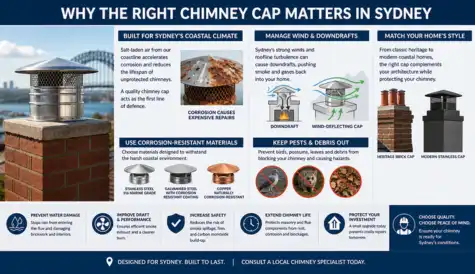
Coastal suburbs from Bondi to Manly, Cronulla, and the Northern Beaches deal with salt-laden air that corrodes standard galvanised steel caps far faster than inland areas. Southern and western Sydney — Penrith, the Blue Mountains fringe, and the Sutherland Shire — experience strong winds that make downdraft prevention a priority.
And Sydney’s older Federation and Victorian-era homes in the Inner West and North Shore have heritage brick chimneys that need multi-flue or crown-mount caps, not standard single-flue fittings.
Getting the type right from the start saves you from water damage, pest infestations, poor draft, and premature cap failure.
Types of Chimney Caps by Function — What Each One Does
The function of a chimney cap should always be the starting point. Before you think about material or style, ask: what problem am I primarily trying to solve?
1. Standard Rain Cap / Chinaman Hat
Basic Rain and Debris Protection for Everyday Use

The standard rain cap — sometimes called a Chinaman hat in Australia due to its cone-like shape — is the most common and straightforward chimney cap available. It features a simple domed or conical lid mounted over the flue opening, designed to deflect rain and keep debris out.
It works well in sheltered positions with minimal wind exposure and straightforward draft conditions. It does not assist with downdraft or improve draw — it simply keeps the weather out.
Best for: Standard flues in sheltered Sydney locations with no downdraft problems and minimal wind exposure.
2. Anti-Downdraught Cowl
The Essential Choice for Windy Sydney Locations

An anti-downdraught cowl uses an aerodynamic design to stabilise airflow at the top of the chimney, preventing wind from pushing air — and smoke — back down the flue into the living area.
Standard caps use open mesh screens that create turbulence during storms. Once wind speeds hit significant levels, smoke and cold air get forced back down the flue causing downdrafts, and negative pressure builds up inside the home.
For Sydney homes exposed to the city’s notorious southerly busters, coastal winds on the Northern Beaches and Eastern Suburbs, or elevated positions on hillsides in the Upper North Shore or Blue Mountains fringe, an anti-downdraught cowl is not optional — it’s essential.
Best for: Exposed Sydney properties, coastal homes, elevated positions, south-facing chimneys.
3. Rotating / Revolving Chimney Cowl
Wind-Powered Draft Improvement and Downdraft Prevention

Revolving chimney cowls rotate with the wind to extract smoke more efficiently and eliminate downdraft. The spinning motion creates a vacuum effect that draws smoke up and out more powerfully than a static cap.
Rotating cowls are particularly effective in homes where the chimney’s natural draft is marginal — either due to chimney height, surrounding obstacles, or the design of the fireplace. They perform best in locations with consistent wind, making them a popular choice across Sydney’s coastal and elevated areas.
What to check: Ensure the rotating mechanism is stainless steel and uses sealed bearings — cheaper models seize up within one to two seasons in Sydney’s coastal environment.
Best for: Homes with marginal draft, windy coastal Sydney locations, wood heaters needing improved draw.
4. Wind Directional Chimney Cap
Maximum Protection Against Wind-Driven Rain and Downdraft

Wind directional chimney caps pivot to always face away from the wind, acting like an umbrella that shields the flue from wind-driven rain at any angle. They are ideal for windy areas and prevent both water ingress and smoky downdrafts.
Unlike a rotating cowl that spins with the wind, a wind-directional cap pivots as a single unit to orient its open face away from the prevailing wind direction. This makes it exceptionally effective in locations where wind comes predominantly from one direction — such as coastal Sydney suburbs exposed to consistent sea breezes.
Best for: Coastal Sydney homes, properties on exposed ridgelines, chimneys suffering from directional downdraft.
5. Bird Guard Cowl
Keeping Possums, Birds and Pests Out of Your Flue

Sydney’s wildlife is spectacular — but not when it’s nesting inside your chimney. Possums, Indian mynahs, pigeons, and starlings are all common chimney nesters in Sydney, and once they’re in, removal and remediation is a significant job.
A bird guard cowl features a mesh screen that completely encloses the flue opening while still allowing smoke and combustion gases to exit freely. The mesh prevents birds and possums from entering while the cap portion keeps rain out.
Key point: Choose a bird guard with mesh that is fine enough to prevent small birds from squeezing through, but coarse enough not to restrict draft or clog quickly with debris. Stainless steel mesh is essential in coastal areas.
Best for: Sydney homes near parks, bushland, or coastal areas where birds and possums are active — which describes most of suburban Sydney.
6. Spark Arrestor Cap
Fire Safety Protection for Wood Heaters

A spark arrestor cap incorporates a wire mesh screen specifically designed to prevent burning embers or sparks from escaping the flue and landing on the roof or surrounding garden.
In Sydney’s bushfire-adjacent suburbs — the Hills District, Northern Beaches, Sutherland Shire, and Blue Mountains fringe — a spark arrestor is a critical safety feature for any wood heater. During periods of high fire danger, an unprotected flue that allows embers to escape is a genuine ignition risk.
Note: Spark arrestor mesh must be maintained and cleaned regularly — a mesh clogged with creosote and debris restricts draft and can itself become a fire hazard.
Best for: Any Sydney wood heater in bushfire-prone areas, properties near bush or long grass.
7. Gas Cowl
Specifically Designed for Gas Flues and Appliances

Gas cowls are purpose-designed and certified for use with gas-burning appliances — fireplaces, gas log fires, and gas central heating flues. They differ from wood heater cowls in their design to accommodate the different exhaust gas characteristics and temperatures of gas appliances.
Critical note: A standard wood heater cowl must never be used on a gas appliance flue — and vice versa. Gas cowls in Australia must comply with Australian Standard AS 4566. Always verify compliance before purchase or installation.
Best for: Gas fireplaces, gas log fires, and gas central heating flues in Sydney homes.
8. Disused Chimney Cap
Capping Off Unused Fireplaces Without Sealing Them Completely

Many Sydney homes — particularly older terraces, semis, and Federation homes in Newtown, Glebe, Balmain, and Leichhardt — have heritage fireplaces that are no longer in use. Leaving those flues completely open wastes heat in winter, allows rain in, and gives birds and possums free entry.
A disused chimney cap — sometimes called a C-Cap or ventilated cap — seals the top of the flue to prevent weather and pest intrusion while still allowing the chimney structure to breathe and release any moisture build-up. This prevents condensation damage inside the masonry.
Important: Do not use a completely airtight seal on a disused chimney — without some ventilation, moisture accumulates inside the flue structure and causes significant long-term masonry damage.
Best for: Heritage Sydney terrace homes, semis, and Federation properties with inactive fireplaces.
Types of Chimney Caps by Chimney Structure
Beyond function, the physical structure of your chimney determines which cap physically fits and performs correctly.
1. Single-Flue Chimney Cap
For Metal Flues and Simple Single-Opening Chimneys

A single-flue cap fits directly over one flue pipe — either a metal liner or a single brick flue opening. This is the most common type on split-system gas fireplaces and standalone wood heater flue installations across Sydney.
2. Multi-Flue Chimney Cap
For Brick Chimneys With Multiple Flue Openings

Older Sydney homes — particularly large Federation and Victorian-era properties — often have brick chimneys with two, three, or even four separate flue openings. A multi-flue cap covers the entire chimney crown rather than individual flues, protecting both the flue openings and the masonry crown from water penetration.
This is a critical distinction. Using a single-flue cap on a multi-flue brick chimney leaves the chimney crown exposed to rain — and water penetration into the crown is one of the most destructive and expensive chimney problems a Sydney homeowner can face.
3. Crown Pot Chimney Cowl
The Heritage Choice for Sydney’s Older Homes

Crown pot cowls sit atop traditional terracotta chimney pots — common on Sydney’s heritage homes throughout the Inner West, Eastern Suburbs, and North Shore. They combine the decorative appearance of a traditional chimney pot with functional rain and downdraft protection.
They’re the authentic choice for heritage properties where visual character matters as much as performance.
Chimney Cap Materials — What Works Best in Sydney
Material choice has a direct impact on durability — particularly in Sydney’s coastal environment.
| Material | Durability in Sydney | Coastal Suitability | Best Application |
| Marine grade 316 stainless steel | Excellent | Best — salt-air resistant | Coastal suburbs, premium installs |
| 304 stainless steel | Very good | Good | Most Sydney suburban homes |
| Copper | Excellent | Excellent — develops protective patina | Heritage and premium properties |
| COLORBOND steel | Very good | Good | Matching roof aesthetics |
| Galvanised steel | Moderate | Poor — corrodes quickly near coast | Inland areas, budget installs only |
| Terracotta / clay | Good | Moderate | Heritage Federation homes |
| Aluminium | Moderate | Moderate | Lightweight, low-load applications |
Marine grade 316 stainless steel is specifically formulated to resist salt-air corrosion and is the recommended material for chimney caps in Sydney’s coastal belt — including Bondi, Manly, Cronulla, Coogee, and the Northern Beaches.
For most Sydney homes more than two kilometres from the coast, 304 stainless steel provides an excellent balance of durability and value. For coastal properties, 316 stainless or copper is the only sensible long-term choice.
How to Choose the Right Chimney Cap for Your Sydney Home
With all those options laid out, here’s a straightforward decision framework.
Step 1 — Identify Your Flue Type
Single Metal Flue vs Brick Chimney
Is your flue a metal pipe (most wood heaters and gas fireplaces installed in the past 30 years) or an original brick chimney (most Federation and pre-war homes)? Metal flues need single-flue caps. Brick chimneys with multiple flue openings need multi-flue or crown-mount caps.
Step 2 — Identify Your Fuel Type
Wood, Gas or Disused
Gas appliances must have AS 4566-compliant gas cowls. Wood heaters must comply with AS/NZS 2918 for flue termination height and cowl design. Disused fireplaces need ventilated disused caps — not airtight covers.
Step 3 — Assess Your Location
Coastal, Windy or Sheltered?
- Coastal Sydney (within 5km of harbour or ocean): Marine grade 316 stainless steel, anti-downdraught or wind directional design
- Windy elevated locations: Anti-downdraught or rotating cowl
- Bushfire-prone suburbs: Spark arrestor cap
- Sheltered suburban locations: Standard rain cap or bird guard cowl in 304 stainless
Step 4 — Consider Wildlife Pressure
Is Bird or Possum Entry a Known Problem?
If you’ve had birds or possums in your chimney before, or you live near bushland, parks, or the harbour foreshores, always choose a cap with integrated bird guard mesh regardless of the primary function type.
Australian Compliance — What Sydney Homeowners Must Know
For active wood heaters in Sydney, ensure any cowl you install complies with AS/NZS 2918 — the Australian standard governing solid fuel heating appliance installation. This specifies minimum flue termination heights and approved cowl designs that maintain proper draft.
Beyond compliance, always use a qualified installer for any chimney cap work that requires roof access — particularly on two-storey homes and properties with steep or tiled roofs. The chimney cap choice is straightforward; getting it safely onto the roof is where professional installation earns its place.
Frequently Asked Questions Chimney Cap in Sydney
1. What is the difference between a chimney cap and a chimney cowl in Australia?
In Australia, both terms refer to the same thing — a cover fitted to the top of a chimney flue. “Cowl” is the more common Australian term; “cap” is more widely used internationally. Both perform the same protective functions.
2. Do I need a special chimney cap for a gas fireplace in Sydney?
Yes — gas appliances require gas-specific cowls that comply with Australian Standard AS 4566.
Using a wood heater cowl on a gas flue is non-compliant and potentially dangerous. Always verify compliance before purchase.
3. What chimney cap is best for coastal Sydney suburbs?
Marine grade 316 stainless steel is the recommended material for any coastal Sydney suburb within approximately five kilometres of the ocean or harbour. It resists the salt-air corrosion that rapidly degrades standard galvanised steel caps.
4. Can I cap off an unused chimney in my Sydney terrace?
Yes — but use a ventilated disused chimney cap, not a fully airtight cover. Completely sealing an unused flue traps moisture inside the masonry structure and causes significant long-term damage to the chimney brickwork and internal render.
5. Do I need a spark arrestor cap for my wood heater in Sydney?
If your property is in or near a bushfire-prone area — including the Hills District, Northern Beaches, Sutherland Shire, or Blue Mountains fringe — a spark arrestor is strongly recommended. In declared bushfire-prone zones, it may also be a requirement under local building regulations.
6. How often should chimney caps be checked in Sydney?
Inspect your chimney cap before each winter heating season and after any major storm or strong wind event. Sydney’s coastal salt air and southerly busters can loosen fittings and accelerate corrosion — catching issues early prevents more significant problems developing.
Conclusion
There is no single best chimney cap for all Sydney homes — but there is definitely a best chimney cap for your specific home.
The right choice comes down to four things: your flue type, your fuel type, your location within Sydney, and the specific problems you’re trying to solve — whether that’s rain, downdraft, birds, sparks, or all of the above.
For most Sydney homes, a stainless steel anti-downdraught cowl with integrated bird guard mesh covers the majority of needs efficiently and durably.
For coastal properties, upgrading the material to marine grade 316 stainless is non-negotiable. For heritage brick chimneys, a properly fitted multi-flue cap protects both the flue and the masonry structure underneath it.
Get the type right, get the material right for your location, and ensure it’s installed safely and in compliance with Australian standards. That combination gives you a chimney cap that does its job reliably through Sydney’s winters for many years to come.
