

It is the middle of a Sydney winter morning. You grab the remote, press heat, and wait. But instead of warm air filling the room, you get a weak trickle of cool air — or nothing at all.
If your split system is not heating, you are not alone. This is one of the most common calls Sydney HVAC technicians receive between June and August.
The good news is that many of the causes are surprisingly straightforward to diagnose, and several can be fixed in minutes without calling anyone out.
This guide walks through every common reason your heater is not working on your AC unit in Sydney winter, what you can check yourself, and when the problem needs a licensed professional.
How a Split System Actually Heats Your Home
Understanding Reverse Cycle Operation Before You Troubleshoot
Before diving into causes, it helps to understand what your split system is doing when it heats.
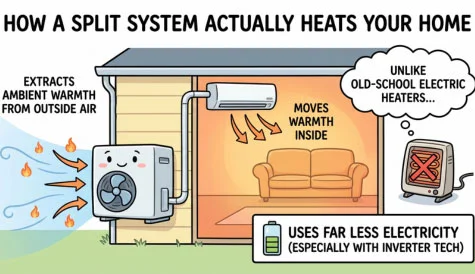
Unlike an old-school electric heater that has to create heat from scratch, a reverse cycle split system works like a heat pump.
It cleverly extracts ambient warmth from the outside air and moves it inside.
This heat transfer process uses far less electricity, especially with modern inverter technology.
In other words, your split system is not generating heat — it is moving heat from outside to inside. This is important context because several of the most common heating faults relate directly to this process being interrupted somewhere along the line.
6 Common Reasons Your Split System Is Not Heating in Winter
1. Wrong Mode or Incorrect Temperature Setting
The Most Common Cause — and the Easiest Fix
This is the starting point for every heating fault, because it catches more people than you would expect.
Make sure your system is actually set to “Heat” in winter — not just “Fan” or “Auto.” Set the temperature at least 2 to 3 degrees above the current room temperature to prompt the system to activate properly.
On most remotes, the heat mode is indicated by a sun icon or the word “Heat.” If the remote is set to “Auto” or “Fan Only,” the system will run without actually producing warm air.
If the set temperature is lower than or equal to the current room temperature, the system has no reason to activate the heating cycle.
What to Check
- Look for the sun icon or “Heat” label on the remote display
- Set the target temperature at least 3 degrees above the current room reading
- Replace the remote batteries if the display looks faint or erratic
2. Dirty or Clogged Air Filter
Restricted Airflow Is the Fastest Way to Kill Heating Performance
One of the most common complaints with inverter split systems is reduced airflow or insufficient heating. This issue can stem from clogged air filters, obstructed vents, or refrigerant leaks.
When the filter is packed with dust, the system cannot draw enough air across the heating coil to transfer warmth into the room. The unit runs continuously but delivers far less heat than it should — and in some cases triggers a safety shutoff to protect the internal components.
What to Check
- Remove the front panel of the indoor unit and slide out the filter
- Hold it up to light — if you cannot see through it, it needs cleaning
- Rinse under warm water, allow to dry completely, then reinstall
- Sydney homes should clean filters every one to three months during heavy use
3. Outdoor Unit Frozen or in Defrost Mode
A Sydney Winter Problem That Surprises Many Homeowners
On cold Sydney mornings — particularly in suburbs like Penrith, the Blue Mountains, and the Upper North Shore where overnight temperatures regularly drop below 5 degrees — the outdoor unit can develop a frost or ice coating on the coils.
A normal defrost cycle usually lasts between 5 and 15 minutes. During this time, the outdoor fan stops and the indoor unit may pause, which is part of its routine operation.
During defrost mode, your split system will temporarily stop producing warm air while it melts the ice from the outdoor coil. This is completely normal and not a fault. The heating will resume once the defrost cycle completes.
What to Check
- Look at the outdoor unit — visible frost or ice on the coil during early morning is normal
- Wait 10 to 15 minutes and check whether heating resumes
- If the outdoor unit is frozen solid and does not clear, or if it freezes repeatedly throughout the day, this signals a deeper issue requiring a technician
What Is Not Normal
- Ice that persists for more than 30 minutes after the system has been running
- The outdoor unit covered in a thick block of ice rather than light frost
- Repeated freezing every hour throughout the day
4. Low Refrigerant or Refrigerant Leak
The Heating Performance Drops Dramatically and Gradually
Refrigerant is vital for both heating and cooling operations. If your unit is blowing room-temperature air or taking too long to reach the set point, refrigerant could be low.
Leaks reduce the system’s ability to absorb or release heat, meaning you will get lukewarm air at best.
A refrigerant leak is one of the most common reasons a split system works perfectly on cooling mode but struggles or completely fails to heat. Because the refrigerant level drops gradually, the heating performance usually deteriorates over weeks or months rather than failing all at once.
Signs of a Refrigerant Leak
- System runs but produces only slightly warm or room-temperature air
- Takes significantly longer than usual to heat the room
- Outdoor unit making a hissing or bubbling sound
- Oily residue visible around the refrigerant line connections
What You Can Do
Nothing — and this is important. Refrigerant handling must be done by a licensed professional due to environmental and safety regulations.
Simply topping it up without fixing the leak leads to repeat failures and potential compressor damage.
In Australia, handling refrigerant without an ARC (Australian Refrigeration Council) licence is illegal. A licensed Sydney HVAC technician will locate the leak, repair it, and correctly recharge the system.
5. Faulty Reversing Valve
The Component That Switches Between Heating and Cooling
Split systems use a reversing valve to switch between cooling and heating modes. If this valve is faulty, your air conditioner may not heat as it should, leaving you with only cool air.
The reversing valve is the component that literally changes the direction of refrigerant flow — from cooling mode to heating mode. When it fails partially, you get cool air in heat mode. When it fails completely, the system may not respond to mode changes at all.
Signs of a Faulty Reversing Valve
- System works perfectly in cooling mode but produces no heat in winter
- Loud clicking or clunking sound when switching between modes
- System seems stuck on cooling even when heat mode is selected
This is a component replacement job that requires a licensed technician — it is not a DIY repair.
6. Electrical Fault or Failed Compressor
When the Outdoor Unit Is Completely Silent
If your indoor unit appears to be running normally but the outdoor unit is not operating at all, the issue is likely electrical.
The most common cause of a unit not turning on in heat mode at all is a tripped circuit breaker or a blown fuse. Check your electrical panel and reset the breaker dedicated to the outdoor unit.
Capacitors help start compressors and fans. When they weaken or fail, motors may not start or might run inconsistently, reducing performance.
What to Check Yourself
- Go to your switchboard and check whether the breaker for the AC has tripped
- If it has, reset it once — if it trips again immediately, do not reset it again and call a technician
- Check the isolator switch on the wall beside the outdoor unit and confirm it is in the ON position
What Requires a Technician
- Breaker that trips repeatedly
- Outdoor unit completely silent with no fan or compressor activity
- Burning smell from the indoor or outdoor unit
- Error codes flashing on the indoor unit display
How to Reset Your Split System — A Quick Fix Worth Trying
Before calling a technician, a full power reset resolves a surprising number of split system heating faults — particularly after power surges or software glitches in the control board.
The Correct Reset Process
Follow these steps in order:
- Turn the split system off using the remote
- Go to the isolator switch mounted on the wall beside the outdoor unit
- Switch the isolator to the OFF position
- Wait a full 5 to 10 minutes — this allows the control board to fully discharge and reset
- Switch the isolator back ON
- Turn the system on using the remote and select heat mode
- Set the target temperature at least 3 degrees above the current room temperature
- Allow 5 minutes for the system to begin the heating cycle
If the system begins heating normally after the reset, the issue was likely a minor control fault or software glitch. If it still fails to heat after a clean reset, the problem is mechanical or refrigerant-related and needs professional diagnosis.
DIY Fixes vs When to Call a Technician
| Problem | Can You Fix It? | Action |
| Wrong mode or temperature setting | Yes | Change setting on remote |
| Dirty air filter | Yes | Clean and reinstall filter |
| Outdoor unit in defrost mode | Yes — wait | Allow 10 to 15 minutes |
| Tripped circuit breaker | Yes — once only | Reset at switchboard |
| Frozen outdoor unit with no defrost | No | Call technician |
| Low refrigerant or refrigerant leak | No | ARC licensed technician |
| Faulty reversing valve | No | Licensed technician |
| Failed capacitor or compressor | No | Licensed technician |
| Persistent error codes | No | Licensed technician |
Warning Signs That Mean Call a Technician Now
Do not wait or attempt further DIY troubleshooting if you experience any of these.
- The outdoor unit is making a loud grinding, hissing, or banging noise
- A burning smell is coming from the indoor or outdoor unit
- The circuit breaker trips every time you reset it
- The system displays error codes that will not clear after a reset
- The outdoor unit has not defrosted after 30 minutes of running
- Your Daikin, Mitsubishi, or Fujitsu unit shows a specific fault code — look up the code in your manual immediately
Frequently Asked Question About Reverse Cycle Not Heating in Winter
1. Why is my split system blowing cold air in heat mode?
The most likely causes are an incorrect mode setting on the remote, a dirty filter restricting airflow, a refrigerant leak, or a faulty reversing valve. Start by checking the remote setting and cleaning the filter.
If the unit is blowing room-temperature air or taking too long to reach the set point, refrigerant could be low — a licensed technician will need to diagnose and repair this.
2. Is it normal for the outdoor unit to steam or mist in winter?
Yes, completely normal. When your split system runs in heating mode on a cold morning, moisture from the air condenses on the warm outdoor coil and produces visible steam or mist.
This is a sign the system is working correctly and extracting heat from the outdoor air.
3. How long does defrost mode last on a split system?
A normal defrost cycle usually lasts between 5 and 15 minutes. During this time the outdoor fan stops and the indoor unit may pause or blow cooler air temporarily.
Heating resumes once the cycle completes. If defrost cycles are happening very frequently, have the system checked by a technician.
4. Can I fix a split system refrigerant leak myself?
No. Refrigerant handling must be done by a licensed professional due to environmental and safety regulations.
In Australia, handling refrigerant without an ARC licence is illegal. Attempting to top up refrigerant without repairing the leak will cause repeat failures and compressor damage.
Conclusion
A split system not heating in winter is frustrating — but in most Sydney homes, the fix starts with three quick checks: correct mode setting on the remote, a clean filter, and a power reset at the isolator switch.
If those three steps do not resolve it, the cause is almost certainly mechanical — a refrigerant leak, a faulty reversing valve, or an electrical component that needs a licensed HVAC technician to diagnose and repair correctly.
Do not leave it unattended. A struggling split system in winter draws more electricity while delivering less heat, and underlying faults like refrigerant leaks worsen the longer they run.
Book a service, get the system diagnosed, and get your home warm again.
