

To deep clean a split system air conditioner, you need to isolate the power, protect the surrounding electronics, thoroughly clean the evaporator coils, and flush the blower wheel until the water runs completely clear — then let the system dry in fan mode before switching it back on.
Rinsing your filters every few weeks is maintenance. A deep clean is something else entirely.
It targets the hidden mould, bacteria, and compacted dust that builds up on the coil fins and fan drum over months — the stuff that chokes airflow, drives up your electricity bills, and in Sydney’s humid climate, grows into a serious mould problem faster than most people realise.
Here’s exactly how to do it properly.
Before You Start — What You’ll Need
Tools and materials for a proper split system deep clean
Attempting this without the right equipment is how you end up with water inside your PCB control board. Get these sorted before you open anything:
- Aircon cleaning bag kit — a funnel-style catchment bag with a drain hose that wraps around the indoor unit
- Coil cleaner spray — alkaline or foam-based, non-corrosive formula
- Low-pressure hand-pump garden sprayer — filled with clean water for rinsing
- Plastic cling wrap and tape — to protect the electronics box during washing
- Soft brush vacuum attachment — for clearing loose dust from the coil fins
- Microfibre cloths — for wiping internal plastic frames dry
- Waterproof tarp — laid over flooring and furniture below the unit
Expert Tip: Never use a commercial high-pressure washer on any part of your split system indoor unit. The aluminium evaporator fins are extremely fine and bend permanently under high pressure — and once bent, airflow is restricted in exactly the same way as a dirty coil. Use a hand-pump sprayer only.
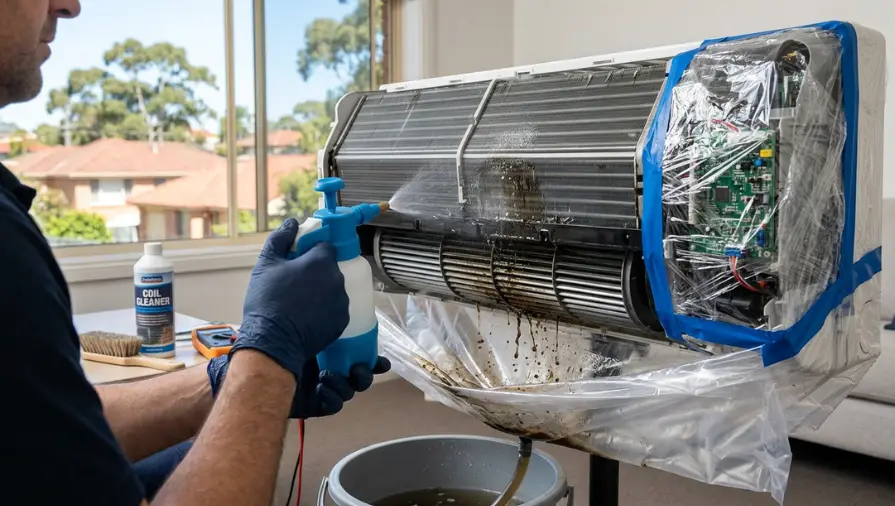
Step 1 — Safety and Preparation
Always isolate the power completely before opening the unit
Switch the unit off using the remote. Then go to your outdoor isolation switch — usually mounted on the wall next to the outdoor compressor — and turn it off at the source. Alternatively, switch off the circuit breaker at your main switchboard.
Don’t rely on the remote alone. The indoor unit remains live to the mains even when switched off via remote.
Lay a waterproof tarp on the floor and furniture below. Attach the aircon cleaning bag around the indoor unit housing and position the drain hose into an empty bucket. This step saves your walls and flooring from dirty coil water.
Step 2 — Disassembly and Filter Cleaning
Remove, wash, and set aside every removable component before touching the coils
Open the front inlet panel and remove the mesh filters.
If your unit has allergen or deodorising pocket filters, slide those out carefully as well. Unscrew and remove the outer plastic casing — the screws are usually hidden under small plastic caps.
Take everything outside. Vacuum loose dust first, then wash with cool water and a small amount of mild dish soap if needed.
Set them in the shade to dry completely — direct sunlight can warp the plastic casing.
Protect the PCB before any water goes near the unit
Locate the printed circuit board control box on the right side of the indoor unit. Wrap it tightly with plastic cling wrap and tape every edge.
This is the most important step in the entire process. Water on the PCB means a damaged control board — an expensive outcome that’s entirely preventable.
Expert Tip: After wrapping the PCB, gently press around the edges of the plastic wrap to feel for any gaps. If you can feel air getting through, add another layer of tape. Water follows the path of least resistance — and during a coil rinse, that path often leads toward the electronics housing.
Step 3 — Deep Cleaning the Evaporator Coil and Blower Wheel
This is where the real work happens — and where most DIY attempts fall short
1. Vacuum the coil fins first
Use your vacuum with a soft brush attachment to remove loose dust from the aluminium evaporator coils.
Work vertically, in the direction of the fins — never across them. The fins are thin and bend easily, and a bent fin reduces airflow permanently.
2. Apply coil cleaner
Spray your coil cleaner liberally across the full face of the evaporator coil. Then direct the spray into the blower wheel opening at the bottom of the unit — the cylindrical fan drum that spins when the system runs.
Manually rotate the fan drum while spraying to coat it evenly on all sides.
3. Let it dwell for 10 to 15 minutes
The foam needs time to break down mould, bacteria, and compacted grease. You’ll see the foam darken and begin to dissolve what’s built up inside the unit.
In Sydney homes that haven’t had a deep clean in 12 months or more, the residue coming off the blower wheel is often black.
4. Rinse until the water runs clear
Fill your hand-pump sprayer with clean water and rinse the coil from top to bottom, flushing grime into the drain pan. Then direct the spray into the blower wheel — spin the drum gently while rinsing.
Keep going until the water draining into your bucket is completely clear. Stopping early means leaving dissolved mould and bacteria inside the unit.
5. Check the drain line
Pour a small amount of clean water directly into the drain pan and watch that it drains freely to the outside. A blocked drain line is one of the most common causes of water leaking from indoor units in Sydney homes.
Step 4 — Reassembly and System Dry
Never switch the system back to cooling until everything is fully dry
Wipe internal plastic frames with a dry microfibre cloth. Peel away the cling wrap from the PCB carefully — check that no water has pooled underneath it before removing. Unclip and remove the cleaning bag.
Only reinstall the casing, louvres, and filters once they are 100% dry. A damp filter going back into a unit is a mould problem waiting to happen.
Once reassembled, turn the outdoor isolation switch back on. Power the unit up and set it to Fan Mode at high speed for 30 to 45 minutes. This dries the internal components completely before any cooling or heating cycle runs.
Expert Tip: While the indoor unit dries in fan mode, walk outside and check the outdoor condenser unit. Clear any weeds, long grass, or debris from around the base and off the grilles. Use a soft brush — not a pressure washer — to remove dust and cobwebs from the metal grilles. Restricted airflow at the outdoor unit reduces the efficiency of the entire system regardless of how clean the indoor unit is.
DIY vs Professional — When to Step Back
A DIY deep clean is appropriate for units with mild dust build-up and light contamination.
Call a professional if you find:
| Situation | Why Professional Help Is Needed |
| Dense black mould covering the full fan drum | Requires commercial-grade antibacterial treatment — not coil spray |
| Pungent sour smell even after cleaning | Bacteria has penetrated beyond surface contamination |
| Water still leaking after drain line check | May indicate cracked drain pan or blocked external line |
| PCB or electrical components exposed to water | Risk of short circuit — requires qualified assessment |
| Unit still not cooling after deep clean | Possible refrigerant issue — licensed technician required |
“The difference between a surface clean and a genuine deep clean is the blower wheel. Most homeowners clean the filters and the coil — and never touch the fan drum. In Sydney’s climate, that’s where the mould lives.”
Final Thoughts
A proper split system deep clean in Sydney isn’t complicated — but it does require the right tools, the right sequence, and the patience to let the system dry completely before switching it back on.
Done correctly, a deep clean restores airflow, removes hidden mould, and brings your system back to running the way it was designed to. Done incorrectly, it creates water damage that costs far more to fix than the clean was worth.
If your system has visible black mould on the fan drum, persistent odours after cleaning, or hasn’t been professionally serviced in more than two years — that’s when you call in a professional.
