
If your Sydney office building has dusty vents, a musty smell when the system runs, staff complaining of headaches or allergies, rising energy bills, or rooms that never seem to reach a consistent temperature — your commercial ducts almost certainly need cleaning.
Those aren’t separate problems. They’re all symptoms of the same underlying issue that an HVAC duct system that’s overdue for professional attention.
In a commercial building, dirty ducts aren’t just an efficiency problem — they’re a workplace health and safety issue. Under AS/NZS 3666.2, building managers in Australia have a legal obligation to maintain air handling systems to minimum hygiene standards.
Ignoring the warning signs isn’t just bad for your team — it can put you on the wrong side of NSW workplace regulations.
Here are the eight signs that tell you it’s time to act.
“A never-before-cleaned commercial duct system isn’t just inefficient — it’s a liability. The dust, mould, and biofilm that accumulates over years doesn’t stay in the ducts. It circulates through every room, every hour the system runs.”
The 8 Warning Signs Your Commercial Ducts Need Cleaning in Sydney
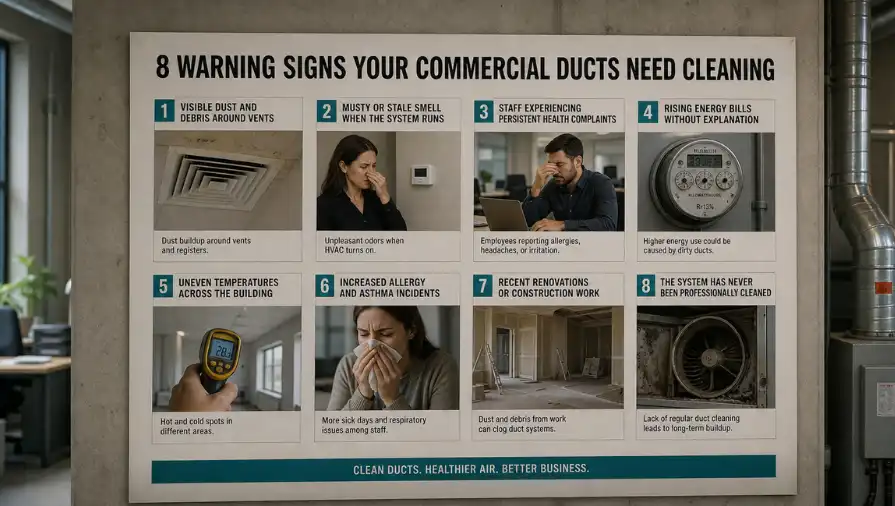
Sign 1 — Visible Dust and Debris Around Vents
The Most Obvious Warning Sign — and the Most Ignored
Walk around your building and look at the ceiling registers and return air grilles. A thin dust coating is normal.
A grey or brown film around the vent face, dust streaks on the ceiling tiles around registers, or visible debris inside the duct opening when you shine a torch in — that’s a system that needs attention now.
Expert Tip: Don’t just check the supply vents. Check the return air grilles — the larger louvred panels that pull air back into the system. These accumulate contamination faster than supply vents and are the first place experienced technicians look when assessing a commercial system. A heavily loaded return air grille means every particle pulled through it is going straight back into your duct network.
Sign 2 — Musty or Stale Smell When the System Runs
When Your Building Smells Like the Ducts, It’s Time
Musty or unpleasant smells upon system startup usually indicate moisture, trapped debris, or mould growth within the ductwork — a 99% reduction in occupant complaints from mould or odours is consistently achieved following professional duct cleaning using HEPA filtration and antimicrobial treatment.
That earthy, stale smell that hits when the AC or heating first starts up in the morning? That’s mould and biological matter disturbed by airflow and pushed into every room in the building simultaneously.
In Sydney’s commercial buildings — particularly those in older CBD towers, Parramatta office parks, and North Sydney buildings with original ductwork — this is one of the most common complaints facility managers receive and one of the slowest to act on.
Acting on the smell before visible mould appears is significantly cheaper than remediating after it’s established.
Expert Tip: Do the morning test. Arrive at the office before the system has been running and note whether the smell is present before startup. If the smell appears only when the system turns on and dissipates as fresh air enters — the contamination is inside the ductwork. If the smell is present regardless of system operation — the source may be elsewhere.
Sign 3 — Staff Experiencing Persistent Health Complaints
Dirty Ducts and Workplace Health Are Directly Connected
AS 3666 compliance requirements govern how building managers manage cleaning tasks that interact with HVAC systems — and commercial buildings in Sydney are expected to maintain air handling systems that don’t create health risks for occupants.
If multiple employees are experiencing unexplained headaches, sinus congestion, persistent fatigue, dry eyes, or worsening asthma — particularly symptoms that improve when they leave the building and return when they come back — the building’s air handling system is the first thing to investigate.
This pattern has a clinical name: Sick Building Syndrome. And in Sydney office buildings, dirty ductwork is among the most common contributing causes.
Health Complaints Linked to Dirty Commercial Ducts
- Persistent headaches — particularly in the morning or after extended time at the desk
- Unexplained fatigue and difficulty concentrating throughout the workday
- Dry, irritated eyes, throat, or nasal passages
- Worsening asthma or allergy symptoms indoors that improve outdoors
- Increased frequency of respiratory infections among staff
Expert Tip: Track sick day patterns. If staff absenteeism spikes during periods when the HVAC system runs heavily — Sydney’s summer and the start of winter heating season — and improves during periods of reduced system use or when windows are opened, that’s a strong correlation between air quality and staff health that warrants a professional duct inspection.
Sign 4 — Rising Energy Bills Without Explanation
Dirty Ducts Make Your HVAC Work Harder Than It Should
When commercial ductwork is clogged with accumulated dust and debris, airflow resistance increases throughout the entire system. The air handling unit has to work significantly harder — drawing more power — to push the same volume of air through restricted ducts.
The result shows up directly on your energy bills. A system that’s operating efficiently should maintain consistent running costs for similar conditions.
An unexplained upward trend in energy consumption — particularly when seasonal variation doesn’t account for it — is a strong indicator of duct obstruction.
Professional duct cleaning using HEPA filtration and proper cleaning methods delivers measurable energy savings alongside improved air quality — the two outcomes are directly connected through restored airflow efficiency.
Expert Tip: Pull three years of energy bills and overlay them against any duct cleaning records you have. Buildings that have regular duct cleaning show flatter, more predictable energy consumption curves. Buildings without regular cleaning show a gradual upward creep that’s easy to attribute to other factors — but frequently traces back to progressively restricted ductwork.
Sign 5 — Uneven Temperatures Across the Building
Hot and Cold Spots Are a Classic Duct Blockage Symptom
If some areas of your Sydney office are consistently too warm while others are too cold — despite the same thermostat settings — localised duct blockages or heavily contaminated duct sections are frequently the cause.
Dust accumulation inside ductwork doesn’t occur evenly.
It concentrates at bends, junctions, and areas of reduced airflow velocity. When accumulation reaches a critical thickness in specific sections, airflow to connected zones drops — creating the hot and cold spot problem that building managers and facility teams consistently struggle to resolve through thermostat adjustments alone.
Expert Tip: Map the complaints. Ask staff to identify which areas of the building are consistently uncomfortable and note whether they correspond to the same duct zones. Patterns that track duct runs — rather than solar orientation or heat load from equipment — almost always indicate duct obstruction rather than system sizing issues.
Sign 6 — Increased Allergy and Asthma Incidents
What’s Circulating Through Your Ducts Is Getting Into Your Team
Commercial duct systems in Sydney office buildings accumulate a significant biological load over time: dust mite allergens from carpeted areas, mould spores from moisture in duct sections, pollen drawn in from outdoor return air intakes, and fine particulate matter from the building’s own activities.
Every time the system runs, that accumulated load gets distributed through every zone connected to the duct network. For staff with asthma or allergies — a significant proportion of any workforce — the cumulative daily exposure is meaningful.
If your business has noticed a pattern of increased allergy or asthma incidents, or more employees disclosing respiratory conditions than previously, the building’s air quality environment is worth investigating seriously.
Sign 7 — Recent Renovations or Construction Work
Post-Renovation Duct Cleaning Is Non-Negotiable
Construction dust is the finest and most pervasive type of contamination that enters commercial duct systems. Even with vent covers taped during works, fine gypsum dust, silica particles, and fibrous materials penetrate HVAC systems through gaps, pressure differences, and improperly sealed sections.
Once in the duct system, construction dust doesn’t clear itself. It coats internal surfaces, reduces airflow, and creates the foundation layer that supports subsequent mould and bacterial growth.
Any commercial building in Sydney that has undergone fit-out work, renovation, or even significant furniture installation in the past 12 months should have a post-construction duct clean — regardless of whether other warning signs are present.
Expert Tip: Specify post-construction duct cleaning in your fitout contracts upfront. Experienced Sydney commercial fit-out teams will include it as standard. Contractors who push back on this specification are a signal worth noting.
Sign 8 — The System Has Never Been Professionally Cleaned
If You Can’t Remember — It’s Overdue
This is the simplest and most honest sign of all. If you can’t recall when the commercial ductwork in your Sydney building was last professionally cleaned — or if you have no cleaning records in the building’s maintenance log — it needs cleaning now.
AS/NZS 3666.2 outlines the minimum operational and maintenance requirements for the control of microbial growth in air handling systems of commercial buildings — including inspection, cleaning schedules, maintenance programs, and maintenance reporting requirements that building managers are legally required to follow.
Annual inspection and cleaning to AS/NZS 3666.2 is the standard for commercial buildings in Australia. Buildings that have never been cleaned — or where records are absent — are almost certainly non-compliant.
Expert Tip: Ask for a written pre-clean inspection report before any commercial duct cleaning service begins. A reputable Sydney commercial HVAC cleaning company will provide video inspection footage of the ductwork condition before cleaning and a post-clean report confirming what was done. This documentation protects you as a building manager and forms part of your AS/NZS 3666 compliance record. Any contractor who won’t provide this is not the right contractor for a commercial building.
What Happens if You Ignore These Signs?
The consequences of delayed commercial duct cleaning in Sydney buildings compound over time.
1. Contamination deepens
Dust layers become biofilm. Biofilm supports mould growth.
Mould colonies release spores continuously into every room. The cleaning required to remediate an established contamination problem is significantly more complex and disruptive than a routine annual clean.
2. Energy costs keep rising
Every month of restricted airflow is a month of excess energy consumption that’s directly recoverable through a professional clean.
3. Compliance exposure grows
AS 3666 compliance requirements are not theoretical obligations — building managers across Sydney are expected to implement risk management plans and maintain records demonstrating active compliance with air handling system hygiene standards. A workplace health incident linked to poor air quality in a building with no cleaning records is a significant legal exposure.
4. Staff productivity and retention suffer
The link between indoor air quality and cognitive performance is well-established. Up to 75% fewer allergens and improved indoor air quality consistently follows professional duct cleaning — and the productivity and attendance improvements that accompany better air quality are measurable.
Conclusion
If your Sydney commercial building is showing any of these eight warning signs — act on them now, not at the next scheduled maintenance review.
The signs are clear. The standard is established.
And in a city like Sydney, where office buildings run their HVAC systems year-round and workplace health expectations are increasingly enforced, maintaining clean, compliant ductwork is a basic professional obligation — not an optional upgrade.
Book a licensed commercial duct cleaning service that operates to AS/NZS 3666 standards, request video inspection documentation before and after, and keep those records as part of your building’s compliance file.
Your team breathes that air every single day.
