
Your outdoor AC unit is always going to make some sound. The compressor runs, the fan spins, and that low, consistent hum in the background is completely normal.
But when that sound suddenly changes — when you hear a rattling, a grinding, a sharp buzzing, or a hiss you have never noticed before — that is not normal operation. That is your system sending you a signal that something needs attention.
Loud buzzing, rattling, grinding, screeching, or banging from your outdoor AC unit usually indicates that something is loose, failing, or out of balance. Some noises are minor, but others can signal damage that may worsen quickly if the system keeps running.
For Sydney homeowners running split systems and ducted units year-round through humid summers and cool winters, catching these sounds early is the difference between a minor service call and a major compressor replacement.
This guide covers every common noise your outdoor AC unit might make, what is behind it, what you can safely check yourself, and — critically — which sounds mean you need to turn the unit off immediately.
Why Sydney Makes Outdoor AC Noise Worse Than Most Cities
Local Conditions That Accelerate Wear and Sound
Sydney’s environment creates challenges for outdoor AC units that are genuinely unique compared to most of Australia.
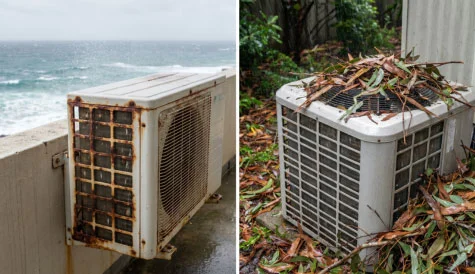
The salt-laden air along the Northern Beaches, Eastern Suburbs, and Cronulla corrodes metal fasteners, condenser fins, and motor housing significantly faster than inland areas.
Once corrosion weakens the fittings, panels loosen, components shift, and sounds that were never there before start appearing.
Sydney’s summer storms drop gum leaves, seed pods, bark, and twigs directly into outdoor units — especially for homes in leafy suburbs like Lane Cove, Killara, Gordon, and the Hills District. Debris accumulation is one of the most common causes of rattling and restricted airflow in Sydney systems.
Add to that the humidity that builds through January and February — which promotes moisture ingress into electrical connections and accelerates the breakdown of rubber components like mounting pads and vibration isolators — and it becomes clear why noisy outdoor AC units are such a common Sydney problem throughout the cooling and heating seasons.
Understanding the local environment helps you stay ahead of these issues rather than being surprised by them.
The 6 Most Common Outdoor AC Noises and Their Causes
1. Rattling or Clanking

What It Sounds Like
A loose, repetitive knocking or shaking sound — either from inside the unit or from the outer casing — that is usually worse when the fan is at full speed.
Most Common Causes
Debris Inside the Unit
Leaves, twigs, seed pods, and small stones get pulled into the outdoor unit through the side grilles by the fan. Once inside, they circulate with every rotation — producing a persistent rattle that often sounds worse than it actually is.
Loose Panels, Screws, or Grille Covers
Vibrations during operation cause screws, bolts, and panels to loosen over time. These loose components rattle against the unit’s housing, producing a rattling sound.
In Sydney’s heat — where outdoor units run for months on end through summer — the cumulative vibration effect on fasteners is accelerated compared to systems used only seasonally.
Worn or Cracked Rubber Mounting Pads
When the rubber anti-vibration pads beneath the outdoor unit harden, crack, or compress flat over the years, the unit’s normal operational vibration transfers directly to the concrete slab below — amplifying every small rattle into a much louder sound.
Bent Fan Blade
A fan blade that has been bent by debris impact will lightly catch the inside casing during rotation, creating a rhythmic clinking that gets progressively worse if left unaddressed.
What You Can Do
- Turn off power at the circuit breaker and the isolator switch first — always
- Remove any visible debris from around and inside the unit through the grille
- Hand-tighten all accessible panel screws and the top grille cover
- Inspect the rubber mounting pads and replace if cracked or fully compressed
- If rattling persists after these checks, book a technician to inspect the fan blade and internal components
2. Buzzing or Humming

What It Sounds Like
A sustained electrical buzzing or a loud, low-frequency hum — often combined with the fan running slowly or not at all.
Most Common Causes
Failing Capacitor
A failing capacitor produces a clicking or humming noise as it struggles to send power to the motor. This is often accompanied by the air conditioner producing warm air instead of cooling.
The capacitor is the component that starts and runs the compressor and fan motors. In Sydney’s heat, capacitors are under sustained stress through summer and tend to fail after several years of operation — often producing a distinctive buzzing sound as the first warning sign.
Faulty Contactor Relay
The contactor relay switch is the key piece that kickstarts your outdoor condenser unit when signalled by your indoor thermostat.
A loud hum from your AC indicates this component is malfunctioning. Turn off your system immediately, as these issues can wreak havoc on the unit if left unchecked.
Electrical Wiring Issues
Frayed, corroded, or loose wiring — common in coastal Sydney units where salt air degrades insulation over time — creates intermittent electrical contact that produces a buzzing or crackling sound under load.
Fan Not Running While Compressor Is Active
If you hear buzzing and the fan is not spinning, turn the system off. Continued operation can overheat and damage the compressor.
What You Can Do
Turn the unit off at the breaker. Do not attempt electrical repairs yourself. Call a licensed HVAC technician — electrical faults worsen rapidly and a compressor destroyed by overheating is one of the most expensive possible outcomes.
3. Grinding or Screeching

What It Sounds Like
A harsh, metallic grinding or a high-pitched screech — either constant or pulsing with the fan rotation. This is one of the most alarming sounds an outdoor unit can produce.
Most Common Causes
Worn Fan Motor Bearings
Grinding is a more concerning noise indicating that something is about to go very wrong. This noise can be caused by lubrication around the dual shaft motor breaking down, indicating it requires replacement.
Further, a fan motor bearing that is worn or has failed is a serious issue that can cause further damage to the unit.
Fan motor bearings have a service life — and in Sydney’s high-use environment, where outdoor units run for six to eight months a year for both cooling and heating, that life is reached faster than manufacturers’ standard estimates.
Motor Shaft Misalignment
When mounting hardware corrodes or loosens — a particular issue for coastal Sydney units — the motor can shift slightly out of alignment, creating metal-on-metal contact that produces grinding under load.
Fan Blade Contacting Internal Components
A severely bent fan blade that is no longer just lightly ticking but physically contacting the internal casing produces a rhythmic grinding or scraping that escalates quickly.
What You Can Do
Turn the system off immediately at the circuit breaker. Do not restart it. For internal mechanical faults, a qualified HVAC technician should be contacted to diagnose and address the issue accurately.
Running the system through grinding dramatically accelerates internal damage and can turn a motor replacement into a full unit replacement.
4. Hissing or Gurgling

What It Sounds Like
A steady or intermittent hissing — similar to air escaping from a tyre — or a liquid gurgling sound from inside or around the outdoor unit.
Most Common Causes
Refrigerant Leak
An AC unit hisses if it is leaking refrigerant. These chemicals are highly toxic with overexposure occurring at even relatively low concentrations.
A refrigerant leak is the most serious cause of a hissing outdoor unit. Signs that accompany the hiss include the system running but producing very little heating or cooling, ice forming on the refrigerant lines in non-winter conditions, an oily residue around the pipe connections, and progressively rising electricity bills without any change in usage.
High Internal Pressure
An unusual hissing combined with the compressor sounding strained can indicate internal pressure exceeding safe operating range — a situation that requires immediate shutdown and professional inspection.
What You Can Do
Turn off the unit at the circuit breaker immediately. Refrigerant handling must be done by a licensed professional due to environmental and safety regulations.
Simply topping it up without fixing the leak leads to repeat failures and potential compressor damage.
In Australia, handling refrigerant without an ARC (Australian Refrigeration Council) licence is illegal. Do not attempt any inspection of refrigerant lines or connections yourself.
5. Banging or Loud Clanking at Startup

What It Sounds Like
A sudden, sharp bang — often at startup — or a heavy clanking sound that appears during operation and was not present previously.
Most Common Causes
Compressor Internal Fault
A loud banging sound is most likely the compressor. With enough use over time, components loosen — resulting in detached parts hitting the compressor’s exterior frame and causing a loud banging noise.
Compressors are not meant to be disassembled, meaning you may need to invest in AC replacement altogether.
Loose Internal Component
A component that has broken free inside the outdoor unit — a fan blade counterweight, a mounting bolt, or an internal bracket — will produce a loud, irregular clanking as it moves with the fan and compressor vibration.
What You Can Do
Turn off the unit immediately and do not restart it. A banging or clanking sound at startup is one of the clearest indicators of serious internal mechanical failure — every additional start cycle risks making the damage significantly worse.
6. Heavy Vibration Against the Slab

What It Sounds Like
A deep, resonant vibrating or thumping sound that seems to come from the base of the unit rather than from the inside components.
Most Common Causes
Degraded Rubber Anti-Vibration Pads
This is one of the most common and most easily fixed noise issues for Sydney outdoor units — particularly in western suburbs like Penrith, Campbelltown, and Blacktown where outdoor units operate at maximum capacity through extended summer heatwaves.
When the rubber pads beneath the unit harden and compress over years of use, all of the unit’s natural operational vibration transfers directly into the concrete slab — amplifying into a resonant thumping that can be heard throughout the house and, in some cases, into neighbouring properties.
Improper Installation or Unit Shift
If the unit has gradually shifted on its slab — common after heavy rain events wash away supporting material, or after the ground settles beneath a concrete pad — it may no longer be sitting level, creating an uneven load distribution that amplifies vibration.
What You Can Do
Anti-vibration rubber pads are inexpensive and available at most hardware stores. Isolate the power completely, carefully tilt or lift the unit with assistance, slide out the old, degraded pads, and replace with new ones.
This single straightforward fix resolves the vast majority of vibration-related noise complaints for Sydney outdoor units.
NSW Noise Regulations — What Every Sydney Homeowner Should Know
Your Outdoor AC Has Legal Noise Limits
Many Sydney homeowners are not aware of this until a neighbour complaint arrives — but outdoor AC units are subject to residential noise regulations under NSW law.
An outdoor unit must not be audible inside a neighbouring habitable room — such as a bedroom or living area — during restricted hours:
- Weekdays: 10pm to 7am the following morning
- Weekends and public holidays: 10pm to 8am the following morning
In densely built inner-Sydney suburbs where outdoor units sit close to shared fences or apartment boundaries — Newtown, Surry Hills, Leichhardt, Glebe, and similar areas — a unit with failing bearings, worn mounts, or loose panels can easily become loud enough to breach these limits and generate a formal council notice.
A well-maintained unit operating within its designed performance range should not cause issues. Regular servicing keeps noise levels within compliance and protects you from neighbour complaints.
Ac Outdoor Unit Noise Type Quick Action
| Noise | Most Likely Cause | Risk Level | Action |
| Light rattle | Debris or loose screws | Low | DIY — clear and tighten |
| Heavy rattle | Worn pads or bent blade | Medium | Replace pads; technician for blade |
| Buzzing / humming | Capacitor or wiring fault | High | Turn off — call technician |
| Grinding | Worn motor bearings | High | Turn off immediately |
| Screeching | Fan motor failure | High | Turn off immediately |
| Hissing | Refrigerant leak | Critical | Turn off — ARC technician only |
| Banging at startup | Compressor fault | Critical | Turn off — do not restart |
| Heavy vibration | Degraded mounting pads | Low–Medium | Replace rubber pads |
What to Check Yourself Before Calling a Technician
Safe DIY Steps in the Right Order
If your outdoor unit is making a noise that does not fit the critical categories above, work through these checks before calling anyone out.
Step 1 — Isolate the Power Completely
Turn off at the remote, the wall isolator switch beside the outdoor unit, and the dedicated circuit breaker at the switchboard. Never inspect or touch the outdoor unit with power connected.
Step 2 — Clear All Debris
Walk around the unit and remove any leaves, twigs, seed pods, or bark from the top, sides, and base. Look through the side grilles for any material that has been pulled inside by the fan.
Step 3 — Check and Tighten All Accessible Fasteners
Use a screwdriver to check the outer panel screws, grille cover bolts, and top cover fixings. In Sydney’s vibration-heavy conditions, these work loose faster than most people expect.
Step 4 — Inspect the Rubber Mounting Pads
Look at the four corners of the unit base. If the pads are cracked, completely flat, or missing, replace them before restoring power.
Step 5 — Confirm Clearance Around the Unit
Ensure at least 60cm of clearance exists on all sides. Vegetation, garden furniture, or stored items too close to the unit restricts airflow and creates both noise and performance problems.
Step 6 — Restore Power and Listen Carefully
If the noise persists after clearing debris, tightening fasteners, and replacing pads — do not continue to run the unit. Book a technician to inspect the internal components.
Frequently Asked Question About Outdoor AC Unit Making Loud Noise in Sydney
1. Is it normal for an outdoor AC unit to make some noise?
Yes — a consistent low hum from the compressor and steady airflow from the fan are normal. Sudden or excessive noise usually indicates a mechanical or electrical issue.
If the noise is loud, grinding, banging, or buzzing without the fan running, turn the system off to avoid further damage.
2. Should I turn my AC off if the outdoor unit is making a loud noise?
For light rattling after clearing debris and tightening panels — you can run the system and monitor it. For buzzing, grinding, screeching, hissing, or banging — turn it off at the circuit breaker immediately and do not restart until a technician has inspected it.
3. How often should I service my outdoor AC unit to prevent noise?
Annual professional servicing is the Sydney standard — ideally in spring before the summer season begins. A technician will clean the condenser coils, inspect the fan motor and bearings, check all electrical connections, verify refrigerant levels, and replace worn components before they become noisy failures mid-season.
Conclusion
A noisy outdoor AC unit is never something to put off dealing with in Sydney. The climate is demanding, the systems run hard and sounds that start as a minor rattle can escalate into compressor failure faster than most homeowners expect.
The good news is that a large proportion of outdoor unit noise comes down to three things that are entirely within your control — debris, loose fasteners, and worn rubber mounting pads. Clearing debris, tightening panels, and replacing pads costs very little and resolves most light rattling and vibration complaints completely.
For the more serious sounds — buzzing, grinding, hissing, and banging — the rule is simple: turn it off, do not restart it, and call a licensed technician. The cost of a repair carried out before failure is almost always a fraction of the cost of replacement after a catastrophic fault.
Stay on top of the annual service schedule. Listen to what your outdoor unit is telling you.
