

If your air conditioner has started dripping water inside, leaving a damp patch on the ceiling, or emitting that familiar stale, musty smell — there is a very good chance your AC unit drain pipe is blocked.
It happens to plenty of Sydney homeowners, and the good news is that in most cases you can fix it yourself without calling anyone out. A blocked condensate drain pipe sounds technical, but the cleaning process is genuinely straightforward once you know what you are dealing with.
This guide walks you through exactly what the drain pipe does, why it blocks up in Sydney’s climate, the step-by-step process to unclog it safely, and what to do if the DIY approach does not clear it completely.
What Is the AC Unit Drain Pipe and Why Does It Matter?
Before getting your hands dirty, it helps to understand what you are working with.
The Role of the Condensate Drain Pipe
Your air conditioner does two things when it runs — it cools the air and removes humidity from it. All that moisture has to go somewhere.
The condensate drain pipe (also called the condensate drain line) is the PVC pipe that carries that collected water safely out of your home.
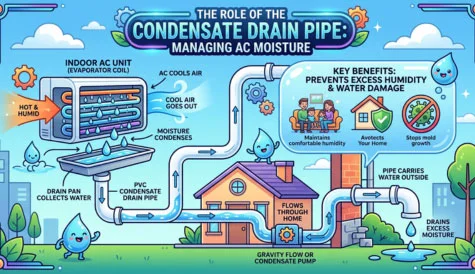
The drain line is typically a PVC pipe connected to the indoor unit of your air conditioner, running to the outside of your home.
Its purpose is to carry away the moisture your AC removes from the air, which prevents excess humidity from accumulating in your home.
In Sydney’s warm, humid summers, your split system or ducted AC unit can remove a significant volume of moisture from the air every single hour it runs. That is a lot of water moving through a relatively narrow pipe — and when that pipe gets blocked, the water has nowhere to go.
What Happens When the AC Drain Line Is Clogged
When the drain pipe gets blocked, the water has no place to go. This can cause a lot of problems like water damage, mould growing, and poor air quality.
If you do not fix it, your air conditioner might even stop working.
Most modern air conditioners have something called a float switch installed, which shuts off power to your system if it detects too much water. Other common symptoms include a blank thermostat or an error saying there is no power to the Rh wire.
In apartments across Sydney’s Inner West and terrace homes in the Eastern Suburbs.
A blocked AC condensate drain line that goes unaddressed can cause ceiling water stains, structural moisture damage, and mould growth — all within a matter of days in summer.

Why Does the AC Drain Pipe Block in Sydney?
Sydney’s environment creates specific conditions that make AC drain pipe blockages more common than in cooler, drier climates.
Common Causes of a Clogged AC Drain Pipe
1. Algae and Mould Buildup
This is the most common culprit — by a wide margin. Moist conditions inside the drain line create an ideal environment for mould, algae, and bacteria, which gradually build up and restrict water flow.
The dark, permanently damp interior of the condensate drain pipe is essentially a perfect growing environment.
In Sydney’s humid summers, algae growth inside the pipe can go from minor to fully blocked within a single season.
2. Dirt, Dust and Debris
In cities like Sydney, airborne dust and particles can enter your AC system and settle in the drain pipe over time.
This is particularly relevant for Sydney homes near busy roads — think Parramatta Road, the Pacific Highway, or any of the main arterials through the western suburbs — where fine particulate matter from traffic settles into the AC system through the return air filter and eventually makes its way to the drain line.
3. Insects, Nests and Organic Debris
Sydney’s outdoor conditions mean that small insects, gecko eggs, leaf debris, and cobwebs can enter the outdoor drain exit point and create partial blockages that gradually worsen. The outdoor end of the PVC drain pipe is an attractive spot for small creatures looking for a dark, sheltered space.
4. Infrequent Maintenance
Simply put — the less often the drain line is flushed and cleaned, the greater the sludge accumulation. Without routine cleaning, buildup increases and eventually leads to a fully clogged AC drain pipe.
Signs Your AC Drain Pipe Is Blocked
Catch a blocked drain early and the fix is quick and simple. Leave it for a few weeks and you are looking at water damage and mould remediation.
Watch for these warning signs:
- Water dripping from the indoor unit or pooling on the floor beneath it
- Damp patches or water stains appearing on the ceiling — especially common in ducted systems
- A musty or stale smell when the AC turns on — a strong indicator of mould in the drain line
- Your AC has stopped working suddenly — the float switch may have triggered
- Gurgling or bubbling sounds from the indoor unit during operation
- Reduced cooling performance despite the system running normally
- Error codes appearing on your wall controller — particularly on Daikin, Mitsubishi, or Fujitsu units
If you are seeing two or more of these at once, the condensate drain line is almost certainly blocked and needs attention now rather than later.
How to Unclog Your AC Unit Drain Pipe — Step by Step
Here is the complete, safe process for clearing a blocked AC unit drain pipe yourself. Most Sydney homeowners can complete this in under 30 minutes.
What You Will Need
Gather these items before you start:
- Wet/dry vacuum (shop vac) — the most effective tool for clearing a blocked drain line
- White distilled vinegar — to dissolve algae and kill mould
- Warm water
- A flexible wire brush (optional — useful for stubborn blockages near the access point)
- A rag or old towel — to seal the vacuum hose to the pipe for better suction
- Rubber gloves — the sludge inside the drain line is unpleasant
- A torch or flashlight — to inspect the drain pan and pipe access
Step 1 — Turn Off the Power First
This step is non-negotiable and must happen before anything else.
To ensure there is no risk of electrical shock or accidents, disconnect the power supply entirely. Locate the breaker panel in your home and flip the switch that corresponds to your air conditioner. If your unit has a dedicated power switch directly on or near it, turn that off as well.
Turn it off at the thermostat and at the circuit breaker. You are about to work near water and electrical components — taking two extra minutes at the switchboard is absolutely worth it.
Step 2 — Locate the Drain Line and Inspect the Drain Pan
Finding the Condensate Drain Pipe
Find the two ends of your AC drain line. Locate the drip pan under the indoor unit — a full condensate pan is one of the clearest signs indicating a clogged drain line.
The indoor access point is usually a T-shaped vent with a removable cap, located near the indoor air handler unit — whether that is a wall-mounted split system unit or the internal section of a ducted system.
Checking the Outdoor Drain Exit
Go outside and find where the drain pipe exits your home. Look for mould, dirt, or insects at the outdoor exit. If the drain line clog is near the outlet, you might see water dribbling slowly or not at all.
For most Sydney homes, the outdoor drain exit is a white PVC pipe — typically around 19mm in diameter — that exits through the wall near the outdoor unit or drains from the eave.
Step 3 — Use the Wet/Dry Vacuum to Suck Out the Blockage
This is the most effective method for clearing a clogged AC drain pipe and should always be your first approach.
A wet/dry vacuum should be powerful enough to accomplish this task with ease. You may need to first remove any caps or plugs from the end of the drain line for it to work properly.
Place the vacuum hose firmly against the outdoor drain exit. Wrap a rag tightly around the connection point to create a better seal and improve suction. Turn on the vacuum and let it run for two to three minutes.
You will often hear the satisfying sound of water and sludge being pulled through the pipe and into the vacuum — that means it is working. Repeat this two or three times if needed.
Step 4 — Flush with White Vinegar
Once the vacuum has cleared the main blockage, treat the drain line with white vinegar to dissolve remaining algae and kill mould.
Vinegar contains acetic acid and can break down algae and other deposits that may have accumulated in your drain line. It is also a natural disinfectant that will kill any bacteria or mould present in your drain line.
The Vinegar Flush Process
Remove the cap from the indoor T-junction access point. Pour one to two cups of undiluted white distilled vinegar directly into the drain line.
Allow the solution to flow through the pipe and let it sit for at least 30 minutes to thoroughly disinfect and break down any stubborn debris. Afterward, flush the drain line with clean water to rinse away the solution and any remaining particles.
What to Avoid
Do not use bleach as your first choice. A mixture of vinegar and water flushes out the drain line and helps break down stubborn clogs.
Vinegar is effective due to its acidity, which helps dissolve mineral deposits and other substances that can cause clogs. Bleach can degrade PVC pipes over time and is harder on the surrounding components. Vinegar or a diluted hydrogen peroxide solution are safer and equally effective alternatives for regular maintenance.
Step 5 — Check and Clean the Drain Pan
While the vinegar is working in the drain line, inspect and clean the condensate drain pan beneath the indoor unit.
The drain pan beneath the evaporator coil can accumulate standing water and debris. Inspecting whether the drain pan is draining properly can prevent clogs and water overflow issues.
Use a damp cloth and warm soapy water to wipe out the pan. Remove any visible algae, sludge, or debris. A clean drain pan is essential — blockages often start here before moving further into the line.
Step 6 — Verify the Drain Is Flowing Freely
After the vinegar flush and rinse, do a flow test before switching anything back on.
Pour a cup of clean water into the indoor drain access point. Go outside and watch the outdoor drain exit.
You should see a steady stream of water flowing out within 10 to 15 seconds. If the water flows freely, the drain line is clear.
Once the AC begins operating after restoring power, monitor it closely for any signs of issues. Check for leaks around the indoor unit, as this could indicate the drain line is still partially clogged.
Step 7 — Restore Power and Test the System
Reattach the cap on the indoor access point securely. Restore power at the circuit breaker.
Turn the system on at the thermostat and run it for 10 minutes.
Monitor the indoor unit during this time. No dripping, no error codes, and a clean, fresh airflow from the vents all confirm that your drain line is clear and functioning properly.
Preventive Maintenance — Keep the Drain Line Clear Year-Round
Fixing a blocked drain is one thing — keeping it from blocking again is the real goal.
Monthly Vinegar Flush Routine
The simplest and most effective prevention strategy for Sydney homeowners is a regular vinegar flush.
Pour one cup of undiluted white vinegar into the indoor drain access point once a month during periods of heavy AC use — which in Sydney means November through to March at minimum. Let it sit for 30 minutes, then flush with water.
This takes five minutes and prevents the algae buildup that causes the vast majority of condensate drain pipe blockages.
Keep the Outdoor Drain Exit Clear
Check the outdoor end of the drain pipe every month or so — particularly after storms, in autumn when leaf fall is heavy, or if you have vegetation growing near the exit point.
Ensure the PVC pipe located at the outdoor drain outlet stays free of leaves, dirt, and pests. Make sure the drain line has a proper slope to allow water to flow out easily.
Annual Professional AC Service
A monthly vinegar flush maintains the drain line between services, but a professional service does much more.
Book air conditioning service once a year to clean and inspect the system thoroughly. A licensed HVAC technician can safely inspect and clear deeper clogs.
A professional technician will inspect the full drain system including the condensate pump (if your system uses one), check the drain pan condition, verify the pipe slope is correct, and identify any slow-developing blockages before they become emergencies — particularly important for ducted systems where a blocked drain can cause ceiling water damage across multiple rooms.
When to Call a Professional Instead of DIYing
The DIY steps above resolve the majority of clogged AC drain pipe situations in Sydney homes. But there are circumstances where professional help is the right call.
Contact a licensed HVAC technician when:
- The vacuum and vinegar method has been attempted twice with no improvement in drainage
- You can see standing water in the ceiling cavity around a ducted system
- There are visible cracks or disconnections in the PVC drain pipe
- The drain pan has significant visible mould that cannot be reached from the outside
- Your AC is triggering an error code related to water detection or float switch activation and it will not clear
- The drain pipe keeps blocking repeatedly despite monthly vinegar flushing — this usually indicates a slope or installation issue that needs a professional to assess
Professional AC maintenance services in Sydney use specialised tools to safely clean and inspect the entire system. For deeply embedded blockages caused by years of accumulated sludge, a professional HVAC technician has equipment that goes well beyond what a shop vac can achieve.
Frequently Asked Question About Unclogging an AC Drain Pipe in Sydney
1. How do I know if my AC drain pipe is blocked?
The most common signs are water dripping from the indoor unit, a musty smell when the system runs, the AC shutting off unexpectedly, or error codes on the wall controller.
One of the most obvious signs is water dripping or pooling inside your home. A clogged drain line often leads to mould growth, which creates unpleasant odours.
2. Can I use bleach to unclog my AC drain pipe?
Vinegar is the better choice for Australian AC systems.
Bleach can be effective for killing mould but risks degrading PVC pipe joints over repeated use. Vinegar is a natural disinfectant that will kill any bacteria or mould present in your drain line without damaging the pipe material.
3. How often should I clean my AC drain pipe in Sydney?
A monthly vinegar flush during heavy use periods is the recommended maintenance routine for most Sydney homes. A full professional clean should accompany your annual AC service.
4. What causes my AC drain to keep blocking even after I clean it?
If your drain line blocks repeatedly, the issue is likely a structural one — usually an incorrect pipe slope that prevents water from draining fully, or a persistent algae source in the drain pan that is not being adequately treated. A professional inspection will identify the underlying cause.
5. Can a blocked AC drain damage my ceiling?
Yes — and it can happen faster than most people expect.
A clogged AC can lead to water damage and mould if the blockage is not fixed quickly. In ducted systems particularly, where the internal unit sits in the ceiling cavity, an overflowing drain pan can saturate ceiling insulation and plasterboard within 24 to 48 hours.
6. Is a blocked AC drain a plumbing or HVAC problem?
It is an HVAC maintenance issue — a licensed air conditioning technician handles it, not a plumber. In Australia, refrigerant work requires an ARC licence, but drain line cleaning and inspection falls within standard HVAC service scope and does not require a plumbing licence.
Conclusion
A blocked AC unit drain pipe is one of the most common maintenance issues Sydney homeowners deal with — and for good reason. Sydney’s humid summers push air conditioners hard, condensation is high, and algae growth inside the drain line is almost inevitable without regular attention.
The steps in this guide — power off, vacuum the line, flush with vinegar, clean the pan, verify the flow — resolve the vast majority of drain blockages in under 30 minutes. A monthly five-minute vinegar flush keeps the drain clear between services.
Take it seriously.
A blocked drain that is ignored for a few weeks can turn a simple DIY fix into a ceiling repair job. Stay on top of it, book your annual professional service, and your system will drain cleanly and reliably through every Sydney summer.
