

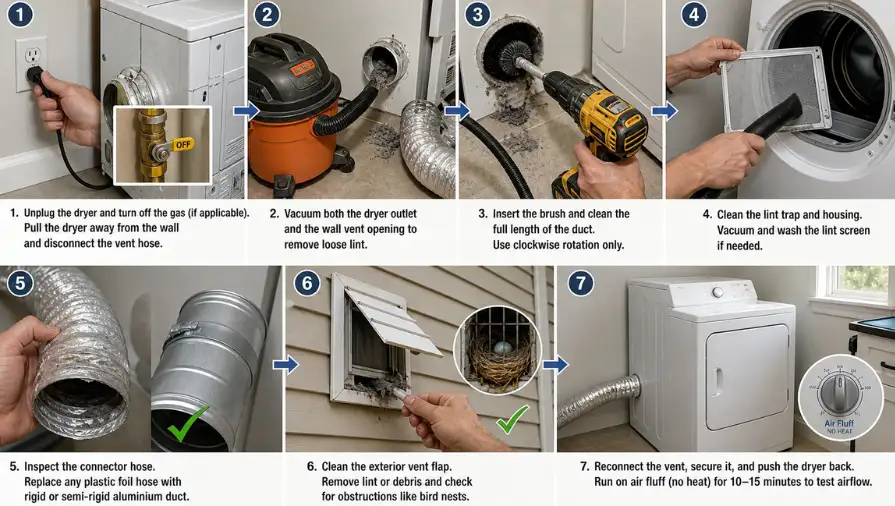
To clean your dryer exhaust vent: unplug the dryer, disconnect the duct from the back of the machine, use a flexible brush kit to scrub the full length of the ductwork, vacuum out the loosened lint, clean the exterior vent flap, and reassemble before running a 15-minute test cycle.
The whole job takes 60 to 90 minutes for a standard duct run — and it’s one of the most important home safety tasks most Sydney homeowners consistently put off.
According to Fire and Rescue NSW, approximately 5% of house fires in Australia originate from clothes dryers, with blocked vents being the primary culprit. And almost all of those fires are preventable with this one straightforward cleaning task done annually.
A clogged dryer vent doesn’t just waste energy — it’s a genuine fire risk sitting in your laundry every single load.
“The lint filter catches a fraction of what your dryer produces. The rest goes into the duct — and it builds up fast, especially in Sydney’s humid coastal climate.”
What You Need Before Starting
Tools and Equipment Checklist
Gather everything before pulling the dryer away from the wall — it makes the job significantly faster and cleaner.
- Dryer vent cleaning kit — flexible rods and a lint brush (available at Bunnings or Sydney hardware stores)
- Power drill — for spinning the brush through the duct
- Electrical tape — to secure rod connections inside the duct
- Shop vacuum — to capture loosened lint at both ends
- Screwdriver — to loosen hose clamps
- Protective gloves and dust mask — lint is fine-particle material
- Torch — for inspecting inside the duct opening
Expert Tip: Wrap electrical tape firmly around every rod joint before inserting into the duct — a joint that unscrews inside the ductwork mid-clean is frustrating and time-consuming to retrieve.
Step-by-Step — How to Clean Your Dryer Exhaust Vent
Step 1 — Disconnect the Dryer Safely
Power Off Before Touching Anything
Unplug the dryer completely from the wall power point. If you have a gas dryer, turn off the gas supply valve at the wall before moving anything — never skip this step with a gas appliance.
Pull the dryer gently away from the wall — roughly 30 to 60 centimetres — to access the duct connection at the back. Loosen the metal clamp securing the duct to the dryer’s exhaust port using a screwdriver, or simply pull the flexible duct connector free if it’s push-fit.
Expert Tip: Take a photo of the duct connection before disconnecting it — knowing exactly how it was attached makes reassembly faster and cleaner.
Step 2 — Vacuum the Connection Points First
Clear the Accessible Accumulation Before Brushing
Use a powerful vacuum to reach into the hole at the back of the machine. You will be surprised at how much “lint cake” accumulates right at the connection point.
Use your shop vacuum’s crevice attachment to clear as much loose lint as possible from both the dryer’s exhaust port and the wall duct opening before introducing the brush. Vacuuming first means the brush is dislodging embedded lint — not just pushing loose material deeper.
Step 3 — Brush the Full Duct Length
The Core Cleaning Step That Clears the Real Buildup
Assemble your flexible rod kit — attach the brush to the first rod and connect it to your power drill. Insert the brush into the wall duct opening and set the drill to clockwise only — never reverse, which can unscrew the rod joints inside the ductwork.
Feed the brush into the pipe while spinning it to scrub the walls and break loose the stubborn, humid lint that sticks to surfaces. Keep adding rods as you advance, pushing and pulling in short increments until the brush reaches the exterior vent.
Have the shop vacuum running at the opening behind you as you withdraw the brush — it captures the loosened lint as it comes back through rather than letting it fall onto the laundry floor.
Expert Tip: Work slowly and methodically — rushing the brush through causes lint to compact against bends rather than dislodging cleanly, leaving partial blockages that reduce airflow within weeks.
Step 4 — Clean the Lint Trap and Housing
The Overlooked Section Right Inside the Dryer
Remove the lint screen and vacuum out the slot it sits in using the crevice attachment. Lint accumulates in the housing channel below the screen and is never captured by simply wiping the screen itself.
If your lint screen has waxy buildup from dryer sheets, wash it with warm soapy water and let it dry completely. Dryer sheet residue blocks fine mesh airflow — test by holding the clean screen to a light source and confirming you can see through it clearly.
Step 5 — Check and Replace the Flexible Connector Hose
The Component Most Commonly Left in Poor Condition
Inspect the short flexible hose connecting the dryer’s exhaust port to the wall duct. In many Sydney laundries — particularly older homes in the Inner West, Eastern Suburbs, and rental properties across the city — this hose is a crinkled plastic foil type that is both inefficient and a genuine fire hazard.
Experts recommend replacing any flexible vent tubing with a rigid type if possible, because lint can build up in the ribbed curves of the flexible-style tubing, causing it to build up faster and increasing the risk of fire.
Replace plastic foil connectors with rigid or semi-rigid aluminium duct — it’s inexpensive, widely available, and significantly safer.
Expert Tip: Keep the connector hose as short and straight as possible — every bend adds airflow resistance and creates a lint accumulation point.
Step 6 — Clean the Exterior Vent Flap
The Component That Gets Completely Forgotten
Go outside and locate the exterior vent flap — usually a small louvred or single-flap cover on an exterior wall or eave. Remove any lint caked around the opening and wipe the flap and surround with a damp cloth.
Check for any obvious obstructions like bird nests or debris blocking the exterior vent. In Sydney, particularly in suburbs near bushland and parks — Ku-ring-gai, Lane Cove, Hornsby, and the Hills District — birds nest in exterior vent openings regularly during spring and summer.
Confirm the flap opens freely by checking it while the dryer is running after reconnection. A flap that barely moves or stays closed indicates the duct is still partially blocked.
Expert Tip: Fit a mesh bird guard to the exterior vent after cleaning — it prevents bird nesting while still allowing lint and moisture to exhaust freely.
Step 7 — Reassemble and Test
The Final Checks Before Calling the Job Done
Reconnect the duct to the dryer’s exhaust port and secure with the metal clamp. Use aluminium foil tape — not plastic duct tape, which cannot handle dryer exhaust temperatures — to seal the joint if needed.
Push the dryer back into position carefully, ensuring the flexible connector doesn’t kink or compress against the wall. Restore power, and for gas dryers, reopen the supply valve.
Run the dryer on an air fluff or no-heat setting for 10 to 15 minutes — this blows any residual loose lint through the now-clean duct without the added fire risk of lint contacting a hot element during the first cycle.
When to Call a Professional Dryer Vent Cleaner
The DIY steps above handle most standard Sydney laundry setups effectively. For anything more complex, our professional dryer vent cleaning service covers ceiling runs, long duct lengths, and hard-to-reach exterior vents safely.
Call a professional when:
- The duct runs through the ceiling — complex routing requires specialist equipment
- You’ve completed the clean but symptoms persist — clothes still damp, burning smell remains
- The exterior vent is on the roof or a second-storey wall requiring ladder access
- The duct run is longer than five metres with multiple bends
Conclusion
Cleaning your dryer exhaust vent is one of the highest-impact home safety tasks you can do yourself in an afternoon — preventing a genuine fire risk, cutting energy consumption, and extending your appliance’s life simultaneously.
Do it annually at minimum. Replace plastic duct connectors with rigid metal.
Check the exterior flap after every Sydney storm. And if the duct run is long or complex — book a professional rather than leaving it half-done.
Your dryer works hard through a Sydney winter. Give the exhaust vent the same attention you give the lint filter — and it’ll repay you with safer, more efficient operation for years.
