

Sydney summers are no joke. From December through to March, your air conditioner runs almost non-stop — battling humidity, heat, coastal dust, and urban pollution all at once.
And the one thing quietly taking the hit every single day? Your aircon filter.
A dirty filter doesn’t just reduce performance. It drives up your energy bill, shortens your system’s lifespan, and pushes contaminated air back into the rooms where your family sleeps, eats, and breathes.
The good news is that cleaning it yourself is one of the easiest home maintenance tasks you can do. This guide walks you through everything — the right way to clean it, how often to do it in Sydney’s specific climate, and how to know when a clean isn’t enough.
Why AC Filter Maintenance Matters More in Sydney Than You Think
Not all Australian cities are equal when it comes to aircon filter contamination. Sydney sits in a category of its own.
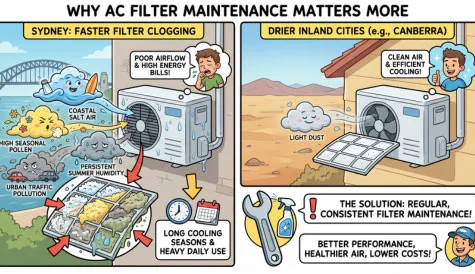
The combination of coastal salt air, high seasonal pollen, urban traffic pollution, and persistent summer humidity means Sydney filters load up significantly faster than those in drier inland cities like Canberra or Orange.
Add in the long cooling seasons and the heavy daily use that comes with them, and the case for regular, consistent filter maintenance becomes hard to argue with.
What a Blocked Filter Actually Does to Your System
Most homeowners notice the obvious signs — weaker airflow, longer cooling cycles, a musty smell. But the damage happening behind the scenes is more serious.
- Increased pressure drop across the filter forces the fan motor to draw more power just to move the same volume of air
- Evaporator coil contamination occurs when the filter can no longer catch fine particles — dust settles on the coil and degrades heat transfer efficiency
- AC filter bacteria growth and mould development accelerate in clogged, humid filter media — releasing biological contaminants directly into your indoor air
- Rising energy costs result from the compressor and fan working overtime to compensate for restricted airflow
- Shortened system lifespan as motors and components wear faster under sustained mechanical strain
How Indoor Air Quality Suffers First
Indoor air quality in HVAC-cooled homes is directly tied to filter condition. A saturated filter stops capturing fine particles effectively.
Pollen, dust mite allergens, mould spores, and fine particulate matter pass straight through and circulate in the air you’re breathing.
For households in Sydney with asthma sufferers, young children, or allergy-sensitive family members, a clean filter isn’t a nice-to-have — it’s a genuine health consideration.

Complete Step-by-Step Air Conditioner Filter Cleaning Process
These air conditioner filter cleaning steps work for both split system and ducted units. Read through the full process before starting.
1. Safety First — Cut the Power Before Anything Else
Turn off the air conditioner at the wall power switch — not just via the remote or app. If your outdoor unit has an isolator switch, turn that off too.
Running the system while the filter is removed pulls unfiltered air directly across the evaporator coil. Even a few minutes of this can deposit enough dust to cause lasting efficiency loss. Don’t skip this step.
2. How to Access the Filter on Different AC Types
Split System Air Conditioners
- Stand in front of the indoor wall unit
- Grip the bottom of the front panel and lift it upward — it hinges open on most models
- The filters sit inside, usually as two rectangular mesh panels side by side
- Slide or unclip them gently — the frames are lightweight and can flex and warp if forced
- Note the orientation before removing so you reinstall them correctly
Ducted Air Conditioning Systems
- Locate the return air grille — typically in the ceiling of a hallway or central living area
- Release the clips or hinges on the grille frame and lower it open
- The filter panel sits inside — it may be one large section or several smaller ones
- Ducted filters are often significantly larger and heavier with dust than split system filters, especially if they haven’t been cleaned in several months
Cassette and Ceiling-Mounted Units
- These have a panel on the underside of the ceiling unit that unclips downward
- The filters are usually smaller and circular or rectangular, depending on the model
- Check your manual if you’re unsure — forcing the wrong panel can crack the housing
3. Remove Loose Dust Before Any Water Touches the Filter
Use a vacuum cleaner with a soft brush attachment to remove the bulk of surface dust before wetting the filter. Run the brush gently across the mesh in one consistent direction.
Why this matters: Loose dust on a wet filter doesn’t rinse away cleanly — it clumps and can embed deeper into the mesh, reducing airflow even after washing. Vacuuming first makes the wet clean far more effective.
4. Washing the Filter — Doing It Properly
- Rinse the filter under lukewarm running water
- For a lightly soiled filter, plain water is usually sufficient
- For heavier buildup, apply a small amount of mild dish soap and work it through the mesh gently with your hands or a soft-bristled brush — use light circular motions
- Never scrub hard — aggressive pressure stretches or tears the mesh, creating gaps that allow unfiltered air to pass through
- If using a garden hose outdoors, keep the pressure low and always rinse from the inside of the filter outward — this pushes debris out rather than driving it deeper into the mesh
5. Drying the Filter — the Step Most People Get Wrong
A damp filter placed back into a running air conditioner is one of the primary causes of mould in AC filters and ongoing indoor air quality problems — particularly in Sydney’s humid conditions.
- Lay the filter flat in a shaded, well-ventilated spot outdoors
- Allow it to air dry completely — typically 1 to 2 hours depending on airflow and temperature
- Do not dry in direct sunlight — UV exposure and heat warp plastic frames and degrade the mesh material
- Do not use a hair dryer, heat gun, or clothes dryer — even brief heat exposure can permanently damage the filter structure
The filter must be completely dry — not just surface dry — before reinsertion.
6. Inspect the Filter While It’s Out
Before reinstalling, take a close look at the filter in good light:
- Check for holes or tears in the mesh — even small ones allow unfiltered air to bypass the filter entirely
- Look for persistent discolouration — grey or black staining that doesn’t wash out can indicate deep mould contamination in the filter media
- Inspect the plastic frame for cracks, warping, or bent sections that could allow air to bypass the seal
- Look inside the unit for a secondary purifying filter — many modern units have a smaller activated carbon or ion filter behind the main mesh that needs separate care on a different schedule
7. Reinstall Correctly and Run a Quick Test
- Slide the filter back into its track, ensuring it seats fully and evenly
- Check that the “Front” label or directional arrow (if present) faces outward toward the room
- Close and latch the front panel firmly
- Restore power at the wall switch
- Set the unit to fan mode on low speed and run it for 3–5 minutes
- Stand near the vents and feel for noticeably improved airflow compared to before
If airflow hasn’t improved meaningfully after a thorough clean, the issue may be elsewhere in the system — likely the evaporator coil.
How Often to Clean Aircon Filters in Sydney
How often to clean aircon filters is one of the most common questions — and the honest answer is more often than most Sydney homeowners currently manage.
Cleaning Frequency Guide for Sydney Homes
| Household Situation | Recommended Cleaning Frequency |
| Standard use, no pets | Every 3–4 weeks |
| Pets in the home | Every 2–3 weeks |
| Peak summer use (Dec–March) | Every 2 weeks |
| Near construction or dusty roads | Every 2 weeks |
| Allergy or asthma in household | Every 2 weeks |
| Within 3km of Sydney coastline | Every 2–3 weeks |
| Secondary purifying filters | Every 3 months |
| Activated carbon or HEPA inserts | Replace annually |
Sydney’s coastal suburbs — Bondi, Manly, Cronulla, Coogee, Freshwater, and surrounding areas — deal with fine salt aerosols in the air year-round. These particles aren’t just dust; they’re corrosive to filter frames over time and contribute to the humidity conditions that accelerate mould development on filter media.
Warning Signs Your AC Filter Needs Attention Right Now
Don’t wait for a scheduled clean if you notice any of the following. These are active indicators of air filter contamination that need addressing immediately.
Performance Warning Signs
- Noticeably weaker airflow from ceiling or wall vents even at high fan speed
- Air conditioner running in long, continuous cycles without reaching the set temperature
- Ice visible on the indoor unit or refrigerant lines — a sign of severely restricted airflow causing the coil to freeze
- Unusual rattling or vibration from the unit — sometimes caused by a filter that has shifted out of position
Air Quality Warning Signs
- A musty, stale, or damp smell when the unit first starts up — or persistently throughout operation
- Sneezing, itchy eyes, or worsening allergy symptoms that correlate with running the AC
- Visible dust settling on furniture or surfaces faster than usual, even with regular cleaning
- Grey or dusty residue visible around ceiling vents or wall unit grilles
How to Extend Air Filter Life Without Cutting Corners
Regular cleaning is the foundation. These additional habits help extend air filter life between cleans and reduce how quickly contamination rebuilds.
Habits That Make a Real Difference
- Keep doors and windows closed during operation — open windows pull in outside pollutants directly, dramatically increasing the filter’s workload
- Vacuum floors and soft furnishings regularly — the less airborne dust in your home, the less reaches the filter
- Keep return air vents unobstructed — furniture, curtains, or stored items blocking vents force the system to strain and accelerate filter loading
- Clean your outdoor unit periodically — debris, leaves, and dirt around the outdoor unit reduce overall system efficiency even when the indoor filter is clean
- Use ceiling fans alongside your AC — improved air circulation means the AC achieves the set temperature faster and runs for shorter cycles, reducing cumulative filter load
Bioactive Filter Treatments — Are They Worth It?

Bioactive filter treatment products available in Australia are designed to inhibit mould spore development and AC filter bacteria growth on filter media between cleaning cycles.
They’re applied to a clean, dry filter and work as a protective layer that slows biological contamination from rebuilding. They don’t replace cleaning.
But for Sydney homes dealing with recurring mould, persistent odours, or high-humidity environments, they can meaningfully improve filter performance and reduce the rate at which contamination returns. For households where mould keeps coming back within days of cleaning, a bioactive treatment is worth serious consideration.
Replace vs Treat Filters — Getting the Decision Right
Knowing when to keep cleaning and when to replace is a core part of smart HVAC filter maintenance. Cleaning a filter that’s past its usable life creates a false sense of security — and can actually harm indoor air quality.
Keep Cleaning If:
- The mesh is physically intact with no tears, holes, or significant sagging
- Contamination washes out fully and the filter looks structurally sound when dry
- No persistent odour remains after a complete wash and thorough drying
- The filter is within the manufacturer’s recommended service life
Replace the Filter If:
- The mesh has visible holes or tears — even small ones compromise filtration completely
- Mould discolouration in the media doesn’t wash out, or returns within days of cleaning
- A persistent smell remains in the filter even after it’s fully dry
- The plastic frame is cracked, warped, or no longer seating properly in the unit
- The filter is older than the manufacturer’s recommended replacement interval
When Neither Cleaning Nor Replacing Solves the Problem
If airflow is still poor after a clean and you’ve confirmed the filter is in good condition, the issue is likely deeper in the system — usually the evaporator coil or condensate drain line. This is when a professional inspection is genuinely necessary, not optional.
When to Bring In a Professional HVAC Technician
DIY filter cleaning handles what you can reach and see. A professional service handles what you can’t.
What a Qualified HVAC Service Covers
- Evaporator coil cleaning — dust and biological contamination on the coil is a major driver of reduced cooling efficiency and poor indoor air quality that filter cleaning alone cannot address
- Condensate drain line inspection and clearing — a blocked drain line causes stagnant water inside the unit, which leads to mould and musty odours that no amount of filter cleaning will fix
- Fan blade cleaning — dust accumulation on fan blades causes vibration, noise, and reduced airflow
- Refrigerant level check — low refrigerant forces the system to run harder and longer to achieve cooling
- Electrical connection inspection — loose connections are both a safety concern and a cause of intermittent performance problems
- Full system performance test — a technician identifies early signs of component wear before they become costly failures
Best Time to Book in Sydney
Schedule your annual professional service in spring — September or October — before the peak summer cooling season begins. That gives your system the best possible start to the months when it works hardest.
Quick Aircon Filter Cleaning Checklist
Save or screenshot this before every clean:
- Power off at wall switch and isolator
- Open front panel (split) or ceiling grille (ducted) carefully
- Remove filters — note orientation for correct reinstallation
- Vacuum loose dust with soft brush attachment
- Rinse under lukewarm water — hose inside-out if outdoors
- Apply mild soap for heavy soiling — scrub gently only
- Check for secondary purifying filter inside the unit
- Air dry in shade for at least 1–2 hours — no heat, no sun
- Inspect for tears, mould, frame damage before reinserting
- Reinstall with “Front” label facing outward — close panel firmly
- Restore power — run on low fan for 3–5 minutes
- Confirm improved airflow from vents
- Record the date — set a reminder for next clean
Frequently Asked Questions Aircon Filter Cleaning In Sydney
1. Can I run my aircon without a filter while I wait for a replacement?
No — even briefly, running without a filter lets dust settle directly on the evaporator coil, causing damage that’s expensive to fix. Always wait for the replacement before running the unit.
2. Do different filter types need different cleaning methods?
Yes. Standard mesh filters can be washed with water and mild soap, but activated carbon, HEPA, or electrostatic filters often cannot be washed and must be replaced on schedule. Check your unit’s manual before wetting any secondary filter.
3. Will a clean filter actually lower my power bill?
Yes, measurably. A clogged filter forces the motor and compressor to draw more power — a clean filter restores airflow efficiency and reduces that unnecessary energy consumption from your next cycle onward.
4. What’s causing the musty smell from my AC if I just cleaned the filter?
If the smell persists after cleaning the filter, the source is likely mould on the evaporator coil or a blocked condensate drain line — both require a professional service to address properly.
5. How is DIY filter cleaning different from a professional service?
DIY cleaning handles the surface filter mesh. A professional clean covers the evaporator coil, drain line, fan blades, and internal components that aren’t accessible during a standard filter clean — both are necessary, on different schedules.
6. Should I clean filters more often with asthma or allergies in the household?
Yes — every 2 weeks during regular use is recommended. Sensitive individuals are directly affected by the particles a saturated filter lets through, so more frequent cleaning is a meaningful health safeguard.
7. Does Sydney’s coastal air affect how quickly my filter gets dirty?
Absolutely. Salt aerosols and coastal humidity in suburbs like Bondi, Manly, and Cronulla accelerate both filter loading and frame corrosion. Coastal Sydney households should clean more frequently and inspect filter frames for degradation annually.
8. Is it safe to clean an aircon filter with a pressure washer?
No — pressure washers deliver far too much force and will damage or destroy the filter mesh. Use a garden hose on low pressure, or run the filter under a tap. Gentle is always the right approach with filter media.
Conclusion
Cleaning your aircon filter is one of those small habits that pays back more than it costs. In Sydney’s climate — where your system works hard through long, humid summers — a clean filter means better airflow, lower running costs, fresher indoor air, and a longer-lasting unit overall.
It takes under half an hour. You don’t need specialist tools. And the difference in how your home feels afterwards is immediate.
Make it part of your regular home maintenance routine, and your air conditioner will reward you for it.
For persistent mould issues, recurring odours, or systems that haven’t been professionally serviced in over 12 months, consider booking a qualified HVAC technician in Sydney for a comprehensive system inspection.
