

Cleaning the AC coils inside your unit involves isolating the power at the switchboard, accessing the evaporator coil behind the front panels, removing surface dust, and applying a no-rinse foam coil cleaner — then waiting for it to drain before reassembling. Every step carries a real risk of electrical damage, bent fins, or PCB water ingress if not done correctly.
That last part is worth sitting with for a moment.
The indoor unit is one of the most technically sensitive parts of your entire AC system. Unlike the outdoor condenser — which can take a rinse with a garden hose — the indoor evaporator coil sits directly in front of a printed circuit board, live electrical connections, and a condensate drain pan.
One wrong move with water or pressure, and the damage shows up weeks later as intermittent faults and an expensive repair bill.
Understanding what the process involves — and where it goes wrong — helps you make the right call about whether to do it yourself or bring in a professional.
What the Process Actually Involves — Step by Step
Here is what a technician does when cleaning AC coils properly
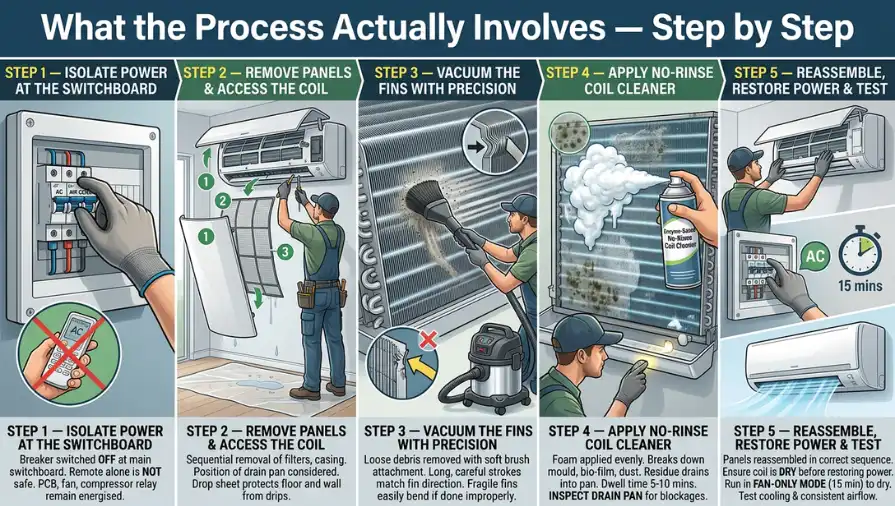
Step 1 — Isolate Power at the Switchboard
The remote control is not enough — the unit stays live until the breaker is off
A qualified technician always switches off the dedicated AC circuit breaker at the main switchboard before touching any internal component. Working on the indoor unit with power active from the remote only is a genuine electrical hazard — the PCB, fan motor, and compressor relay all remain energised.
Step 2 — Remove Panels and Access the Coil
Panel removal sequence matters — especially in ducted systems
The front cover, mesh filters, and inner plastic or metal casing all need to come off in the correct sequence to expose the evaporator coil. In ducted air handlers, this typically requires removing multiple panels in a specific order — and knowing where the drain pan sits relative to the coil before applying anything wet.
A drop sheet is always placed beneath the unit before any cleaner is applied — coil cleaner drips as it works, and the wall and floor below need protection.
Step 3 — Vacuum the Fins With Precision
Surface debris comes off before any chemical cleaner touches the coil
Using a shop vacuum with a soft brush attachment, loose dust, hair, and debris are removed from the coil face in long, careful strokes that follow the fin direction exactly.
This is where most DIY attempts go wrong. The fins are fragile enough that even moderate sideways pressure bends them — and vacuuming across rather than along the fins does exactly that.
A trained technician knows the difference by feel. Most homeowners discover it by accident.
Step 4 — Apply No-Rinse Coil Cleaner
The chemistry does the work — but application needs to be even and controlled
A no-rinse, enzyme-based coil cleaner — such as AerisGuard Indoor Coil Cleaner — is sprayed evenly across the full coil face. The foam reacts with mould, bio-film, dust, and bacteria embedded in the coil surface, breaking them down and carrying the residue into the drain pan below.
The dwell time is 5 to 10 minutes. During this time, the technician also inspects the condensate drain pan for blockages — a blocked pan is the most common cause of water dripping from indoor units in Sydney homes.
Expert Tip: Dark patches or a greenish-grey film on the coil surface before cleaning indicates mould and bio-film — extremely common in Sydney’s humid coastal climate. A single no-rinse application handles mild contamination. Heavy mould growth requires commercial-grade antimicrobial treatment that consumer coil cleaners simply can’t match — another reason significant contamination warrants a professional service rather than a DIY attempt.
Step 5 — Reassemble, Restore Power, and Test
The drying step is non-negotiable before power is restored
Once the cleaner has fully drained and the coil surface is dry, panels are reassembled in the correct sequence, filters are reinstalled, and power is restored at the switchboard.
The system is run on fan-only mode for 15 minutes before switching to cooling — this dries any residual moisture from internal surfaces before the cooling cycle begins and confirms airflow is consistent across all vents.
What Makes Indoor Coil Cleaning Technically Demanding
The environment inside an indoor AC unit is unforgiving of mistakes

Sensitive electronics sit immediately behind the coil
The PCB control board inside your split system or ducted air handler is positioned directly behind or beside the evaporator coil. Any moisture that reaches the board — from over-spraying cleaner, from a high-pressure rinse, or from condensation during reassembly — can cause electrical faults that don’t always appear immediately.
The aluminium fins bend permanently under pressure
The evaporator coil is covered by rows of extremely fine aluminium fins.
A single firm brush stroke in the wrong direction, or light contact with a vacuum nozzle at the wrong angle, bends fins that cannot be straightened without a specialised fin comb tool. Bent fins restrict airflow — defeating the purpose of the clean entirely.
“We regularly service units in Sydney where a homeowner has attempted a coil clean and accidentally bent a section of fins. The unit works after — but never quite as well as it should. The airflow restriction from bent fins is invisible but measurable.”
Conclusion
Understanding what AC coil cleaning actually involves makes it clear why most Sydney homeowners are better served by a professional service than a DIY attempt.
The process isn’t complicated in the hands of someone who does it daily. But the margin for error — bent fins, water near the PCB, incorrect panel sequence, inadequate mould treatment — is narrow enough that the risk of causing more problems than you solve is real.
A professional AC coil clean by Real Time Air Duct Cleaning takes 60–90 minutes, covers every component the DIY process cannot safely reach, and comes with a system performance test before the technician leaves.
