
You can check your home’s indoor air quality yourself using a combination of physical observation, low-cost monitoring devices, and a simple series of room-by-room assessments. For a full picture — including pollutants you can’t see, smell, or detect with basic tools — professional IAQ testing provides lab-grade measurement of specific contaminants including VOCs, CO2, PM2.5, and mould spore counts.
Most Sydney homeowners assume their indoor air is fine because they can’t smell anything wrong. That assumption is consistently inaccurate.
Australia’s State of Indoor Air report 2025 found that indoor air in Australian homes commonly contains pollutant levels that exceed outdoor air — often without any detectable odour or visible sign.
Here is how to check yours — starting with what you can do today, and ending with when you need a professional to take over.
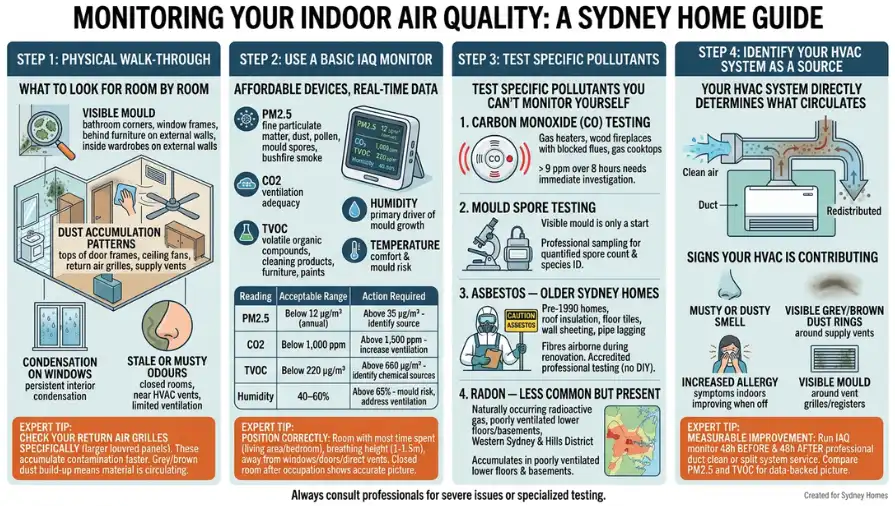
Step 1 — Start With a Physical Walk-Through
The observations that don’t require any equipment at all
Before reaching for a monitoring device, a careful walk-through of your home tells you more than most people realise.
What to look for room by room
- Visible mould — Check corners of bathrooms, around window frames, behind furniture against external walls, and inside wardrobes on external walls. Visible surface mould is always accompanied by airborne mould spores.
- Dust accumulation patterns — Check the tops of door frames, ceiling fans, return air grilles, and supply vents. Heavy dust accumulation at vents means the HVAC system is distributing contamination through the home with every cycle.
- Condensation on windows — Persistent condensation on interior window surfaces indicates high humidity levels — the primary condition for mould growth throughout the home.
- Stale or musty odours — Particularly noticeable in rooms that are closed for extended periods, near HVAC vents, or in areas with limited natural ventilation.
Expert Tip: Check your return air grilles — the larger louvred panels that pull air back into the HVAC system — specifically. These accumulate contamination faster than supply vents and are the first place to show evidence of what’s circulating through your duct system. A grey or brown dust build-up on the return air grille means that same material is being pulled through your air handling unit and redistributed throughout the home.
Step 2 — Use a Basic Indoor Air Quality Monitor
Affordable devices that give real-time data
Standalone IAQ monitors have become significantly more accessible in recent years. A basic device suitable for Sydney home use measures:
- PM2.5 — Fine particulate matter including dust, pollen, mould spores, and bushfire smoke particles
- CO2 — Carbon dioxide levels indicating ventilation adequacy
- TVOC — Total volatile organic compounds from cleaning products, furniture, paints, and building materials
- Humidity — The primary driver of mould growth risk
- Temperature — Relevant to both comfort and mould risk assessment
What the readings mean for Sydney homes
| Reading | Acceptable Range | Action Required |
| PM2.5 | Below 12 µg/m³ (annual) | Above 35 µg/m³ — identify source |
| CO2 | Below 1,000 ppm | Above 1,500 ppm — increase ventilation |
| TVOC | Below 220 µg/m³ | Above 660 µg/m³ — identify chemical sources |
| Humidity | 40–60% | Above 65% — mould risk, address ventilation |
Expert Tip: Position your IAQ monitor in the room where household members spend the most time — typically the main living area or master bedroom — rather than in a hallway or open space. Place it at breathing height (approximately 1–1.5 metres from the floor), away from windows, doors, and direct airflow from vents. Readings taken in a closed room after several hours of occupation give the most accurate picture of what the air quality is like when people are actually present.
Step 3 — Test Specific Pollutants You Can’t Monitor Yourself
The contaminants that require targeted testing
A general IAQ monitor measures common pollutants — but Sydney homes carry specific risks that require dedicated testing beyond what a consumer device provides.
1. Carbon monoxide testing
Carbon monoxide is colourless, odourless, and potentially fatal. Gas heaters, wood fireplaces with blocked or deteriorating flues, and gas cooktops are all sources in Sydney homes.
A standalone CO detector (separate from a smoke alarm) provides continuous monitoring. Any reading above 9 ppm over 8 hours warrants immediate investigation.
2. Mould spore testing
Visible mould on surfaces indicates a larger invisible problem — mould spore counts in air are typically far higher than surface growth suggests. Professional mould air sampling provides a quantified spore count and species identification — critical for homes where occupants are experiencing respiratory symptoms without an obvious cause.
3. Asbestos — older Sydney homes
Sydney homes built before 1990 frequently contain asbestos in roof insulation, floor tiles, wall sheeting, and pipe lagging. Asbestos fibres become airborne during renovation or deterioration.
Any suspicion of asbestos requires accredited professional testing — this is not a DIY assessment.
4. Radon — less common but present
Radon is a naturally occurring radioactive gas that can accumulate in poorly ventilated lower floors and basements. While less prevalent in Sydney than in some other Australian regions, homes in certain geological areas of Western Sydney and the Hills District carry measurable radon risk.
Step 4 — Identify Your HVAC System as a Source
Your air conditioning and duct system directly determines what circulates through your home
The HVAC system is the single biggest determinant of indoor air quality in Sydney homes. A contaminated duct system doesn’t just fail to filter pollutants — it actively distributes mould spores, dust mites, bacteria, and allergens into every room it serves with every cycle.
Signs your HVAC system is contributing to poor IAQ
- Musty or dusty smell when the system runs — even briefly at startup
- Visible grey or brown dust rings around supply vents
- Increased allergy or respiratory symptoms indoors that improve when the system is off
- Visible mould around vent grilles or on supply registers
If any of these are present, checking your air quality without addressing the HVAC system produces incomplete results. The source of contamination needs to be removed — not just measured.
Expert Tip: After any professional duct clean or split system service, run your IAQ monitor for 48 hours before and 48 hours after the service. The before-and-after comparison in PM2.5 and TVOC readings gives you a measurable, data-backed picture of the improvement — and confirms that the service made a real difference to the air your family breathes, not just to the appearance of the vents.
Why Indoor Air Quality Checking Matters Specifically in Sydney
Sydney’s environment creates specific IAQ challenges
Sydney homes face indoor air quality pressures that most Australians underestimate.
Coastal humidity accelerates mould growth inside wall cavities, ceiling spaces, and HVAC ductwork. Bushfire seasons deposit PM2.5 particulate matter that infiltrates homes through gaps, vents, and poorly sealed windows — and lingers long after the smoke clears.
Urban traffic pollution introduces nitrogen dioxide and fine particles at levels that consistently exceed indoor thresholds in inner-city and near-motorway suburbs.
Add older housing stock with limited ventilation, gas appliances, and HVAC systems that haven’t been cleaned in years — and Sydney homes regularly carry pollutant loads that directly affect the health of the people living in them.
“According to Australia’s State of Indoor Air 2025 report, Australians spend approximately 90% of their time indoors — making indoor air quality a primary determinant of respiratory health, not a secondary consideration.”
Conclusion
Checking your indoor air quality in Sydney is not a one-step process. It starts with observation, moves through monitoring, and reaches professional testing when specific contaminants or health concerns require it.
The most important thing most Sydney homeowners can do right now is check their HVAC system — because a contaminated duct system or split system indoor unit is the most consistent source of poor indoor air quality in Australian homes, and it’s the one that affects every room simultaneously.
