

Sydney summers push your ducted air conditioner to its limits. From the humid coast of Bondi to the heat trapped in Western Sydney suburbs like Penrith and Parramatta, running your system hard for months at a time is simply part of life here.
But running it hard doesn’t have to mean running it expensively. The difference between a household spending a manageable amount on cooling and one bleeding money every summer almost always comes down to how the system is used — not just which system they have.
This guide covers everything Sydney homeowners need to know about ducted air conditioning efficiency: what drives it, what kills it, and the practical steps you can take right now to get more out of your system every season.
What Does Ducted Air Conditioning Efficiency Actually Mean?
When we talk about ducted air conditioning efficiency, we’re really talking about how much useful cooling or heating your system delivers for every unit of electricity it consumes.
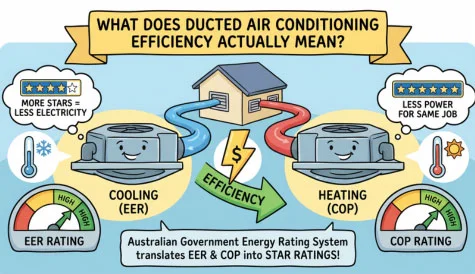
Efficiency is measured using a rating called the Energy Efficiency Ratio (EER) for cooling and the Coefficient of Performance (COP) for heating.
The Australian Government’s Energy Rating system translates these into the familiar star rating you see on new units — the more stars, the less electricity the system needs to do the same job.
Why Efficiency Matters More in Sydney
Sydney’s climate is harder on ducted systems than people realise. Coastal humidity makes the air feel warmer than the actual temperature, which means your system works harder to achieve the same level of comfort.
On top of that, Western Sydney regularly records some of the highest temperatures in greater metropolitan Australia — days above 40°C are common in summer.
All of this means that a system which performs adequately in a milder city may underperform or run continuously in Sydney conditions. Choosing an efficient system and running it correctly isn’t just about saving money — it’s about whether your home actually cools down properly on the days that matter most.

The Biggest Efficiency Drivers for Ducted Systems
Inverter Technology — the Single Most Important Factor
If there is one technology that defines modern ducted air conditioning efficiency, it’s the inverter compressor. Older fixed-speed systems work like a light switch — fully on or fully off.
When the room reaches the target temperature, the compressor cuts out. When it drifts, it kicks back in. This constant cycling wastes energy every time the system restarts.

Inverter systems work differently. The compressor runs continuously but adjusts its speed to match exactly how much cooling or heating is needed at any given moment.
When the room is close to the target temperature, it slows right down and ticks over quietly. When conditions change, it ramps back up smoothly.
The result is a system that can reduce energy consumption by up to 55% compared to older fixed-speed models — and that delivers more consistent, comfortable temperatures throughout your home.
What to Look for in an Inverter System
- Variable speed compressor that modulates output continuously
- A minimum 4-star energy rating under Australian standards
- Smart thermostat compatibility for remote and automated control
- Reverse cycle capability for both heating and cooling efficiency year-round
Zoning — the Most Effective Way to Cut Running Costs
After inverter technology, smart zoning is the most efficient way to run ducted air conditioning in any Sydney home. Zoning divides your home into separate areas — typically 2 to 8 zones depending on the system — and allows you to control the temperature in each one independently.
The logic is simple. If your family is spending the evening in the living area and bedrooms, there’s no reason to cool an empty formal dining room, a study, or a guest bedroom.
Closing those zones and directing airflow only to the rooms in use can reduce running costs by 20 to 30% compared to running the whole home simultaneously.

How to Use Zoning Properly in Sydney
- Daytime: Cool only the main living areas — kitchen, living room, home office if in use
- Evening: Transition cooling to the bedroom zones as the family moves to bed
- Overnight: Keep bedroom zones active on a lower fan speed; close all other zones
- Pre-cooling: In peak summer, run the system before the hottest part of the day (typically 2 to 4pm in Sydney) to get ahead of the heat without the compressor working at maximum load
System Sizing — Getting It Right for Your Home
An incorrectly sized ducted system is one of the most common and most costly efficiency problems in Sydney homes. Both directions cause problems.

An undersized system runs continuously trying to reach a target temperature it can’t achieve. It never shuts down, draws power constantly, and still leaves the home uncomfortable.
An oversized system reaches the target temperature too quickly, shuts off, then the temperature drifts and it kicks back in repeatedly. This short-cycling prevents the system from running in its efficient inverter range and leads to higher energy use than a correctly sized unit would produce.
Correct sizing depends on your home’s floor area, ceiling height, insulation quality, window size and orientation, and the specific climate of your Sydney suburb. A home in Cronulla with good sea breezes has different requirements from an equivalent home in Blacktown with full western sun exposure.
Always have a licensed HVAC technician perform a proper load calculation before installation.
Energy Star Ratings — Reading the Label Correctly
Australia’s Energy Rating label is one of the most useful tools for comparing ducted system efficiency before you buy.
Here’s a quick guide to what the ratings mean in practical terms:
| Star Rating | Efficiency Level | Best suited for |
| 2–3 stars | Basic efficiency | Budget installs, mild climates |
| 4 stars | Good efficiency | Standard Sydney homes |
| 5 stars | High efficiency | Larger homes, high-use households |
| 6+ stars | Premium efficiency | Best long-term running cost savings |
For Sydney homes running their system through a long cooling season, a 5 or 6-star rated inverter system makes financial sense over time. The higher upfront cost is offset by consistently lower running costs across each season.
High-Efficiency Ducted Systems Worth Considering in Sydney
Several brands perform consistently well in Australian conditions, particularly in Sydney’s demanding climate:
1. Daikin

The Premium Inverter series is widely regarded as a benchmark for efficiency and reliability in the Australian market
2. ActronAir

An Australian-designed brand whose AIRES and Advance systems are engineered specifically for local conditions including high humidity and extreme heat
3. Mitsubishi Electric

Known for high static pressure performance, which makes it effective in homes with longer duct runs
4. Midea

A strong option for reliable inverter-driven reverse cycle performance at a competitive price point
Each of these brands offers systems that meet or exceed 4-star ratings, and all support zoning integration with smart controllers.
How Duct Condition Affects Efficiency
This is one of the most overlooked efficiency factors in ducted air conditioning systems — and one of the most important.
Your ducts are the delivery network for every bit of cooling or heating your system produces. If they’re leaking, poorly insulated, or blocked with years of accumulated dust, a significant proportion of that conditioned air never reaches the rooms it’s meant to cool.
Signs Your Ducts May Be Reducing Efficiency
- Some rooms in the house cool significantly better than others
- The system runs for long periods without the home reaching the set temperature
- There are noticeable differences in airflow between vents in different rooms
- Your energy bills have increased without any change in usage habits
Duct leakage is particularly common in older Sydney homes where original ductwork hasn’t been inspected or replaced. A professional duct inspection can identify leaks, collapsed sections, or insulation gaps — all of which directly affect how efficiently your system runs.
Temperature Settings That Actually Save Energy
One of the most effective and immediate ways to improve ducted air conditioning efficiency is simply adjusting how you set the thermostat.
Recommended Settings for Sydney Homes
- Summer cooling: Set between 24°C and 26°C — every degree lower than this increases energy consumption by approximately 5 to 10%
- Winter heating: Set between 18°C and 20°C — every degree above this adds a similar energy penalty
- Sleep mode: Many modern systems have a sleep or night mode that gradually adjusts the temperature by 1–2 degrees after you fall asleep, reducing energy use while maintaining comfort
- Away from home: Rather than turning the system off completely in summer, set it to 28°C — it takes significantly more energy to cool a superheated house from scratch than to maintain a moderate temperature throughout the day
Maintenance — the Efficiency Factor Most People Ignore
A well-maintained ducted system runs noticeably more efficiently than a neglected one. Dust and debris build up inside filters, coils, and duct interiors over time, restricting airflow and forcing the system to work harder to move the same volume of air.
Ducted AC Maintenance Schedule for Sydney Homes
What You Can Do Yourself
- Filter cleaning: Every 4 to 6 weeks during periods of heavy use — Sydney’s coastal and urban dust loads filters faster than in drier cities
- Return air grille inspection: Check for blockages or dust buildup around ceiling grilles monthly
- Outdoor unit clearance: Keep the outdoor condenser unit free of leaves, debris, and vegetation — at least 50cm of clear space on all sides
What Requires a Professional
- Full system service: Every 12 to 18 months — covers coil cleaning, refrigerant check, electrical inspection, and airflow testing
- Duct inspection: Every 3 to 5 years, or sooner if you notice rooms cooling unevenly
- System performance test: Annual check to confirm the system is operating within its rated efficiency range
The ideal time to book a professional service in Sydney is spring — September to October — before the summer cooling season begins and before technicians become booked out.
Home Improvements That Boost Ducted AC Efficiency
The most efficient ducted air conditioning system in the world will still struggle if it’s fighting against a poorly insulated, poorly shaded home. A few targeted home improvements can meaningfully reduce the load on your system.
Insulation
Adequate ceiling and wall insulation is the single highest-impact home improvement for ducted AC efficiency. Insulation keeps the cool air your system produces inside the home for longer, reducing how frequently the system needs to run to maintain the set temperature.
Window Treatments
- External awnings or shade sails on north and west-facing windows reduce heat gain dramatically during Sydney summers
- Heavy blockout curtains or cellular blinds trap cool air inside and prevent radiant heat from entering through glass
- Reflective window film on west-facing windows can reduce solar heat gain by up to 70%
Draught Proofing
Gaps under doors, around windows, and at penetration points in the ceiling (light fittings, exhaust fans) allow conditioned air to escape and hot outside air to enter. Sealing these gaps is inexpensive and has an immediate impact on how long your ducted system needs to run to maintain temperature.
Frequently Asked Questions Ducted Air Conditioning Efficiency In Sydney
1. Is ducted air conditioning efficient for large Sydney homes?
Yes — for homes with multiple rooms in regular use, ducted systems with smart zoning are typically more energy-efficient than running multiple split systems simultaneously. The efficiency advantage grows the more rooms you’re conditioning at once.
2. What is the most efficient way to run ducted air conditioning in summer?
Use zoning to cool only occupied areas, set the thermostat between 24°C and 26°C, pre-cool before the hottest part of the day, and keep blinds closed on sun-facing windows. These habits together produce a significantly lower energy bill than running the system on full output all day.
3. How often should I service my ducted AC in Sydney?
A professional service every 12 to 18 months is recommended for Sydney homes. Filter cleaning should happen every 4 to 6 weeks during heavy use.
Sydney’s coastal air and urban dust load systems faster than drier inland cities, so erring toward more frequent maintenance pays off.
4. Does duct leakage really affect my running costs?
Yes, significantly.
Leaking ducts can waste 20 to 30% of the conditioned air your system produces before it ever reaches the rooms. If some rooms consistently fail to reach temperature, a duct inspection is worth doing before assuming the system itself needs replacing or upgrading.
5. Are older ducted systems worth repairing or should I replace them?
Systems older than 10 to 15 years are typically running at a fraction of their original efficiency and lack modern features like variable-speed inverters and smart zoning. In most cases, upgrading to a modern high-star-rated inverter system delivers running cost savings significant enough to justify the replacement over a 3 to 5 year horizon.
6. Does home insulation actually make a difference to ducted AC efficiency?
Absolutely.
Ceiling insulation in particular has a major impact on how long a ducted system needs to run to maintain a set temperature. In Sydney’s climate, adequate insulation combined with window shading can reduce the cooling load on your system by 30 to 40% compared to an uninsulated home of the same size.
Conclusion
Running ducted air conditioning efficiently in Sydney isn’t a single decision — it’s a combination of the right system, the right settings, the right habits, and the right maintenance routine.
The homes that consistently spend less on cooling aren’t always the ones with the newest systems. They’re the ones where the zoning is set up thoughtfully, the filters are cleaned regularly, the thermostat is set to a sensible temperature, and the ducts are in good condition.
Those things together make a far bigger difference than any one factor alone.
Start with what you can control today — your temperature settings, your zoning schedule, and when you last had the system serviced. Then, when it’s time to upgrade, you’ll know exactly what to look for.
For a professional assessment of your ducted system’s efficiency, including duct condition inspection and load calculation, contact a licensed HVAC technician in Sydney. A system running below its rated performance can often be restored to near-new efficiency with targeted servicing — before a full replacement becomes necessary.
