

That small fan sitting in your bathroom ceiling — the one you probably haven’t thought about in months — might be the reason mould keeps coming back no matter how many times you clean the tiles.
Most Sydney homeowners don’t connect the dots between a dirty exhaust fan and the black mould creeping around the shower recess or across the bathroom ceiling. But that connection is direct, well-established, and genuinely worth understanding.
A clogged, dust-choked exhaust fan can’t do its job. And when it can’t do its job, your bathroom becomes a warm, damp, poorly ventilated environment — exactly what mould needs to thrive.
Here’s the full picture: why dirty exhaust fans cause mould in Sydney homes, what other damage they cause, and exactly how to fix the problem.
Why Exhaust Fans Matter So Much in Sydney
Sydney’s climate — warm, humid summers with plenty of coastal moisture — means bathrooms and kitchens generate significant amounts of steam and airborne moisture every single day.
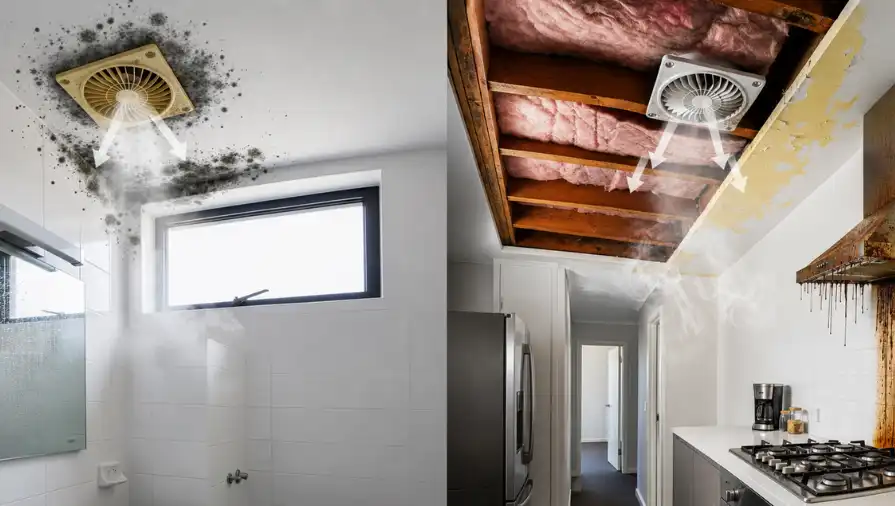
Sydney apartments and homes are especially prone to ventilation issues. A blocked or poorly functioning exhaust fan doesn’t just reduce comfort — it can lead to serious health and property problems including mould spores spreading through the home, grease build-up in kitchen exhaust fans becoming a fire hazard, and excess moisture damaging ceilings, walls, and fixtures over time.
Your exhaust fan is the only mechanical barrier between all that daily steam and moisture — and your walls, ceiling, and structural timbers absorbing it. When the fan is clean and working properly, moisture is removed efficiently. When it’s clogged with dust and grime, that moisture has nowhere to go.
How a Dirty Exhaust Fan Causes Mould — The Mechanism
This is the part that most people don’t fully understand, so it’s worth explaining clearly.
A clear sign that your fan needs attention is when it no longer effectively removes steam from the room. This can lead to increased humidity and potential mould growth, making it crucial to ensure the fan is functioning properly.
Here’s exactly what happens inside a neglected exhaust fan — and how it turns your bathroom into a mould factory.
Step 1 — Dust Clogs the Fan Cover and Blades

Every time your exhaust fan runs, it pulls air through a grille and across rotating blades. Dust, lint, dead skin cells, hairspray residue, and airborne particles from cleaning products all get pulled toward the fan — and a significant portion of them stick to the cover, blades, and housing rather than passing through.
Over months, that layer of dust becomes thick enough to noticeably restrict airflow. The fan still runs — you can still hear it — but it’s operating at a fraction of its designed capacity.
Step 2 — Reduced Airflow Traps Moisture

When a bathroom exhaust fan is clogged due to a thick layer of dust, it can’t remove the bathroom’s moisture properly. As a result, it creates an ideal environment for mould and mildew.
Bathroom humidity can easily exceed 80–90% during a hot shower.
A properly functioning exhaust fan brings that down to safe levels within minutes of you finishing. A dust-clogged fan barely makes a dent — leaving moisture suspended in the air long after you’ve left the room.
Step 3 — Mould Establishes and Spreads

Dust and dirt accumulate on fan blades over time.
When the fan is in operation, this dust can be dispersed into the air. If the dust contains mould spores or bacteria, these particles can be spread throughout the room, contributing to indoor air pollution.
Mould spores are always present in the air — they’re just waiting for the right conditions to germinate. Sustained high humidity above 60% is exactly what they need.
A dirty exhaust fan doesn’t just fail to prevent mould — it actively helps create the conditions where mould can’t be stopped.
“40% of Australians are inherently allergic. Allowing bathroom humidity to exceed 60% — which a dirty exhaust fan makes inevitable — creates fungal growth that directly triggers those allergies.”
The Other Dangers of a Dirty Exhaust Fan in Sydney Homes
Mould is the most visible consequence of a neglected exhaust fan — but it’s not the only one.
1. Fire Risk — The Danger Nobody Talks About
How Dust Buildup Creates a Fire Hazard
A fan packed with dust blanks its blades and forces the motor to work harder. Older models without built-in thermal cut-outs can overheat and ignite.
Dirt grinds the bearings, wearing out the motor long before its time. A dirty or clogged fan can pose a fire hazard due to the buildup of dust and debris.
In kitchen exhaust fans, this risk is compounded by grease. Kitchen exhaust fans collect grease from cooking, which can be harder to remove if left for too long.
Grease-coated fan components near a heat source is a fire hazard that no Sydney homeowner should ignore.
Warning Signs of Overheating
- The fan feels unusually hot to touch after running
- You notice a burning or electrical smell during or after use
- The fan makes grinding or straining sounds
- The fan cuts out mid-operation unexpectedly
If any of these signs appear, stop using the fan and call an electrician immediately.
2. Structural Damage to Your Home
What Trapped Moisture Does to Sydney Homes Over Time
When exhaust fans can’t remove moisture effectively, that moisture has to go somewhere. It absorbs into:
- Ceiling plasterboard — which softens, sags, and eventually requires replacement
- Wall paint and surfaces — bubbling, peeling paint is often the first visible sign
- Timber framing — long-term moisture exposure causes rot in structural timbers
- Silicone sealant around showers and baths — deteriorates faster in sustained high humidity
- Grout between tiles — becomes discoloured and porous, allowing further moisture penetration behind tiles
In Sydney apartments — particularly older blocks in the Inner West, Eastern Suburbs, and North Shore — this kind of moisture damage is extremely common and very expensive to remediate.
3. Indoor Air Quality and Health Effects
What Breathing Mould-Contaminated Air Does
Mould can cause respiratory infections, nasal congestion, sneezing, eye irritation, skin rashes, eczema, and other fungal infections. Mould can also cause chronic asthma and allergies.
For Sydney’s significant asthma population, a bathroom with consistently poor ventilation isn’t just uncomfortable — it’s a genuine health trigger in the room they use multiple times every day.
Signs Your Exhaust Fan Needs Cleaning Right Now
Don’t wait for mould to appear before taking action. Your exhaust fan gives you early warning signals if you know what to look for.
Key Warning Signs at a Glance
| Warning Sign | What It Means |
| Visible dust on the fan cover or grille | Cleaning is well overdue — airflow is already restricted |
| Steam or condensation lingers after shower | Fan isn’t removing moisture effectively |
| Mould forming around the fan housing | Fan performance is failing — moisture is trapped |
| Unusual sounds — grinding, rattling, straining | Dust is affecting motor and bearings |
| Fan runs but barely moves air | Blades and housing are severely clogged |
| Burning or musty smell when fan runs | Overheating or mould inside the housing |
| Bathroom mirror takes a long time to clear | Humidity isn’t dropping fast enough |
Unusual odours emanating from the fan could be due to dust, dirt, or even mould accumulating inside the unit. These odours are not only unpleasant but can also be harmful to your health.
How to Clean a Dirty Exhaust Fan — Step-by-Step for Sydney Homes
The good news: regular exhaust fan cleaning is straightforward and something most Sydney homeowners can handle themselves.
What You’ll Need
- Screwdriver (flathead or Phillips depending on your fan)
- Vacuum cleaner with crevice and brush attachments
- Bucket with warm water (40–50°C)
- Mild dish soap or laundry detergent
- Degreaser spray for kitchen fans
- Soft brush or old toothbrush
- Microfibre cloths
- Dry towel
Step-by-Step Cleaning Process
Step 1 — Switch Off the Power
This is non-negotiable. Turn off the fan at the wall switch and switch off the circuit breaker at your switchboard. Never work on any electrical fixture with the power on.
Step 2 — Remove the Fan Cover
Most bathroom exhaust fan covers are clipped in and can be pulled away from the wall easily. If the vent cover is screwed on, you’ll need a screwdriver.
After removing the fan cover, soak it in your cleaning solution for 15–20 minutes to loosen any caked-on grime.
Prepare your cleaning solution: warm water at 40–50°C with a generous squeeze of dish soap. For kitchen fans, add a cup of white vinegar or use a dedicated degreaser to cut through grease buildup.
Step 3 — Vacuum the Fan Blades and Housing
With the cover off, use your vacuum’s brush attachment to gently remove dust from the fan blades and motor. Be cautious not to dislodge any wiring or components.
Work carefully — the goal is to remove loose dust before wiping, so it doesn’t get pushed deeper into the housing.
Step 4 — Wipe Down Blades and Interior Housing
Using a damp microfibre cloth with a small amount of soapy water, wipe down each blade and the interior housing.
For stubborn grime, use the soft brush or toothbrush to work into tight spaces. Never spray liquid directly into the fan motor.
Step 5 — Clean and Rinse the Cover
Remove the soaked cover from your cleaning solution.
Scrub with the soft brush to remove any remaining residue. Rinse thoroughly with clean water and dry completely with a towel before reattaching.
Step 6 — Clear the Duct Opening
The vent linking your bathroom exhaust fan to the outdoors can get clogged with dust and debris, cutting down on airflow and efficiency. Use your vacuum cleaner’s hose attachment to reach into the vent and clear any build-up.
Step 7 — Reassemble and Test
Reattach the dry cover, restore power at the switchboard, and test the fan.
Hold a sheet of tissue paper near the grille — it should be pulled firmly toward the fan when running. Weak suction means the ductwork may also need professional attention.
How Often Should You Clean Exhaust Fans in Sydney?
Frequency matters. And Sydney’s humid climate means more regular attention than drier parts of Australia.
| Fan Type | Quick Clean (Cover Wipe) | Full Cover-Off Clean | Professional Service |
| Bathroom exhaust fan | Monthly | Every 3–6 months | Every 1–2 years |
| Kitchen exhaust fan / rangehood | Monthly | Every 3 months | Annually |
| Laundry exhaust fan | Every 2–3 months | Every 6 months | Every 2 years |
| High-use bathrooms (family of 4+) | Fortnightly | Every 3 months | Annually |
If you shower or use your bathroom daily, deep clean the bathroom exhaust fan every 3 to 6 months. Do a quick dust and wipe every month. For less-used bathrooms, clean the exhaust fan at least once a year.
After Sydney dust storms — which carry fine red dust that can penetrate fan housings and damage motors — always check your exhaust fans immediately and clean if needed.
DIY vs Professional Exhaust Fan Cleaning — When to Call in the Experts
| Factor | DIY Cleaning | Professional Service |
| Accessibility | Good for standard ceiling fans | Essential for hard-to-reach or ducted systems |
| Grease removal | Manageable with degreaser | Superior for heavy commercial-grade grease |
| Mould treatment | Surface-level only | Sanitisation and antimicrobial treatment |
| Motor inspection | Not possible | Full motor check and lubrication |
| Ductwork cleaning | Limited — vacuum attachment only | Full duct inspection and clearing |
| Cost | Low — DIY supplies only | Higher — but prevents expensive damage |
| Safety | Safe for standard units with power off | Required for complex or commercial systems |
When You Should Always Call a Professional
If there is excessive mould growth around the fan housing, if the motor is overheating or not working properly, or if you’re uncomfortable handling electrical components — professional cleaning is required. Experts recommend professional cleaning at least once every 1–2 years for optimal performance.
Call a professional exhaust fan cleaning service in Sydney specifically when:
- Mould is visible inside the fan housing — not just on the surface
- The fan makes unusual sounds even after cleaning
- You smell burning or electrical odour from the unit
- The fan is installed in a location that requires ladder access above safe DIY height
- You have a commercial kitchen with significant grease buildup
- The ductwork runs through the ceiling and may be partially blocked
Frequently Asked Questions Mould in Exhaust Fan in Sydney
1. Can a dirty exhaust fan cause mould in a Sydney bathroom?
Yes — directly.
A clogged exhaust fan cannot remove steam and moisture effectively after showering. The sustained high humidity this creates provides exactly the conditions mould needs to germinate and spread.
Regular dirty exhaust fan cleaning is the most effective way to prevent bathroom mould in Sydney homes.
2. Is a dirty exhaust fan a fire hazard?
Yes.
Dust buildup on fan blades forces the motor to work harder and run hotter. Without adequate thermal protection, this can cause overheating.
In kitchen exhaust fans, accumulated grease near heat sources is a direct fire risk. A burning smell or unusually hot fan are warning signs requiring immediate attention.
3. What are the signs my exhaust fan needs cleaning?
Key signs include visible dust on the cover or grille, steam lingering in the bathroom long after showering, mould forming near the fan housing, unusual sounds from the motor, a musty or burning smell when running, and noticeably weak airflow.
Conclusion
A dirty exhaust fan is one of the most overlooked maintenance issues in Sydney homes — and one of the most consequential.
It’s the direct cause of persistent bathroom mould. It’s a structural moisture problem waiting to happen. And in its worst state, it’s a fire hazard sitting in your ceiling.
The fix is straightforward: clean your exhaust fan covers monthly, do a full cover-off clean every three to six months, and book a professional service every one to two years. In Sydney’s humid climate, that maintenance schedule isn’t excessive — it’s the minimum that keeps your home genuinely protected.
And if mould is already appearing around your fan housing, don’t just clean the tiles and hope for the best. The fan is the source. Fix the source.
