
If there’s a dead animal stuck in your Sydney chimney, do not light a fire and do not attempt DIY removal. Call a licensed Sydney pest control service or chimney specialist immediately — they will locate, extract, sanitise, and deodorise the area safely.
The longer you leave it, the worse it gets.
Decomposition begins within hours, the smell intensifies rapidly, and the carcass attracts secondary pests — flies, maggots, and rodents — into your home. This is not a problem that resolves itself.
When an animal dies in or near your home, several problems arise almost immediately — foul odour from the decomposition process, health hazards from bacteria, maggots, and disease-carrying pests, and secondary infestations that follow the carcass.
“A dead animal in your chimney isn’t just unpleasant — it’s a genuine health hazard that needs professional attention, not a wait-and-see approach.”
What Animals Commonly Get Stuck in Sydney Chimneys?
Sydney’s urban wildlife is diverse — and chimneys are surprisingly attractive entry points for several species.
Common Chimney Intruders in Sydney
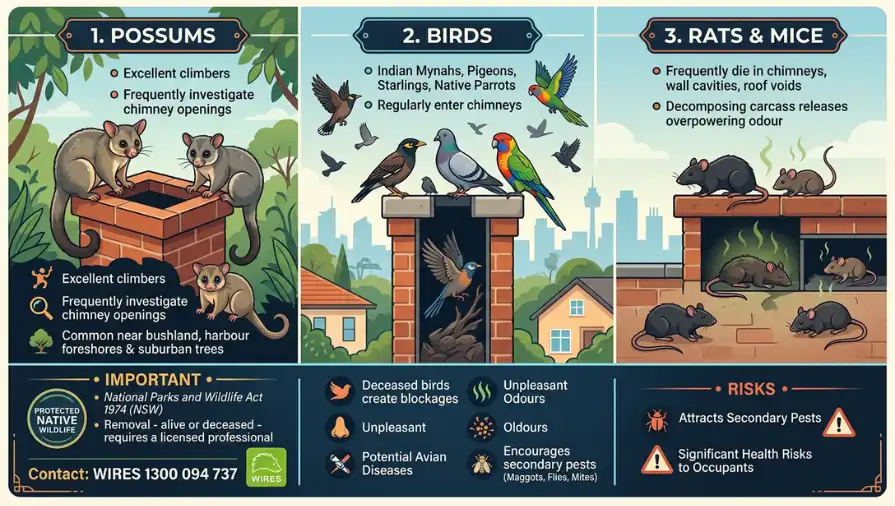
1. Possums
Possums coming down chimneys is a documented and common occurrence in Sydney homes. They are curious, excellent climbers, and frequently investigate chimney openings — particularly in homes near bushland, harbour foreshores, and suburban tree corridors.
Important: Possums are protected native wildlife under the National Parks and Wildlife Act 1974 (NSW). Their removal — alive or deceased — requires a licensed professional. WIRES (1300 094 737) should be contacted for any native wildlife situation.
2. Birds
Indian mynahs, pigeons, starlings, and native parrots all regularly enter chimneys across Sydney’s suburbs. Dead birds in chimneys create blockages, unpleasant smells, and potential health hazards — and dead birds can spread avian diseases and encourage secondary maggot, fly, and mite infestations.
3. Rats and Mice
Rodents frequently die in chimneys, wall cavities, and roof voids. The decomposing carcass releases an overpowering odour and attracts a host of secondary pests, posing significant health risks to occupants.
Signs There’s a Dead Animal in Your Chimney
You don’t always see it — but your nose and your home tell you clearly.
Warning Signs to Watch For

- Persistent foul smell from the fireplace or flue — intensifying rather than clearing over days
- Smell that worsens when you open the damper or fireplace door
- Flies appearing near the fireplace without explanation
- Buzzing or insect sounds from inside the flue
- Visible staining on the firebox walls from decomposition fluid
- Reduced draft when using the fireplace — carcass causing blockage
Expert Tip: A smell that worsens significantly when warm weather arrives — or when you open the damper — almost certainly means a decomposing animal inside the flue, not a general chimney odour issue.
What to Do Immediately When an Animal Is Stuck in Your Sydney Chimney

Step 1 — Do Not Light a Fire
This is the most important rule. Lighting a fire with a dead animal in the flue does not remove the problem — it spreads burning organic matter and hazardous smoke throughout your home.
The smell becomes dramatically worse and the health risk multiplies.
Step 2 — Do Not Attempt DIY Removal
Dead animals in chimneys are difficult to locate without professional help, and attempting removal without proper equipment and protective gear creates serious contamination and health risks.
Reaching blindly into a flue — even with gloves — risks contact with decomposition fluid, disease-carrying parasites, and biological hazards. Leave it to someone equipped to handle it safely.
Step 3 — Ventilate the Room
Open windows in the room with the fireplace while you wait for professional assistance. This reduces the concentration of odour and any airborne particles entering the living space.
Step 4 — Call the Right Professional
Who to Call in Sydney
| Situation | Who to Call |
| Dead possum or native wildlife | WIRES — 1300 094 737 |
| Dead bird, rat, or unknown animal | Licensed Sydney pest control service/Real Time Air Duct Cleaning |
| Chimney blockage or structural issue | Sydney chimney service specialist/Real Time Air Duct Cleaning |
| Emergency same-day removal | 24/7 pest control — multiple Sydney providers |
Expert Tip: Always confirm the pest control technician is licensed under NSW Fair Trading and carries public liability insurance before allowing any chimney work.
What a Professional Dead Animal Chimney Removal Covers
A professional dead animal removal service includes inspection to locate the source of the odour or carcass, safe removal, disinfection of the affected area to prevent bacteria and secondary pests, and odour neutralisation using eco-friendly deodorisers.
A thorough professional service for your chimney specifically should include:
- Carcass location and extraction — using specialist tools to safely remove the animal without contaminating the firebox or living area
- Sanitisation of the flue — killing bacteria, parasites, and biological matter left behind
- Odour neutralisation — professional-grade deodoriser applied throughout the affected area
- Chimney inspection — confirming no structural blockage or damage remains
Health Risks of a Dead Animal in Your Chimney
This is not a situation to delay acting on. The health consequences of a decomposing animal in an enclosed chimney space are real and progressive.
The carcass and its bodily fluids can contain harmful bacteria and pathogens, posing a direct health risk. A dead animal is a breeding ground for flies, maggots, and carrion beetles, and can attract other scavengers like rodents.
Specific risks include:
- Bacterial contamination from decomposition fluids entering the living space via the fireplace
- Airborne pathogens from decomposing bird carcasses — avian disease risk
- Fly and maggot infestation spreading beyond the chimney
- Secondary rodent attraction — rats follow the scent of decomposition
- Ongoing indoor air quality degradation if the carcass remains unaddressed
How to Prevent Animals Getting Stuck in Your Chimney Again
Once the immediate problem is resolved, prevention is straightforward — and far easier than dealing with another carcass.

1. Install a Quality Chimney Cap or Bird Guard
Install sturdy mesh over all vents, flues, and chimneys to block entry by birds, possums, and rats.
A heavy-duty stainless steel bird guard cowl fitted by a Sydney chimney professional prevents virtually all future animal entry. For coastal suburbs — Bondi, Manly, Cronulla — marine grade 316 stainless is the right material choice for longevity against salt air corrosion.
2. Trim Trees Near the Chimney
Cut back tree limbs that provide an easy bridge for possums and rodents to access your roof. Sydney’s common ringtail and brushtail possums are exceptional climbers — overhanging branches directly above or near the chimney are the most common access route.
3. Schedule Regular Chimney Inspections
An annual chimney inspection — ideally before winter — catches any damage to existing caps or guards before animals exploit the gap. A cracked cowl or missing mesh section that goes unnoticed through autumn becomes a wildlife entry point by winter.
Expert Tip: After any professional animal removal, always request a post-service chimney cap inspection — the same gap the animal entered through must be sealed before the job is truly finished.
Frequently Asked Questions About Dead Animal in Chimney
1. How do I know if there’s a dead animal in my chimney and not just a general smell?
A dead animal smell intensifies over days rather than clearing, worsens when the damper is opened, and is often accompanied by flies appearing near the fireplace without explanation.
2. Can I light a fire to get rid of the dead animal smell in my chimney?
Never — burning with a carcass in the flue spreads hazardous smoke and decomposing material through your entire home, making the problem dramatically worse.
3. Who do I call for a dead possum in my chimney in Sydney?
Call WIRES on 1300 094 737 for guidance on native wildlife, and a licensed Sydney pest control service for safe extraction and sanitisation.
4. How long does a dead animal smell last in a chimney without removal?
Without professional extraction, the decomposition odour can persist for several weeks and attracts secondary pests including flies, maggots, and rodents throughout that period.
5. Is a dead animal in my chimney a health hazard?
Yes — decomposing carcasses carry harmful bacteria, parasites, and pathogens and attract secondary pests that spread contamination beyond the chimney into your living space.
6. How do I stop animals from getting stuck in my chimney again?
Have a licensed chimney professional install a heavy-duty stainless steel bird guard cowl immediately after removal — this prevents re-entry by possums, birds, and rodents permanently.
Conclusion
If there’s a dead animal stuck in your Sydney chimney — stop, don’t light anything, open the windows, and call a licensed professional today.
The smell is unbearable, the health risks are genuine, and it gets significantly worse with every day of delay.
Professional removal, sanitisation, and chimney cap installation is the complete solution — and the cap installation at the end is what prevents you from dealing with the same problem again next winter.
