
Professional commercial duct cleaning in Sydney improves indoor air quality, reduces staff sick leave, lowers energy consumption, extends HVAC equipment lifespan, eliminates persistent odours, and ensures your property meets Australian safety and hygiene compliance requirements — all from a single scheduled service.
Most Sydney business owners and property managers think about their commercial duct system only when something visibly goes wrong. By that point — a musty smell, a spike in energy bills, or a wave of staff health complaints — the contamination has typically been building for months or years.
The real value of professional commercial duct cleaning is what it prevents, not just what it fixes. Here is exactly what a properly cleaned commercial duct system does for a Sydney business.
The 6 Key Benefits of Commercial Duct Cleaning for Sydney Businesses
Benefit 1 — Measurably Better Indoor Air Quality
The foundation benefit that drives every other outcome
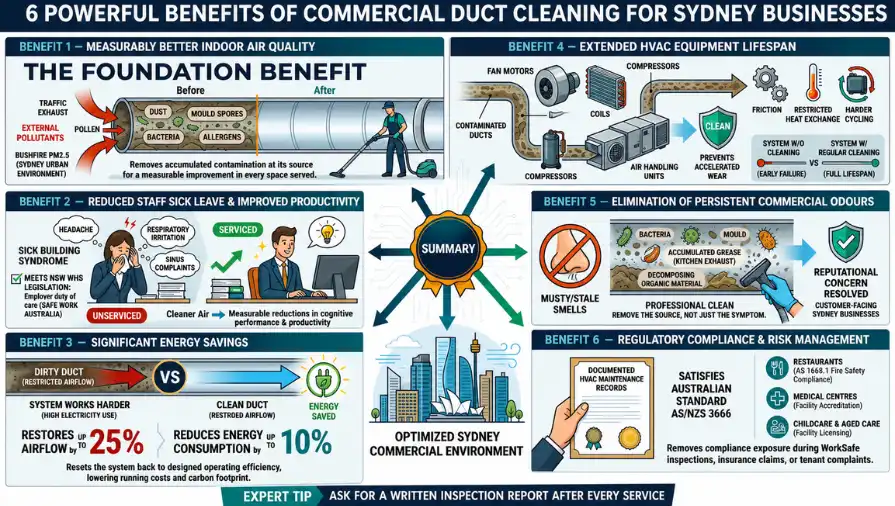
Commercial duct systems accumulate dust, mould spores, bacteria, allergens, and fine particulate matter — all of which circulate through the building with every HVAC cycle. In Sydney’s urban environment, outdoor pollutants including traffic exhaust, pollen, and during bushfire seasons, PM2.5 particles — enter the system and compound the internal contamination.
A professional commercial duct clean removes this accumulated contamination at its source. The result is a measurable improvement in the air quality of every space the duct system serves — not just the rooms nearest the air handling unit.
Benefit 2 — Reduced Staff Sick Leave and Improved Productivity
The business case that most Sydney employers don’t connect to their HVAC system
Poor indoor air quality is a direct contributor to what occupational health researchers call Sick Building Syndrome — a pattern of headaches, fatigue, respiratory irritation, and sinus complaints that improve when employees leave the building.
Safe Work Australia recognises poor indoor air quality as a workplace health and safety issue under NSW WHS legislation. Employers have a duty of care to maintain a safe working environment — and a contaminated HVAC system circulating bacteria, mould spores, and allergens through the office is a direct breach of that standard.
Expert Tip: If your Sydney business has seen an increase in unexplained sick days, respiratory complaints, or headaches reported by staff — particularly complaints that consistently improve on weekends or during annual leave — your commercial duct system is the first place to investigate. It’s the single most common overlooked source of workplace air quality problems in Sydney offices.
The productivity connection
Studies consistently link poor indoor air quality to measurable reductions in cognitive performance and productivity. Cleaner commercial air means a more focused, more comfortable, and more productive workforce — an outcome that compounds over the full working year.
Benefit 3 — Significant Energy Savings
Dirty ducts cost more to run than clean ones — measurably
Dust and debris accumulated inside commercial ductwork restricts airflow. When airflow is restricted, the HVAC system works harder to maintain the programmed temperature output — consuming more electricity to achieve the same result.
Removing blockages from commercial duct systems restores airflow by up to 25%, with corresponding reductions in energy consumption of up to 10%. For a Sydney commercial building running air conditioning for 10 to 12 hours a day through summer, that efficiency gain represents a meaningful reduction in operating costs across the season.
The compounding effect
A system that runs dirty doesn’t just use more electricity today. It continues degrading over time — each month of uncleaned operation adding more restriction and more inefficiency to a compounding cycle.
A professional clean resets the system back to its designed operating efficiency, stopping the degradation cycle before it reaches critical levels.
Benefit 4 — Extended HVAC Equipment Lifespan
Protecting a significant capital investment
Commercial HVAC systems represent a substantial capital investment for any Sydney business or building owner. Fan motors, coils, compressors, and air handling units all experience accelerated wear when operating through contaminated ductwork.
Dust and debris increase friction on moving components, restrict heat exchange across coils, and force compressors to cycle harder and more frequently than designed. The cumulative effect is a system that fails years before its designed lifespan — at a replacement cost that professional cleaning would have prevented.
Expert Tip: Ask your commercial duct cleaner to provide a written inspection report after every service. This report documents the condition of the duct interior, any areas of concern identified during cleaning, and the components inspected. That record becomes your maintenance history — and it’s exactly what insurance companies and building assessors ask for when evaluating a commercial HVAC system’s condition.
Benefit 5 — Elimination of Persistent Commercial Odours
Musty, stale, or unidentifiable smells that surface cleaning never fixes
Persistent odours in commercial spaces — particularly the musty or stale smell that seems to appear whenever the air conditioning starts up — almost always originate inside the duct system.
Bacteria, mould, accumulated grease in kitchen exhaust ducts, and decomposing organic material embedded in duct debris all produce odours that circulate continuously as long as the source remains in the system. No amount of surface cleaning, air freshener, or ventilation addresses an odour that is being actively generated and distributed by the HVAC system itself.
A professional commercial duct clean removes the source — not just the symptom. For customer-facing Sydney businesses including retail stores, restaurants, medical practices, and offices, a persistent indoor odour is a direct reputational concern that a duct clean resolves at the root level.
Benefit 6 — Regulatory Compliance and Risk Management
The compliance benefit Sydney commercial property owners cannot afford to overlook
Australian Standard AS/NZS 3666 sets out mandatory requirements for the maintenance and hygiene of air handling systems in commercial buildings. Building owners and facilities managers who cannot produce documented HVAC maintenance records are exposed to compliance risk — particularly in the event of a WorkSafe inspection, an insurance claim, or a tenant health complaint.
For specific commercial property types, the compliance requirements are even more stringent:
- Restaurants and commercial kitchens — AS 1668.1 requires regular cleaning of kitchen exhaust ducts for fire safety compliance
- Medical centres and clinics — HVAC hygiene standards are part of facility accreditation requirements
- Childcare and aged care facilities — Indoor air quality is directly regulated under facility licensing conditions
A professional commercial duct clean with documented reporting satisfies the maintenance record requirement across all of these property types — removing the compliance exposure that an undocumented or unserviced system creates.
Expert Tip — How Sydney Businesses Should Structure Their Cleaning Schedule
The most effectively managed commercial properties in Sydney don’t treat duct cleaning as a reactive response to problems. They operate on a documented schedule matched to their building type — and they request a written inspection report after every service.
That report is their compliance record, their maintenance history, and their evidence of due diligence if any occupant health concern is ever raised. The businesses that call us after a staff complaint or a WorkSafe visit always wish they had implemented a schedule years earlier.
Recommended cleaning frequencies for Sydney commercial properties:
- Standard office building — every 1–2 years
- Restaurant or commercial kitchen — every 3–6 months
- Medical centre or clinic — every 6–12 months
- Childcare or aged care facility — every 6–12 months
- Retail tenancy (high foot traffic) — every 12–18 months
How Often Should Sydney Commercial Buildings Clean Their Ducts?
Sydney businesses should schedule commercial HVAC maintenance annually or semi-annually and perform commercial air duct cleaning to prevent dust and allergen buildup.
Recommended Cleaning Frequency by Building Type
- Standard offices — CBD and suburban Sydney: Annually as a minimum
- High-traffic retail and hospitality venues: Every six months
- Medical and healthcare facilities: Every three to six months — stricter air quality standards apply
- Post-renovation — any commercial building: Immediately following any construction or fitout work
- Buildings with no cleaning records: Treat as overdue — inspect and clean immediately
Conclusion
For Sydney businesses, professional commercial duct cleaning is not a maintenance expense — it is an operational investment that pays returns in staff health, energy efficiency, equipment longevity, and compliance standing.
The longer a commercial duct system goes without a professional clean, the more each of these factors degrades — and the more it costs the business in ways that rarely get attributed to the HVAC system until the connection becomes impossible to ignore.
Real Time Air Duct Cleaning services commercial properties across all of Sydney — offices, restaurants, medical centres, retail tenancies, and large commercial facilities — with flexible after-hours scheduling and full written documentation.
