

If your Sydney home was built before 1990, there’s something you need to know before you turn your heating on, book a duct clean, or start any renovation work near your HVAC system.
It might contain asbestos.
Not might as in “remotely possible.” Might as in genuinely, statistically likely — because one in three Australian homes still contains asbestos materials, and HVAC systems in older properties are one of the places nobody thinks to check.
Despite being banned more than two decades ago, asbestos continues to kill more than 4,000 Australians every year — a staggering 300 percent higher than the annual road toll. Most of those deaths trace back to exposure that happened years or even decades earlier, in buildings and homes where asbestos was simply part of everyday construction.
Your air ducts could be part of that story. Here’s what you need to know.
Why Older Sydney Homes Are at Risk
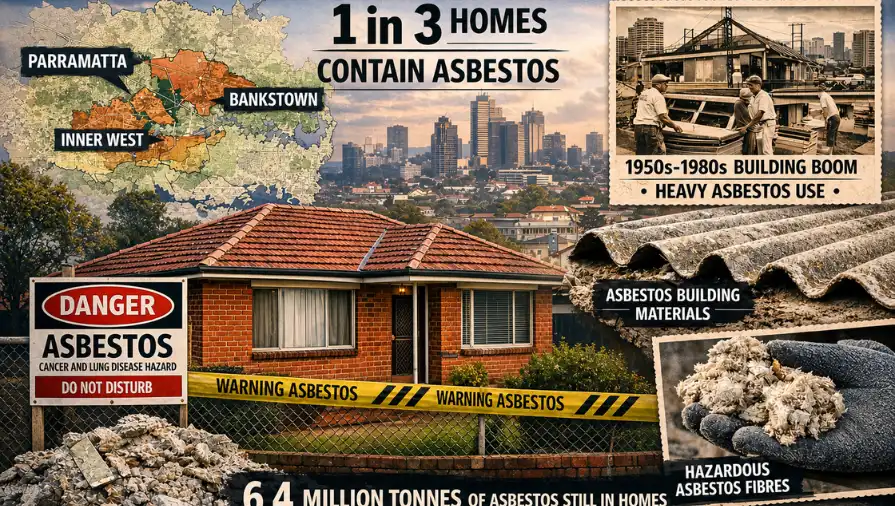
Sydney was a city in rapid expansion during the post-war decades. Suburbs like Parramatta, Bankstown, Penrith, Liverpool, Campbelltown, and the older parts of the North Shore and Inner West were built largely between the 1950s and 1980s — exactly the era when asbestos was Australia’s go-to building material.
Australia was known for having the highest per capita asbestos consumption in the world. Asbestos was a favoured material during the post-war construction boom as it was durable, heat-resistant, fireproof, cheap, and readily available.
One in three homes in Australia contains asbestos — homes built and renovated before 1990 are likely to contain it. An estimated 6.4 million tonnes of asbestos-containing materials remain in the built environment as of 2021.
That’s not a historical footnote. It’s the current reality for a huge proportion of Sydney’s housing stock.
“Asbestos kills slowly and silently, with many people not even realising they’re affected until it’s too late.” — Institute for Respiratory Health, 2024
Does Your Home Fall in the Risk Zone?
Quick Age-Based Risk Assessment
| Home Construction Period | Asbestos Risk Level | What It Means |
| Built before mid-1980s | High | Asbestos almost certainly present somewhere in the building |
| Built mid-1980s to 1990 | Moderate | Some asbestos products likely used |
| Built after 1990 | Low | Unlikely to contain asbestos materials |
| Renovated before 2003 | Variable | Renovation materials may have introduced asbestos |
Buildings constructed before 1990 probably contain asbestos in construction materials. If these materials deteriorate or are disturbed by repair work or renovation, the fibres can come loose and contaminate the air.
Where Asbestos Hides in HVAC Systems and Air Ducts
Most homeowners know to look for asbestos in roof sheeting, wall linings, and floor tiles. Far fewer think to look inside their heating and cooling systems — which is exactly why this risk is so frequently missed.
1. Heater Bank Linings
The Most Common HVAC Asbestos Location

Ducted heating systems from the 1960s through the 1980s typically featured inline electric heating elements — the “heater bank” — surrounded by insulation material designed to withstand high temperatures.
Asbestos insulation was used around boilers, furnaces, and other heating equipment to prevent heat loss and increase efficiency. This insulation can be found as sheets or blankets and is particularly hazardous if disturbed.
This millboard insulation often contained chrysotile (white asbestos) and sits directly in the path of airflow through the system. When it deteriorates — which happens naturally over decades — fibres can become airborne and circulate through every duct run in the house.
2. Flexible Duct Connectors
The Fabric Joints You’ve Never Noticed

Where rigid metal ductwork connects to the air handling unit, older systems used woven fabric connectors — flexible gaskets that allowed for vibration isolation and slight movement.
In pre-1990 systems, these fabric connectors frequently contained asbestos fibres woven directly into the material. They look unremarkable — a short section of what appears to be canvas or fabric — but they can be highly friable and dangerous when disturbed.
3. Asbestos Tape on Duct Joints and Seams
The White or Brown Tape Sealing Your Ductwork

HVAC components including gaskets were used to provide heat resistance and durability. These components can become hazardous if they deteriorate or are disturbed during maintenance.
Asbestos tape was widely used in Australian HVAC installations to seal duct joints and seams — particularly where sections of metal ductwork connect. It typically appeared as a white or brownish textured tape and was standard practice in Sydney installations through the 1970s and into the 1980s.
As this tape ages, it becomes brittle and friable. A duct cleaning contractor running a brush or vacuum through ducts sealed with deteriorating asbestos tape can release fibres into the entire air distribution system.
4. Fire Dampers
Hidden Inside the Duct System

Fire dampers — barriers installed inside ductwork to prevent fire from spreading through a building — in some older commercial and residential buildings were made from asbestos composite boards.
These are particularly concerning because they’re located deep inside the duct system, invisible during routine inspection, and disturbed during any significant HVAC maintenance or modification work.
5. Duct and Pipe Insulation
The Wrapping Around Your Ducts

Asbestos was used to wrap hot water pipes and ductwork to prevent heat loss and protect against fire. This insulation appears as a white or grey fibrous material wrapped around ducts.
In older Sydney homes — particularly those with ducted gas heating — the external insulation wrapping around duct runs through ceiling spaces and wall cavities may contain asbestos. This material is often in poor condition in homes that are several decades old, with crumbling or flaking sections that are actively releasing fibres into ceiling spaces.
When Does Asbestos in Air Ducts Become Dangerous?
This is a critical distinction that changes the level of urgency for your situation.

Asbestos that is intact, undisturbed, and in good condition poses no immediate health risk. The fibres are contained within the material and are not becoming airborne. This is called non-friable asbestos — it’s solid, bound, and stable.
Asbestos becomes an active health hazard the moment it’s disturbed, deteriorating, or friable — meaning it can be crumbled by hand pressure and releases microscopic fibres into the air.
What Makes Asbestos in Ducts Particularly High-Risk
Why the HVAC Context Is Especially Concerning
The location of asbestos inside an air duct system creates a compounding risk that doesn’t exist when asbestos is in, say, an external wall.
When asbestos in a duct system is disturbed — whether by the HVAC running, maintenance work, or duct cleaning — any released fibres don’t just sit in one spot. They get picked up by the airflow and distributed through every duct run in the house, blowing out through every register into every room that occupants breathe in.

Over time, asbestos fibres migrated to other areas such as wall cavities, subfloor spaces, cupboards, heating and cooling ducts and vents, living areas, and bedrooms.
This is why the combination of asbestos and HVAC systems is treated as a high-priority hazard under Australian Workplace Health and Safety laws.
The Health Risks — Why This Matters So Seriously
The health consequences of asbestos fibre inhalation are severe, well-documented, and typically irreversible. What makes them particularly insidious is the latency period — symptoms often don’t appear until 20 to 50 years after exposure.
Diseases Caused by Asbestos Fibre Inhalation
What You’re Protecting Your Family From
- Mesothelioma — An aggressive, incurable cancer affecting the lining of the lungs, abdomen, or heart. Almost exclusively caused by asbestos exposure. There were 870 mesothelioma deaths in 2020 in Australia, expected to rise to 1,500 deaths from mesothelioma in 2040.
- Asbestosis — A chronic, progressive lung disease caused by scarring of lung tissue from inhaled asbestos fibres. There is no cure. Symptoms include progressive breathlessness, chronic cough, and significantly reduced quality of life.
- Lung cancer — Prolonged exposure to asbestos fibres significantly increases the risk of lung cancer. This risk is dramatically compounded in smokers.
- Pleural disease — Thickening and scarring of the pleura — the lining around the lungs — that impairs breathing capacity over time.
“In many cases, asbestos-related illnesses do not appear until decades after exposure, and by the time symptoms emerge, treatment options are often limited.”
There is no safe level of asbestos fibre inhalation. Even low-level residential exposure carries real risk — and in the context of a compromised duct system running daily, cumulative exposure is the concern.
What to Do If You Suspect Asbestos in Your Sydney Ducts
This section is the most important part of this entire guide. Because the actions you take — and critically, the actions you don’t take — in the next 24 hours matter enormously.
Step 1 — Stop Using the System Immediately
If you see white dust coming from your vents, notice deteriorating tape or insulation around your ductwork, or suspect asbestos is present in any component of your HVAC system — turn the system off at the thermostat and at the circuit breaker. Do not run it again until a licensed professional has inspected it.
Running the system with compromised asbestos materials distributes fibres throughout every room. Every additional hour of operation compounds the potential exposure.
Step 2 — Do Not Touch, Clean, or Disturb Anything
Why DIY Is Genuinely Dangerous Here
Never use high pressure water, a garden hose, or compressed air on asbestos-containing products. Breaking asbestos-containing materials and dry-sweeping ACM are offences under SafeWork NSW regulations that carry on-the-spot fines.
Do not attempt to wipe down vents, clean accessible duct sections, or investigate the extent of the problem yourself. Any disturbance of friable asbestos-containing materials releases fibres. Leave the area as undisturbed as possible until professionals arrive.
Step 3 — Get a Licensed Asbestos Assessment
Who Can Legally Inspect and Handle Asbestos in NSW
In NSW, asbestos work is strictly regulated under the Work Health and Safety Regulation 2025 and requires specific licensing:
- Class A licence — required for removal of friable asbestos, including deteriorating heater bank linings and flexible duct connectors
- Class B licence — required for removal of non-friable (bonded) asbestos, including intact asbestos tape on duct joints
SafeWork NSW inspectors can issue on-the-spot fines to workers who don’t follow asbestos-safe work procedures. Offences include breaking asbestos-containing materials, not engaging an asbestos professional to conduct clearance inspections, and issuing clearance certificates without attending the site.
Verify any contractor’s licence before they touch your property. Use the Licence Check function at SafeWork NSW to confirm validity.
Step 4 — Understand Your Options After Inspection
Removal vs Encapsulation — What’s Right for Your Situation
A licensed assessor will recommend one of two approaches depending on the condition and type of asbestos found:
- Removal — Physical removal of all asbestos-containing materials from the duct system by a Class A or Class B licensed removalist, followed by air monitoring and a clearance certificate confirming the area is safe.
- Encapsulation — In some cases where asbestos is in good condition and non-friable, encapsulation — sealing the material with a binding agent to prevent fibre release — may be an appropriate interim measure. However, this is not suitable for friable asbestos or material in poor condition.
Only a licensed assessor can determine which approach is appropriate for your specific situation.
Step 5 — Get a Clearance Certificate Before Resuming Use
After any asbestos removal work, an independent clearance inspection by a licensed hygienist must be completed and a clearance certificate issued before the HVAC system is put back into operation. This is a legal requirement under NSW regulations — not optional.
Frequently Asked Questions About Asbestos in HVAC System
1. How do I know if my Sydney home’s air ducts contain asbestos?
If your home was built or renovated before 1990, asbestos in HVAC components is a genuine risk. The only way to confirm its presence is through inspection and testing by a licensed asbestos assessor — visual identification alone is not reliable.
2. Is asbestos in air ducts dangerous if I don’t disturb it?
Intact, stable asbestos that isn’t deteriorating or being disturbed poses no immediate risk. The danger arises when it becomes friable or is disturbed by HVAC operation, maintenance, or cleaning — releasing microscopic fibres into circulating air.
3. Can a duct cleaning company safely clean ducts with asbestos?
No. Duct cleaning must not proceed until a licensed asbestos assessment has been completed and any asbestos-containing materials have been professionally removed or confirmed safe. An unlicensed cleaner disturbing asbestos creates serious legal and health consequences.
4. What licence do I need for asbestos removal from ducts in NSW?
Friable asbestos — such as deteriorating heater linings and flexible connectors — requires a Class A licence. Non-friable bonded asbestos tape or insulation requires a Class B licence. Verify any contractor’s licence through SafeWork NSW before work begins.
5. What should I do if white dust is coming from my vents?
Turn the system off immediately at both the thermostat and circuit breaker. Do not attempt to clean or inspect the ducts yourself. Contact a licensed asbestos assessor in Sydney as a matter of urgency before running the system again.
6. Where can I find a licensed asbestos professional in Sydney?
Contact the Asbestos Safety and Eradication Agency for guidance, or use the licence verification tool at SafeWork NSW to find and confirm licensed asbestos assessors and removalists operating in the Sydney area
Conclusion
If your Sydney home was built before 1990, the question isn’t really “could there be asbestos in my air ducts?” — it’s “where is it and what condition is it in?”
Asbestos can still be found in one out of every three Australian homes. There is an estimated 6.2 million tonnes of asbestos material still present in the built environment, and many people may unknowingly disturb these dangerous fibres.
The risk isn’t abstract. It’s in thousands of Sydney homes right now, in duct systems that run daily, maintained by well-meaning people who have no idea what they’re working with.
The path forward is straightforward: get a licensed asbestos assessment before any duct cleaning, HVAC maintenance, or renovation work on any pre-1990 property. Don’t run a system you suspect contains compromised asbestos materials. And never attempt to inspect, clean, or disturb any material you think might contain asbestos.
Protect your family. Call a licensed professional before anything else.
