
If you run a business in Sydney, your air conditioning system is one of your hardest working assets — and one of the most overlooked.
Most business owners only think about their commercial AC when something breaks. By that point, the system has usually been running through months (sometimes years) of accumulated dust, mould, and debris.
Cleaning commercial air conditioning isn’t optional maintenance — it’s what keeps your staff healthy, your energy bills manageable, and your system running the way it was designed to.
This guide covers everything Sydney businesses need to know: how commercial AC cleaning actually works, how often it needs to happen, what’s included in a proper service, and the signs that your system is overdue.
How Commercial Air Conditioning Cleaning Differs from Residential
This is a question we get a lot — and the answer matters.
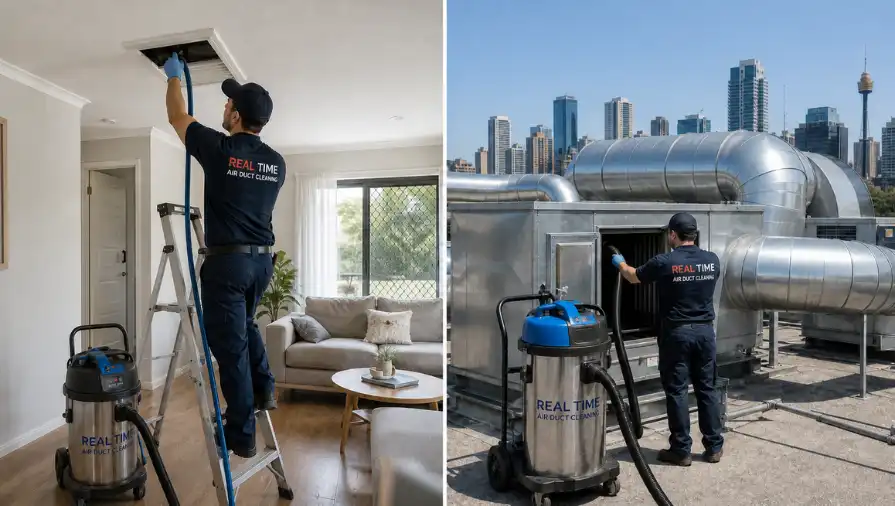
Residential duct and AC cleaning is relatively straightforward. Most homes have one system, a simple duct layout, and modest airflow requirements. A standard residential clean takes a few hours and follows a predictable process.
Commercial systems are a different beast entirely.
A typical Sydney office, restaurant, or medical centre might have multiple air handling units, complex ductwork across different floors, rooftop equipment, high-volume supply and return registers, and zoned temperature controls. These systems run longer hours, process higher volumes of air, and accumulate contamination faster than any home system.
This is why commercial air conditioning cleaning in Sydney requires specialist equipment, trained technicians, and a proper site assessment before any work begins.
What’s Actually Included in a Commercial AC Clean?
A thorough commercial clean covers far more than wiping down vent covers. Here’s what a professional service should include:
- Supply and return air ducts — The full duct network is vacuumed and brushed to remove dust, debris, mould spores, and built-up contamination. This is the core of the service.
- Air handling units (AHUs) — The fan blades, coil housing, and drain pans are cleaned. A dirty AHU is often the main source of musty odours in commercial spaces.
- Cooling and heating coils — Coils clogged with dust and grime transfer heat less efficiently, driving up your energy consumption. A clean coil can noticeably reduce running costs.
- Filters — Inspected and either cleaned or replaced depending on condition and type.
- Grilles and diffusers — Removed, cleaned, and reinstalled. These are the most visible part of the system — dirty grilles create a poor impression for clients and customers.
- Sanitisation — A commercial-grade antimicrobial treatment applied to prevent mould and bacterial regrowth after the clean.
“A commercial system that hasn’t been cleaned in two or more years is typically carrying 3–5 times the contamination load of a residential system. The volume of air these systems process means build-up happens much faster.”
How Often Does Commercial AC Need to Be Cleaned in Sydney?
The honest answer is: it depends on your business type. Here’s a practical guide:
| Business Type | Recommended Frequency |
| Standard office (low traffic) | Every 2–3 years |
| Busy office or coworking space | Every 12–18 months |
| Restaurant or commercial kitchen | Every 6–12 months |
| Medical centre or clinic | Every 6–12 months |
| Retail store or shopping tenancy | Every 12–18 months |
| Warehouse or industrial space | Every 2 years |
| Childcare or aged care facility | Every 6–12 months |
Sydney’s climate adds another consideration. High humidity periods — particularly late summer and early autumn — accelerate mould growth inside ductwork. If your business is near the coast or in a high-humidity suburb, the lower end of these ranges applies.
5 Signs Your Commercial AC System Is Overdue for a Clean
You don’t always need to wait for the calendar to tell you when it’s time. These are the signs we see most often when Sydney businesses call us in:
1. A musty or stale smell when the system runs. This is almost always mould or bacteria inside the ductwork or AHU. It’s also the first thing clients and customers notice.
2. Visible dust around vent grilles. If there’s a grey ring or film forming around your supply vents, contamination is being blown directly into your workspace.
3. Uneven temperatures across the building. Poor airflow from blocked ducts causes some areas to be too warm while others are overcooled.
4. Increasing energy bills without a clear reason. Dirty coils and restricted airflow force the system to work harder, consuming more power to achieve the same result.
5. More frequent staff sick days or allergy complaints. This is a significant sign. Contaminated air conditioning is a known contributor to Sick Building Syndrome — a real issue in Sydney offices with ageing or unmaintained systems.
What Sydney Business Owners Should Look for in a Commercial Cleaner
Not all air conditioning cleaning companies are set up to handle commercial work. Before booking, ask:
- Do they carry commercial liability insurance? For any work in a business environment, this is non-negotiable.
- Do they provide a written scope of work? A professional commercial cleaner will document exactly what’s being cleaned, not give you a vague verbal quote.
- Can they work outside business hours? Good commercial cleaners offer early morning, evening, or weekend scheduling to avoid disruption to your operations.
- Do they have experience with your system type? Ducted systems, VRF systems, rooftop units, and split systems all require different approaches. Ask specifically about experience with your setup.
The Real Cost of Skipping Commercial AC Cleaning
This is worth spelling out clearly.
A neglected commercial air conditioning system costs you in three ways:
- Higher energy bills
- A dirty system can use 20–30% more electricity than a clean one to maintain the same temperature — a meaningful figure for any Sydney business paying commercial electricity rates.
- Shorter equipment lifespan
- Commercial AC equipment is a significant capital investment. Contamination accelerates wear on fans, coils, and compressors. Regular cleaning extends the life of the system considerably.
- Staff and customer health
- Poor indoor air quality affects concentration, causes headaches, aggravates respiratory conditions, and increases sick days. For a Sydney business, this is a productivity and retention issue — not just a comfort one.
“The cost of a professional commercial AC clean is a fraction of what a single unplanned repair costs — let alone the productivity lost when staff are uncomfortable or unwell.”
Conclusion
Don’t wait for a smell, a complaint, or a breakdown — by then, you’re already paying the price.
Regular commercial AC cleaning is one of the simplest ways to protect your staff’s health, keep energy bills in check, and extend the life of a system that works hard every single day. For Sydney businesses, it’s not a luxury — it’s just good practice.
