

That popping or banging noise from your ductwork is almost always caused by something called “oil canning” — where the thin sheet metal in your ducts flexes in and out due to sudden pressure changes or rapid temperature shifts.
It’s not usually a sign of a broken system. But it is a sign that something in your ductwork needs attention — and ignoring it tends to make the problem louder and more frequent, not less.
“Popping ducts aren’t dangerous on their own — but they’re your ductwork’s way of telling you it’s under more stress than it should be.”
Here in Sydney, where ducted reverse cycle systems run hard through both humid summers and cold winter mornings, this noise is something a lot of homeowners notice — especially right when the system first kicks on.
Let’s break down exactly why it happens and what you can actually do about it.
What Is Air Duct Popping Noise?
The “Oil Canning” Effect Explained
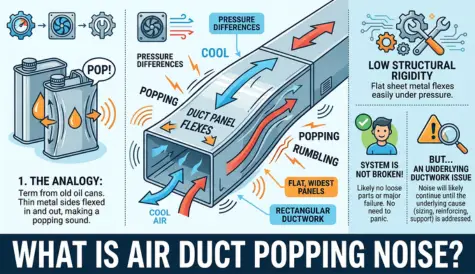
The term comes from old oil cans — the kind that made a distinctive popping sound when their thin metal sides flexed in and out. Your ductwork does the same thing.
When the walls of your air ducts move in and out due to pressure differences, you get a rumbling, popping sound — this is what’s known as oil canning. It happens at the flattest, widest panels of rectangular ductwork, since flat sheet metal has the least structural rigidity and flexes most easily under pressure.
The good news first: in most cases, nothing is seriously broken. It’s unlikely that your system is broken or that there’s some loose part you need to panic about — but there is an underlying ductwork issue that, until addressed, the noise probably won’t go away on its own.
Why Does My Ductwork Make a Popping Sound? — The Real Causes

1. Clogged or Dirty Air Filter
How a Simple Filter Creates a Loud Problem
A dirty filter restricts airflow significantly, forcing your system’s blower to create excess static pressure just to push air through. That trapped pressure has to go somewhere — and it often shows up as the thin metal panels of your ductwork popping in and out.
The Fix: Check your filter every month and replace it if it’s more than two to three months old. Replacing the filter regularly also improves indoor air quality and overalgel system efficiency, not just the noise.
Expert Tip: If the popping noise gets noticeably quieter right after a filter swap, you’ve found your culprit — no need to look any further.
2. Closed or Blocked Vents
Why Shutting a Vent in the Spare Room Backfires
A lot of Sydney homeowners close vents in rooms they don’t use often, thinking it saves energy by redirecting air elsewhere. In reality, it does the opposite — it forces excess pressure into the ducts that are still open, and that extra pressure is exactly what triggers oil canning.
The Fix: Keep at least 80–90% of your home’s vents fully open and unblocked by furniture, rugs, or curtains.
Expert Tip: Walk through your home and check every vent isn’t sitting half-covered by a bed frame or bookshelf — it’s a surprisingly common and easy fix.
3. Thermal Expansion — Hot Air Meeting Cold Metal
The Most Common Cause When the System First Starts
When your heat pump or ducted system kicks on, warm air begins moving through cold metal ducts. As the metal warms up, it expands slightly — and when it cools down after the system switches off, it contracts again.
This explains why the popping is usually loudest right at startup, particularly noticeable in rectangular ducts with large, flat panels — these have the least resistance to flexing compared to round ductwork.
The Fix: Have an HVAC technician add a cross-break — a diagonal crease pressed into the flat metal panel — or install a stiffening bar across the duct’s widest sections. Circular ducts generally handle pressure changes with far less noise than square or rectangular ones, since the round shape resists flexing naturally.
Expert Tip: If you’re ever upgrading or replacing sections of ductwork, ask your installer about round duct options — they’re genuinely quieter long-term.
4. Undersized Ductwork or Loose Duct Straps
When Your Ducts Simply Can’t Handle the Airflow
Sometimes ductwork pops because it’s the wrong size for what your system is actually pushing through it. If the ductwork is too small to handle the airflow your system produces, it pops as it expands trying to manage more pressure than it was designed for.
Loose duct hangers or straps cause a related issue — as a house settles over the years, metal ductwork can end up under physical tension, which makes it more prone to popping as temperatures shift.
The Fix: In some cases, the popping is just a specific weak spot needing extra support — tightening the screws in that section or reinforcing it with thicker metal can solve it without a full duct replacement. For genuinely undersized systems, a technician will need to assess sizing and adjust static pressure properly.
Expert Tip: Ask your technician to physically pinpoint exactly where the popping originates — a localised fix is almost always cheaper than replacing entire duct runs.
What Happens If You Ignore the Popping Noise From Air Duct?

The noise rarely fixes itself. It might start out fairly soft, but it tends to become increasingly louder over time until it can no longer be ignored.
Left unaddressed, the underlying pressure problem can lead to:
- Duct leaks developing at weak points — duct leaks can account for up to 30% of total airflow loss, meaning your heating and cooling literally escapes before reaching your rooms
- Higher energy bills — your system works harder to compensate for lost air pressure and restricted flow
- Accelerated wear on your HVAC unit — popping noises can signal an underlying issue, such as duct leaks, that lead to reduced efficiency, higher costs, or even damage to your HVAC system over time
- Uneven heating and cooling between rooms as pressure imbalances worsen
- A bigger repair bill later — what starts as a simple filter change or cross-break fix can progress into needing full section replacement if left for years
Expert Tip: Don’t wait for “popcorn season” to become a nightly event — a 10-minute filter check today is far cheaper than a full duct reinforcement job down the track.
When Should You Call a Sydney HVAC Technician?

DIY checks — filter replacement, opening vents — solve a genuine portion of these cases. But call a professional if:
- The popping is accompanied by a burning smell — this can indicate an electrical issue and needs immediate attention
- The noise is constant throughout the entire heating or cooling cycle, not just at startup
- You suspect the ductwork itself is undersized for your system
- The popping has noticeably gotten louder or more frequent over recent weeks
A qualified technician can pinpoint exactly which section of ductwork is flexing, check your system’s static pressure, and recommend the right fix — rather than you guessing room by room.
Conclusion
Air duct popping noise is genuinely common, especially in Sydney homes running ducted reverse cycle systems through humid summers and cool winter mornings. It’s almost always oil canning — pressure or temperature-driven flexing in thin sheet metal ductwork — and it’s fixable.
Start with the simple checks: clean filter, open vents. If the noise persists, it’s likely a sizing, insulation, or reinforcement issue that a licensed technician can sort out properly.
Just don’t ignore it. A small pop today is a lot cheaper to fix than a duct leak or system strain six months from now.
