

Before Sydney’s winter arrives, clean your AC filters, clear the outdoor condenser unit, flush the condensate drain line, wipe down indoor louvers, and switch the mode from cooling to heating. Then book a professional service if it hasn’t been done in the past 12 months.
That’s the complete pre-winter checklist in one sentence. Here’s exactly how to do each step properly — with the expert details that make the difference between a system that heats your home reliably all winter and one that struggles from day one.
As the weather shifts throughout the year, your air conditioner becomes an essential part of keeping your home comfortable, cooling you through Australia’s hot summers and warming you during the cooler months. Before each seasonal change, follow the steps below to ensure your unit operates efficiently.
“Most Sydney homeowners think about the air conditioner when it’s hot. The ones whose systems never break down in winter are the ones who thought about it in April.”
7 Air Conditioner Cleaning Tips Before Sydney’s Winter
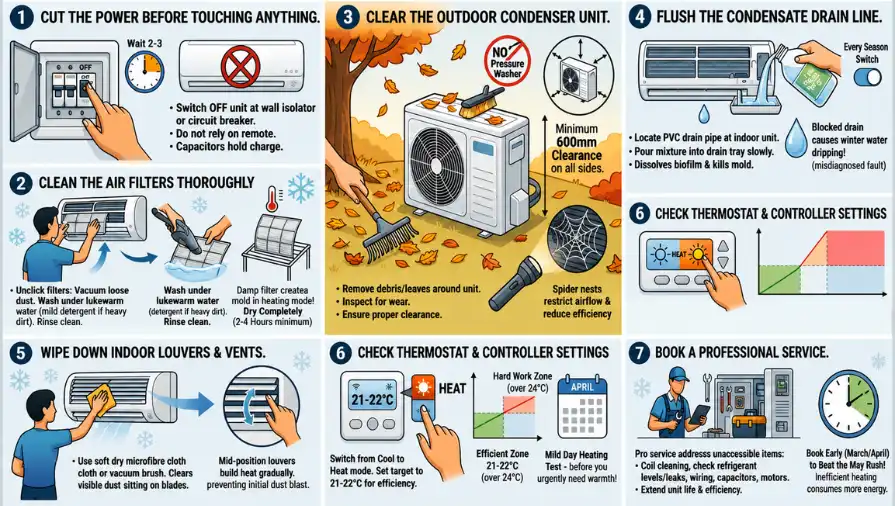
Tip 1 — Cut the Power Before Touching Anything
Safety Is Non-Negotiable — Here’s How to Do It Correctly
Switch the unit off completely at the wall isolator switch or at the circuit breaker in your switchboard. Do not rely on the remote control or wall controller alone — the indoor unit remains partially energised and capacitors inside the system hold electrical charge even after the controller shows “off.”
Expert Tip: Wait a full two to three minutes after isolating the breaker before opening any panel or touching internal components. This allows residual charge in the capacitors to dissipate safely. It’s the step most homeowners skip — and the one that matters most.
Tip 2 — Clean the Air Filters Thoroughly
The Single Most Impactful Pre-Winter Step You Can Do Yourself
Air filters accumulate significant dirt and dust particles, particularly after heavy summer use. Remove the filter by unclicking it from behind the grille or cover.
Vacuum using a soft brush attachment to remove loose dust and fluff. Wash under lukewarm water — for heavier dirt, use mild detergent, then rinse clean.
After washing, shake off excess water and place the filter in a well-ventilated spot to dry completely. Never reinstall a damp filter.
Expert Tip: The damp filter rule is more important in winter than any other season. When you switch to reverse cycle heating, warm air passes through the filter and any residual moisture creates exactly the conditions mould needs to establish on the evaporator coil. Allow minimum three to four hours of air-drying time before reinstalling — not “mostly dry” but completely dry.
Tip 3 — Clear the Outdoor Condenser Unit
Autumn Debris Accumulates Fast — and Restricts Winter Heating Performance
Remove debris, leaves, or dirt that may have gathered around the unit to prevent blockages and potential damage. Inspect the unit for signs of wear or damage — address any issues now rather than wait until the heating season is underway.
Ensure a minimum 600mm clearance on all sides of the outdoor unit. Remove leaves from between the fin panels using a soft brush — never a pressure washer, which bends the delicate aluminium fins permanently.
Expert Tip: Spider nests are the most underestimated outdoor unit problem in Sydney. During autumn, when the unit runs less frequently during the transition between cooling and heating, spiders colonise the inside of the condenser housing rapidly. Before your first sustained heating day, shine a torch into the condenser housing and look for white web material inside the fin structure. A significant spider nest inside the unit creates meaningful airflow restriction that directly reduces heating efficiency — and it takes 30 seconds to identify.
Tip 4 — Flush the Condensate Drain Line
Sydney’s Humidity Creates Blockages That Cause Winter Water Damage
The condensate drain line carries moisture away from the indoor unit — not just in cooling mode, but in reverse cycle heating under certain conditions too. Sydney’s summer humidity leaves a residue of biological material inside drain lines that thickens and eventually blocks the outlet.
Locate the PVC drain pipe at the indoor unit. Pour a mixture of warm water and a small amount of white vinegar slowly into the drain tray.
This dissolves biofilm and kills mould without damaging the drain components.
Expert Tip: The condensate drain blockage is the most common cause of water dripping from indoor units in winter — and most homeowners assume it’s a refrigerant or heating fault rather than a blocked drain. A two-minute vinegar flush in April prevents the most frequent winter callout technicians receive across Sydney. Do it every time you switch seasons.
Tip 5 — Wipe Down Indoor Louvers and Vents
Dust Sitting on Louvers Gets Blown Straight Into the Room When Heating Starts
Use a soft dry microfibre cloth or a vacuum with a brush attachment to clear visible dust from the louvre blades and vent grille of the indoor unit. When heating mode first activates, warm airflow dislodges any sitting dust and pushes it directly into your living space.
Expert Tip: After wiping the louvers, close them to their mid-position before running the system for the first time in heating mode. Fully open louvers direct the initial dust-dislodging airflow at maximum velocity into the room. Mid-position louvers allow the system to build heat gradually while the first minutes of operation clear any residual dust from internal surfaces more gently.
Tip 6 — Check Thermostat and Controller Settings
Switching Modes Correctly Ensures Efficient Heating From Day One
Switch your controller from Cool to Heat mode. Set the target temperature — reverse cycle heating is most energy-efficient at 21–22°C for a Sydney winter.
Higher settings force the compressor to work significantly harder for marginal additional warmth.
By combining smart thermostat settings with proactive maintenance, you protect your air conditioner through the winter season and set yourself up for reliable, efficient operation.
Expert Tip: Test the heating mode on a mild day — not on the first cold night of winter. Running a heating test in mid-April when you don’t urgently need warmth gives you time to notice any performance issues, call a technician, and get the problem resolved before you’re dependent on the system in June. Technicians’ diaries in Sydney fill rapidly once the cold nights arrive in May and June.
Tip 7 — Book a Professional Service
What DIY Maintenance Cannot Reach — and Why It Matters for Winter
The six steps above address everything accessible to a homeowner. A professional service addresses everything that isn’t.
Inspect and clean the condenser coil and evaporator coil if accessible. Check refrigerant levels and look for signs of leaks.
Inspect wiring, capacitors, contactors, and fan motors. Schedule professional maintenance at least annually to inspect coils, electrical components, and refrigerant levels.
Low refrigerant affects heating performance just as significantly as cooling performance — and it’s not detectable without pressure testing equipment. A system running low on refrigerant will heat less effectively and run longer cycles all winter, consuming more energy and stressing the compressor throughout the coldest months.
Expert Tip: Book your pre-winter professional service in late March or early April — before the May rush. In Sydney, the window between the end of daylight saving and the first cold snap is when technician availability drops sharply. Homeowners who wait until the heating is visibly underperforming in June are typically looking at a four-to-six week wait during the season they need it most. Book early, beat the rush, and go into winter with a fully serviced system.
Why Pre-Winter AC Cleaning Matters in Sydney

Sydney winters are mild by national standards — but that doesn’t mean your reverse cycle system gets a break.
Nights in the western suburbs regularly drop to 8–10°C. Homes across the Hills District, Penrith, and the Upper North Shore rely on their split system as the primary heat source for months at a stretch.
A system going into that heating load still carrying five months of summer dust, a partially blocked drain line, and an outdoor condenser full of autumn leaves is going to work harder, cost more to run, and deliver less warmth than a clean, well-maintained unit.
The pre-winter clean takes a couple of hours. The consequences of skipping it last all season.
Conclusion
Cleaning your air conditioner before Sydney’s winter takes a couple of hours and genuinely changes how the system performs all season.
Clean filters mean unrestricted airflow from the first heating cycle. A cleared outdoor unit means the compressor isn’t working against blocked airflow on the coldest nights.
A flushed drain line means no mid-winter water leak callout. And a pre-booked professional service means a technician who’s checked the refrigerant, the coils, and the electrical components before you’re dependent on that system in June.
Preventative maintenance saves money on costly repairs, helps maintain the unit’s efficiency reducing energy bills, and improves indoor air quality by removing dust, allergens, and other pollutants.
Do the seven steps. Book early. And go into winter with an AC system that’s actually ready for it.
