
You feel fine on Monday. By Wednesday you have a scratchy throat, a runny nose, and that heavy, foggy feeling that makes everything harder.
But you have not been near anyone who is sick. You have barely left the house. So, what is going on?
For a growing number of Sydney households, the answer is sitting right there on the wall — the air conditioner.
Air conditioning itself does not cause illness. It does not produce germs or viruses.
But if your system is dirty, poorly maintained, or blasting cold air continuously, it can contribute to symptoms that feel a lot like a cold, the flu, or hay fever.
That distinction matters. Because if your air conditioner is causing cold-like symptoms, the fix is usually straightforward — and entirely preventable going forward.
Can an Air Conditioner Really Cause a Cold?
The Honest Answer — Not Directly, But Yes Indirectly
Let us clear up the most common misconception first. Cold air itself does not cause a cold.
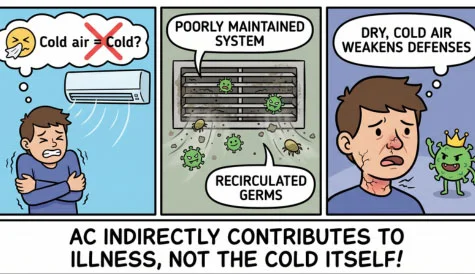
Colds are caused by viruses — and no amount of cool air creates a virus from nothing.
While cold air itself does not cause colds, your air conditioning can indirectly contribute to illness.
What air conditioning sickness actually comes from is a combination of what builds up inside a poorly maintained system, how that air is recirculated through your home, and the physical effects that dry, cold air has on your body’s natural defences.
In Sydney, where split systems and ducted air conditioners run hard from November through to March — and increasingly year-round for heating — the exposure is prolonged and the conditions for problems are ideal.
What Actually Causes Air Conditioning Sickness in Sydney
4 Real Reasons Your AC Might Be Making You Feel Unwell
1. A Dirty Filter Circulating Contaminants Through Your Home
This is the most common cause — and the most preventable.
Build ups of dust, dirt and other particles cause your symptoms. If the air quality in a room is already low, running your air conditioner can spread pollutants that cause irritation and other symptoms.
Air conditioners do not introduce any fresh air into your room. Instead, they circulate air that is already inside the space.
So, if the air in a room is full of dust, or if there is mould or bacterial growth on the air conditioner filter, you might start seeing the symptoms of air conditioning sickness.
For Sydney homeowners running split systems in bedrooms or living rooms throughout summer, a filter that has not been cleaned in three to six months becomes a direct delivery system for accumulated dust, mould spores, and allergens — straight into the air you breathe while you sleep.
2. Dry Air Weakening Your Body’s Natural Defences
How AC Strips the Moisture That Protects You
Your nose and throat are lined with mucous membranes — your body’s first line of defence against viruses and bacteria. They trap pathogens and prevent them from reaching your lungs.
Clinical discomfort due to respiratory illnesses can be exacerbated by indoor cold temperatures due to air conditioning. Respiratory infections can be caused by cold air through increased bronchial inflammation, as both cold and infections are trigger factors able to destabilize the patient.
When your AC runs for hours on end in a closed room, it progressively removes humidity from the air. That dry air dries out your mucous membranes, reducing their effectiveness and leaving your airways more vulnerable to whatever is circulating in the environment — whether that is dust, allergens, or a genuine virus.
This is why so many Sydney families describe a “summer cold” that seems to appear out of nowhere — the AC has been quietly lowering their defences all season.
3. Thermal Shock — The Heat-to-Cold Transition Problem
Why Moving Between Extremes Stresses Your System
Sydney summers are genuinely brutal. Stepping from 35-degree heat outside into an aggressively air-conditioned room set to 18 degrees is a dramatic temperature swing — and your body has to manage it every time.
The increasing use of air conditioners in homes, cars, hotels and shopping centres has highlighted new public health issues resulting from sudden temperature changes. In recent years more attention is being paid to related pathologies, from simple thermal discomfort to real pathologies such as sick building syndrome, or aggravation of asthma and COPD.
Repeated thermal shock throughout a Sydney summer — from the car park to the office, from the garden to the lounge room — gradually stresses the immune system and makes it harder for your body to respond effectively when it does encounter a pathogen.
4. Mould and Bacteria in a Neglected System
When the Unit Itself Becomes the Problem
Your air conditioning unit is a breeding ground for all sorts of pathogens. Air circulates through the unit which gets cooled in the evaporator coil.
This is where moisture forms and mould, mildew, fungi, and bacteria can build up, which will then be circulated out into your home.
In serious cases, poorly maintained systems — particularly ducted air conditioning in older Sydney buildings — can harbour Legionella bacteria. Symptoms of Legionnaires’ disease are similar to pneumonia, causing coughing, shortness of breath, chest discomfort, fever and general flu-like symptoms.
While this is more common in commercial settings, it underlines why regular professional servicing is not optional maintenance.
Signs of Air Conditioning Sickness — What to Watch For
Recognising AC Symptoms vs a Genuine Cold or Flu
Sick building syndrome is the general name for symptoms that can develop after spending extended periods of time in air-conditioned environments. Symptoms can include headaches, dizziness, congested or runny nose, persistent cough or wheeze, skin irritation or rashes, trouble focusing on work, and tiredness.
The symptoms tend to get worse the longer you are in a particular building and are alleviated after you leave.
That last point is the key diagnostic clue. If your symptoms improve noticeably when you are away from home — at work, visiting family, or spending time outdoors — and worsen when you return to the air-conditioned environment, your AC cold symptoms are almost certainly environment-related rather than viral.
Common air conditioner sickness symptoms in Sydney households include:
- Persistent dry cough or scratchy throat that does not progress to a full cold
- Runny nose or nasal congestion without fever
- Recurring headaches that ease after leaving the house
- Dry, irritated or itchy eyes — particularly in the morning
- Fatigue and mental fog that seems worse at home than elsewhere
- Dry or flakey skin, especially on the face and hands
- Muscle stiffness after sleeping in a heavily air-conditioned room
How to Prevent Air Conditioning Sickness in Sydney
Simple, Practical Steps That Make a Real Difference
The good news is that air conditioning sickness is almost entirely preventable. Most of the causes come down to maintenance and usage habits — both of which are entirely within your control.
1. Clean Your Filter Every 3 to 6 Months
The Single Most Effective Prevention Step
Regular servicing and proper setup are the real keys to staying healthy with air con.
For split systems in Sydney homes running through summer, rinse or vacuum the filter every three months at minimum. During peak use — November to March — monthly checks are a sensible habit.
A clean filter means the system is not recirculating accumulated dust, mould spores, and allergens through your living spaces with every cycle.
2. Set the Temperature Between 22 and 24 Degrees
Avoid the Extremes That Cause Thermal Shock and Dryness
Running your AC at 18 or 19 degrees might feel luxuriously cool, but it dramatically increases the rate of moisture removal from indoor air and maximises the temperature gap between inside and outside — both of which contribute to AC cold symptoms.
Setting the thermostat between 22 and 24 degrees maintains comfort without stripping humidity or creating the extreme thermal shock that stresses your body’s defences.
3. Do Not Sleep Directly in the Airflow
Positioning Matters More Than Most People Realise
Direct, continuous cold airflow across your face and throat while sleeping is one of the fastest routes to a dry, scratchy throat by morning.
Point the louvres away from the bed, set the timer so the system cycles off after you fall asleep, or use the sleep mode many modern Daikin, Mitsubishi, and Fujitsu units offer — which gradually raises the temperature over several hours to prevent overnight temperature extremes.
4. Ventilate Regularly — Even During Summer
Let Fresh Air in for 10 Minutes Each Morning
Air conditioners circulate air that is already inside the space. Without occasional fresh air introduction, the concentration of indoor contaminants — dust, CO₂, VOCs, and biological particles — builds progressively throughout the day.
Open windows for 10 to 15 minutes each morning before the heat builds. This simple habit flushes recirculated indoor air and resets the baseline air quality in the room before the AC takes over for the day.
5. Stay Hydrated Through the Day
AC-conditioned air is drier than natural outdoor air — and your mucous membranes pay the price if you are not replacing that moisture from the inside. Drinking adequate water throughout the day helps maintain the protective lining of your nose and throat, keeping your natural defences functional even in a heavily air-conditioned environment.
6. Book a Professional Service Before Summer
A professional AC service covers what a filter rinse cannot — evaporator coil cleaning, drain pan flush, mould treatment on internal components, and a full performance check. For Sydney households running their system year-round, annual professional servicing keeps the system clean at a level that routine DIY maintenance simply cannot match.
Frequently Asked Question About Can Air Conditioner Cause Cold in Sydney
Can my air conditioner actually give me a cold?
Air conditioning itself does not cause illness — it does not produce germs or viruses. But a dirty, poorly maintained system that recirculates dust, mould spores, and allergens can absolutely cause cold-like symptoms including dry throat, runny nose, headaches, and fatigue.
Is it safe to sleep with the AC on in Sydney?
Yes — with the right setup.
Point louvres away from the bed, keep the temperature at 23 to 24 degrees, and use the sleep timer or sleep mode so the system is not running at full cold intensity all night. A clean, well-maintained unit running at a moderate temperature is safe for overnight use.
How often should I service my AC to prevent illness?
Clean or rinse the filter every three to six months — monthly during peak summer use. Book a full professional service at least once a year, ideally in spring before the Sydney summer cooling season begins.
When should I see a doctor instead of cleaning my AC?
If your symptoms include high fever, chest pain, shortness of breath, or do not improve after cleaning the AC and improving ventilation, see a medical professional promptly.
Legionnaires’ disease symptoms include coughing, shortness of breath, chest discomfort, fever and general flu-like symptoms — if these are present, seek medical attention rather than assuming the issue is AC-related.
Conclusion
Can an air conditioner cause a cold? Not directly — but a dirty, poorly maintained system combined with low temperatures, dry recirculated air, and no fresh air ventilation creates exactly the conditions that make you feel like you have one.
The fix is not complicated. Clean your filter regularly.
Set a sensible temperature.
Ventilate occasionally. Book a professional service before summer.
And point those louvres away from the bed.
Your AC should be making your Sydney summer more comfortable — not something to dread. With the right maintenance habits, it absolutely can.
