
Every Sydney business manager knows that energy is one of the biggest controllable operating costs in a commercial building. What far fewer realise is that one of the most effective levers for reducing that energy spend is sitting right above the ceiling tiles — in the ductwork of the HVAC system.
HVAC systems contribute up to 50% of energy use and 30% of water consumption in Australia’s commercial buildings. That is an enormous proportion of a building’s total energy footprint — and when that system is running through dirty, blocked ductwork, a significant share of that energy is being wasted rather than used productively.
Commercial air duct cleaning directly addresses this. By removing the accumulated dust, debris, mould, and contaminants that choke airflow and force HVAC components to work harder, a professional duct clean restores the system’s ability to operate at its designed efficiency — and the energy savings that follow are real, measurable, and immediate.
This guide explains exactly how commercial duct cleaning enhances energy efficiency for Sydney businesses, what the cleaning process involves, when it should be done, and the warning signs that your system needs attention right now.
Why HVAC Ductwork Gets Dirty in Commercial Buildings
The Unique Contamination Challenge in Sydney Commercial Spaces
Commercial HVAC systems face a contamination challenge that is fundamentally different from residential systems — and significantly more serious.
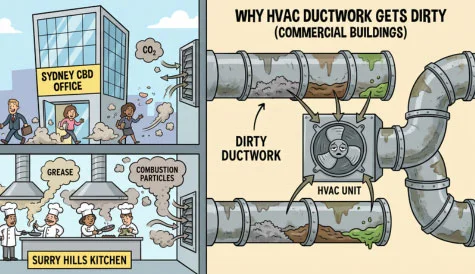
Commercial buildings face different demands than homes: larger spaces, varied occupancy levels, and stricter air quality expectations.
A Sydney office building in the CBD handles hundreds of people moving through it daily — each bringing in outdoor particulates, shedding skin cells, generating CO₂, and contributing to the biological and particulate load the HVAC system must process. A restaurant kitchen in Surry Hills generates grease-laden combustion particles with every service.
A medical facility in Parramatta maintains strict contamination protocols that demand a higher standard of duct cleanliness than almost any other environment.
All of these spaces share one thing: ductwork that accumulates contamination over time and degrades system performance if it is not regularly cleaned.
What Builds Up Inside Commercial Ductwork
1. Dust and Particulate Matter
Fine dust accumulates in supply ducts, return air plenums, and around registers and grilles. Over time this builds into a dense coating that progressively restricts airflow — forcing the fan motor to work harder to push the same volume of conditioned air through the system.
2. Biological Contaminants — Mould and Bacteria
Sanitisation treatment includes antimicrobial solutions to help eliminate bacterial and fungal growth inside commercial duct systems. Sydney’s humid climate creates conditions where mould establishes itself in return air plenums and evaporator coil housings — particularly in buildings where condensate drainage is imperfect or where ductwork passes through unconditioned ceiling spaces.
3. Grease and Combustion Residue
Restaurants, café kitchens, and food processing facilities across Sydney generate grease-laden exhaust that coats kitchen duct systems rapidly. This creates both a HVAC energy efficiency problem and a genuine fire safety risk that makes regular cleaning a compliance imperative.
How Commercial Air Duct Cleaning Enhances Energy Efficiency
1. The Direct Link Between Clean Ducts and Lower Power Bills
The relationship between duct cleanliness and commercial HVAC energy efficiency is straightforward — and the numbers behind it are compelling.
Dirty ductwork creates resistance. Resistance forces the blower fan to work harder.
Working harder means consuming more electricity. And in a commercial building where the HVAC runs for 10 to 12 hours a day, that additional electrical draw compounds significantly over a month, a quarter, and a year.
2. Reduced Blower Motor Strain and Energy Draw
When a blower fan is pushing conditioned air through clean, unobstructed ductwork, it operates within its designed performance parameters. When the same fan is fighting against a thick coating of accumulated dust and debris, it consumes more electricity while delivering less airflow.
Professional commercial duct cleaning targeting the blower motor specifically can reduce its electrical consumption by up to 15%. Across a full commercial HVAC system, some Sydney businesses report a 15% to 27% reduction in total HVAC energy usage following a comprehensive clean.
3. Improved Airflow to Every Zone
The growing emphasis on energy efficiency is becoming a critical factor for businesses and homeowners seeking to reduce their energy bills while contributing to sustainability goals.
Blocked ductwork means uneven conditioned air distribution — some zones get too much, others too little. The controller responds by running longer cycles to compensate, consuming more electricity in the process.
Removing debris from trunk lines can increase supply air volume by up to 40%, restoring the balanced distribution the system was designed to deliver.
4. Enhanced Heat Transfer at the Evaporator Coil
Why a Clean Coil Is Central to HVAC Efficiency
The evaporator coil is where the refrigerant absorbs heat from the air — it is the core heat exchange component of the cooling system. When the coil is coated in dust and biological matter, that coating acts as insulation, reducing the rate of heat transfer and forcing the compressor to work harder and longer to achieve the same temperature drop.
Commercial HVAC coil cleaning as part of a comprehensive duct service can improve heat transfer efficiency by up to 30% — which translates directly into reduced compressor run time and lower electricity consumption.
Duct Sealing — Stopping Energy Loss at the Source
A professional commercial duct cleaning service in Sydney will also assess ductwork for air leaks — joints, seams, and connections that allow conditioned air to escape into ceiling cavities rather than reaching the intended zones.
Internal duct sealing using products like Aeroseal can prevent up to 20% of energy loss attributed to duct leakage. In older commercial buildings across the Sydney CBD, North Sydney, and Parramatta — where original ductwork may be decades old — this represents a substantial and often untapped efficiency opportunity.
The Commercial Duct Cleaning Process — What to Expect
What a Professional Sydney Commercial Duct Clean Involves
Understanding the commercial duct cleaning process helps building managers evaluate service quality and set accurate expectations. A thorough commercial clean is a significantly more involved operation than residential duct cleaning — both in equipment and scope.
Stage 1 — System Inspection and Scoping
New robotic tools and camera systems help technicians reach deeper into ductwork and show homeowners exactly what’s inside.
In a commercial setting, a pre-clean camera inspection of major trunk lines identifies the locations and severity of contamination, allows the technician to detect structural issues such as collapsed duct sections or disconnected joints, and provides documented baseline condition data — increasingly important for NABERS energy rating reporting and compliance with AS4254.1, the Australian standard governing commercial ductwork design and maintenance.
Stage 2 — Negative Pressure Containment Setup
Before any cleaning begins, the system is placed under negative pressure using high-powered industrial HEPA vacuum equipment connected to the main return air plenum or trunk line.
This negative pressure environment ensures that dislodged contaminants are drawn toward the vacuum collection point rather than being redistributed through the building. It is the fundamental difference between a professional commercial clean and a partial DIY effort — without negative pressure, cleaning one section of ductwork simply relocates contamination rather than removing it.
Stage 3 — Mechanical Agitation and Debris Removal
With negative pressure established, technicians work through each supply and return duct branch using a combination of rotary brushes, air whips, and compressed air tools to dislodge and drive accumulated contamination toward the collection equipment.
Thorough industrial-grade cleaning eliminates accumulations of significant dust, debris and contaminants within large and intricate duct systems.
Supply registers, return air grilles, and accessible duct sections are cleaned individually, with particular attention to bends, junctions, and the areas immediately downstream of supply fans where contamination typically accumulates most densely.
Stage 4 — Coil, Blower, and Drain Pan Service
A comprehensive commercial duct clean includes the HVAC plant components — not just the ductwork itself.
Cleaning includes washing the evaporator and condenser coils, which will help improve cooling capacity and reduce system pressure, making your air conditioner last longer.
The blower motor and fan assembly are cleaned to restore free rotation and reduce electrical draw. The condensate drain pan is flushed and sanitised to eliminate standing water and the mould growth it supports.
Filter housings are cleaned and new filters installed before the system is returned to service.
Stage 5 — Antimicrobial Treatment and Final Inspection
Following the mechanical clean, an antimicrobial treatment is applied to duct surfaces, coils, and the drain pan to inhibit regrowth of mould and bacteria between service intervals.
Antimicrobial treatments are also being used more frequently to prevent regrowth of dust and allergens after cleaning.
A post-clean camera inspection of the same duct sections documents the condition improvement, providing the building manager with a before-and-after record for compliance and reporting purposes.
How Often Should Commercial Ducts Be Cleaned in Sydney?
Cleaning Frequency by Building Type
The right cleaning frequency depends on the type of commercial space, its occupancy levels, and the nature of the activities taking place inside it.
| Building Type | Recommended Cleaning Frequency |
| Standard office buildings | Every 3 to 5 years |
| High-traffic retail spaces | Every 2 to 3 years |
| Restaurants and commercial kitchens | Every 6 to 12 months |
| Healthcare facilities and hospitals | Every 1 to 2 years |
| Warehouses and industrial facilities | Every 3 to 5 years |
| Buildings after renovation or construction | Immediately post-completion |
Sydney businesses operating in high-humidity environments — ground-floor offices in the CBD, buildings near waterways, or spaces with known condensate drainage issues — should sit at the more frequent end of these ranges, as mould growth in ductwork accelerates significantly in persistent moisture conditions.
Warning Signs Your Commercial HVAC Ducts Need Cleaning Now
Do not wait for the scheduled service interval if you are seeing any of these in your Sydney building.
- Rising electricity bills without a corresponding increase in occupancy or hours of use — a strong indicator of reduced HVAC efficiency
- Uneven temperatures across different zones despite the system running normally — suggests blocked supply ducts restricting airflow to affected areas
- Musty or stale odours when the HVAC system is running — almost always indicates mould growth in the ductwork or at the evaporator coil
- Visible dust or dark marks around ceiling supply registers or return air grilles
- Staff complaints about air quality — headaches, eye irritation, fatigue, or increased sick days that correlate with time spent in the building
- HVAC system running longer cycles than usual to maintain set temperatures — a sign of reduced system efficiency
- Recent renovation or construction work in or around the building — construction dust contaminates ductwork rapidly and requires cleaning before the system returns to normal operation
Compliance and NABERS Considerations for Sydney Businesses
Why Commercial Duct Cleaning Is Both a Performance and a Compliance Issue
Commercial sector retrofits and net-zero building goals, as well as smart technology integration, are further supporting the expansion of energy-efficient HVAC solutions in Australia.
For Sydney businesses operating in buildings with NABERS energy ratings — increasingly standard for office tenants and building owners in the CBD and North Sydney — documented HVAC maintenance including regular duct cleaning contributes directly to maintaining and improving the building’s star rating.
The Australian standard AS4254.1 governs ductwork design and maintenance requirements for commercial buildings. A professional commercial duct cleaning contractor in Sydney operating to this standard will provide documented service records suitable for compliance reporting, NABERS submission, and building management audits.
Frequently Asked Question About Commercial Duct Cleaning Energy Efficiency in Sydney
1. How much energy can commercial duct cleaning actually save?
Sydney businesses have reported energy reductions of 15% to 27% following comprehensive commercial duct cleans. The combined effect of reduced blower motor strain, improved airflow, better coil heat transfer, and sealed duct leaks delivers measurable utility cost savings that typically justify the service investment within a single financial year.
2. How long does a commercial duct clean take in Sydney?
The duration depends on building size and system complexity. A typical medium-sized Sydney commercial office with one or two HVAC plant units can usually be completed in four to eight hours. Larger buildings with multiple plant rooms and extensive duct runs may require a planned multi-day service, often staged outside business hours to avoid disruption.
3. What is the difference between commercial and residential duct cleaning?
Commercial duct cleaning operates at a significantly larger scale — industrial HEPA vacuum equipment, negative pressure containment, camera inspection, and antimicrobial treatment are standard. Residential cleaning is typically simpler in scope and equipment.
The contamination types also differ — commercial environments introduce grease, higher biological loads, and greater particulate volumes that require a more intensive process.
4. Can dirty commercial ducts shorten HVAC equipment lifespan?
Yes — significantly.
When HVAC components are working against restricted airflow, they run hotter, cycle more frequently, and experience accelerated mechanical wear. Regular commercial duct cleaning reduces compressor stress, extends fan motor life, and protects coil integrity — all of which contribute to extending the operational lifespan of expensive commercial HVAC plant that can take years to replace.
5. Does commercial duct cleaning improve staff productivity?
The research connection between indoor air quality and workplace productivity is well established. HVAC systems offer improved occupant comfort and health, better indoor air quality through filtration and ventilation, and precise temperature control.
When those systems are operating through clean ductwork, the air quality delivered to occupants is measurably better — reducing the headaches, fatigue, and concentration difficulties that poor IAQ produces.
Conclusion
For Sydney business owners and building managers, commercial air duct cleaning energy efficiency is not a maintenance checkbox. It is a direct pathway to lower operating costs, better environmental performance, extended equipment life, and a healthier environment for everyone working in the building.
HVAC systems contribute up to 50% of energy use in Australia’s commercial buildings — meaning that any meaningful improvement in HVAC efficiency has an outsized impact on the building’s total energy footprint.
Follow the cleaning frequency guidelines for your building type. Act immediately when warning signs appear.
And engage a licensed Sydney commercial HVAC cleaning contractor who operates to AS4254.1 standards and provides documented before-and-after service records.
Your HVAC system was designed to deliver efficiency. Clean ducts let it do exactly that.
