
Most Sydney residents worry about outdoor air pollution — smog, traffic fumes, bushfire smoke rolling in from the Blue Mountains. And fair enough, those are real concerns.
But here’s what the research actually shows: for most of us, most of the time, the air inside our homes is significantly more polluted than the air outside.
That’s not a minor finding. Australians spend roughly 80 to 90 percent of their time indoors. The air quality inside the spaces where we live, sleep, work, and breathe matters enormously — and right now, it’s largely unmonitored, poorly regulated, and in many cases genuinely harmful.
Let’s break down the indoor air quality vs outdoor air quality picture in Sydney properly, with real data and practical takeaways.
How Does Australia’s Outdoor Air Quality Actually Stack Up?
Before comparing the two, it’s worth understanding where Sydney’s outdoor air genuinely sits.
Australia ranked 10th cleanest nation globally for air quality in 2026, with an annual average PM2.5 concentration of around 4.4 micrograms per cubic metre — far outperforming most countries and meeting the World Health Organisation’s strict guidelines for safe breathing air.
Sydney’s current outdoor AQI sits at 34 — classified as “Good” — with air pollution posing little to no risk on most days.
On the surface, that sounds reassuring. And for most of the year, Sydney’s outdoor air genuinely is clean.
When Outdoor Air Quality Turns Dangerous
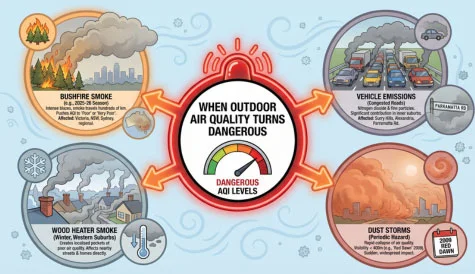
The problem isn’t the average — it’s the spikes.
The Main Outdoor Threats in Sydney
- Bushfire smoke is the most dramatic. The 2025–2026 fire season brought intense blazes in Victoria and New South Wales, with smoke plumes drifting hundreds of kilometres and temporarily pushing AQI levels into “Poor” or “Very Poor” categories across Sydney and regional areas.
- Vehicle emissions from Sydney’s congested road network contribute significantly to nitrogen dioxide and fine particle levels, particularly in inner suburbs like Surry Hills, Alexandria, and Parramatta Road corridors.
- Dust storms remain a periodic hazard. Sydney’s 2009 “Red Dawn” — when visibility dropped below 400 metres — remains the most dramatic example of how rapidly outdoor air quality can collapse.
- Wood heater smoke in Sydney’s cooler western suburbs during winter creates localised pockets of poor air quality that affect nearby streets and homes directly.
What “Good” Outdoor Air Quality Looks Like
Australia uses the National Environment Protection Measure (NEPM) standards to define acceptable outdoor air quality:
- PM2.5: Below 8 µg/m³ annually (planned reduction to 7 µg/m³)
- PM10: Below 25 µg/m³ over 24 hours
- Nitrogen Dioxide (NO₂): Below 0.12 ppm (1-hour average)
- Carbon Monoxide (CO): Below 9 ppm (8-hour average)
- Ozone (O₃): Below 0.10 ppm (4-hour average)
On most Sydney days, these benchmarks are comfortably met. But the indoor picture tells a very different story.
The Uncomfortable Truth About Indoor Air Quality in Sydney
Here’s where the comparison shifts dramatically.
Australia’s first national indoor air quality report — the “State of Indoor Air in Australia 2025,” led by QUT researchers — analysed 106 peer-reviewed studies across more than 2,500 buildings and found widespread variations in pollutant concentrations across Australian homes, workplaces, schools, and public buildings.
The headline finding: indoor air in Australian homes is consistently two to five times more polluted than outdoor air — and in some cases, up to ten times worse. Less than 0.03% of Australia’s building stock has been studied for indoor pollutant levels, meaning the full scale of the problem is almost certainly underestimated.
Why Indoor Air Accumulates More Pollution
Outdoor air, for all its faults, has one major advantage over indoor air: it moves. Wind disperses pollutants. Rain washes particles out of the atmosphere. Sunlight breaks down some chemical compounds.
Indoor air has none of these natural cleaning mechanisms. Every pollutant produced inside a building stays there — unless someone actively ventilates it out.

The Airtight Building Problem
Modern Sydney homes are built with energy efficiency in mind. Better insulation, tighter seals around doors and windows, double glazing — all of it reduces the natural air exchange that older homes relied on to flush indoor pollutants out.
The result is a well-insulated, comfortable home that traps everything produced inside it: cooking fumes, cleaning product chemicals, pet dander, mould spores, and VOCs off-gassing from furniture and building materials.
What Causes Bad Indoor Air Quality in Sydney Homes?
Understanding the sources is the first step to addressing them. Indoor air pollution in Sydney homes comes from a surprisingly wide range of everyday activities and materials.
1. Cooking — The Biggest Everyday Source
Gas Cooktops and Indoor NO₂
Gas stoves and cooktops produce nitrogen dioxide (NO₂) every single time they’re used. Research consistently shows that homes with gas cooking have significantly higher indoor NO₂ levels than homes with electric or induction cooking — often exceeding WHO guidelines during and after meal preparation.
In Sydney, where gas cooking is still widespread, this is a daily exposure concern that most residents are completely unaware of.
What Cooking Without Ventilation Does
- Particulate matter from frying spikes dramatically without rangehood use
- Acrolein and other combustion byproducts from cooking oils accumulate rapidly
- CO₂ levels in poorly ventilated kitchens can rise to levels that affect cognitive function within minutes
Use your rangehood — on high — every time you cook. Open a kitchen window for cross-ventilation. This single habit makes a measurable difference to indoor air quality.
2. VOCs From Building Materials and Household Products
What VOCs Are and Where They Come From
Volatile Organic Compounds (VOCs) are chemicals that evaporate at room temperature and linger in indoor air.
Sydney homes contain dozens of VOC sources that most residents never think about:
- New furniture and carpets — off-gas formaldehyde and other chemicals, particularly in the first year
- Paints and varnishes — even “low-VOC” options release compounds during and after application
- Cleaning products — particularly spray products that aerosolise chemicals directly into breathing air
- Air fresheners and scented candles — a significant VOC source that many asthma and allergy sufferers don’t identify as a trigger
- New flooring — engineered timber, vinyl, and laminate all off-gas VOCs, especially when new
Indoor VOC and formaldehyde concentrations in Australian homes can be 8 to 12 times higher than outdoors in some studies — a statistic that puts the indoor vs outdoor air quality comparison in sharp relief.
3. Mould — Sydney’s Humidity Problem
Why Mould Is a Bigger Issue in Sydney Than Most Cities
Sydney’s combination of coastal humidity, warm summers, and periodic wet weather creates ideal conditions for mould growth inside homes — particularly in poorly ventilated bathrooms, laundries, under-floor spaces, and inside air conditioning units.
Once mould establishes itself, it continuously releases spores into the air. Those spores are potent allergens and respiratory irritants — directly linked to worsened asthma, allergic rhinitis, and respiratory infections.
Suburbs with older housing stock — Marrickville, Newtown, Leichhardt, and parts of the Inner West — tend to have higher rates of indoor mould problems due to older building construction with less effective moisture management.
4. Biological Allergens
The Invisible Indoor Pollution in Every Sydney Home
- Dust mites thrive above 50% relative humidity — which describes most Sydney homes in summer
- Pet dander from cats and dogs accumulates in soft furnishings, carpets, and AC filters
- Pollen that enters through open windows and doors during Sydney’s high pollen season
- Cockroach allergens — particularly in higher-density housing — are a well-documented asthma trigger
5. Bushfire Smoke Infiltration
When Outdoor Pollution Becomes an Indoor Problem
During Sydney’s bushfire events — increasingly common with climate-driven fire seasons — smoke plumes push AQI levels into dangerous categories. And while closing windows provides some protection, fine PM2.5 particles penetrate even relatively well-sealed homes.
During a smoke event, indoor PM2.5 levels can approach or exceed outdoor levels within hours — particularly in older homes with less effective sealing. This is when a HEPA air purifier becomes genuinely essential, not optional.
Indoor vs Outdoor Air Quality — Side-by-Side Comparison
| Factor | Indoor Air (Sydney Homes) | Outdoor Air (Sydney) |
| PM2.5 levels | Often 2–10x outdoor levels | Generally below 8 µg/m³ — one of world’s cleanest |
| VOC concentration | 8–12x outdoor levels in some studies | Low, dispersed by wind |
| Main pollutants | Mould, dust mites, VOCs, NO₂ from gas cooking, formaldehyde | PM2.5, NO₂, ozone (mainly traffic and bushfire) |
| Regulation | Largely voluntary, minimal enforcement | Strictly regulated under NEPM standards |
| Seasonal variation | Worse in winter (lower ventilation) | Worse in summer/bushfire season |
| Natural cleaning | None — pollutants accumulate | Wind, rain and sunlight disperse and break down pollutants |
| Monitoring | Less than 0.03% of buildings studied | Well-monitored via NSW Health AQI network |
| Main risk periods | Year-round in poorly maintained homes | Bushfire season and peak traffic hours |
What Is Good Indoor Air Quality? — The Standards
Australia doesn’t have a mandatory national standard for residential indoor air quality — a gap the 2025 report explicitly called out as needing urgent attention. However, CSIRO and WHO guidelines give us useful targets to work toward.
CSIRO Indoor Air Quality Targets for Australian Homes
| Pollutant | Target Level |
| PM2.5 (fine particles) | Below 8 µg/m³ annually / below 25 µg/m³ over 24 hours |
| Carbon dioxide (CO₂) | Below 1,000 ppm |
| Total VOCs | Below 500 µg/m³ (1-hour average) |
| Formaldehyde | Below 100 µg/m³ (30-minute average)\ |
| Relative humidity | 40–60% — below this range for mould prevention |
| Temperature | 18–24°C — supports both comfort and reduced biological growth |
What Causes Bad Outdoor Air Quality in Sydney?
To complete the comparison fairly, it’s worth understanding when outdoor air in Sydney becomes genuinely problematic.
The Main Outdoor Air Quality Threats in Sydney
1. Bushfire Smoke — The Dominant Risk
Climate change is intensifying Australia’s fire seasons.
Exposure to Australia air pollution — even at relatively low average levels — is estimated to result in 4,880 premature deaths annually, with respiratory and cardiovascular impacts being the primary pathways. Yoast During extreme fire events, that toll rises sharply.
2. Vehicle Emissions in Urban Sydney
Traffic is the dominant day-to-day outdoor pollutant source in Sydney’s urban corridor. Nitrogen dioxide from diesel vehicles is particularly problematic near major roads — Oxford Street, Parramatta Road, and the M4 corridor consistently register higher NO₂ levels than suburban areas.
3. Dust Storms
Periodic dust storm events — driven by drought conditions in outback NSW — can rapidly push Sydney’s AQI from “Good” into dangerous territory within hours.
4. Wood Heater Smoke in Winter
In cooler western and southern Sydney suburbs — the Hills District, Penrith, and the Upper Blue Mountains — residential wood heaters create localised winter pollution that can be as severe as traffic-related emissions on cold, still nights.
How to Improve Indoor Air Quality in Your Sydney Home
The good news: most indoor air quality problems are fixable with consistent, practical habits.
1. Ventilate Actively and Consistently
Simple Ventilation Habits That Make a Real Difference
- Open windows and doors for at least 10 minutes every morning to flush stale indoor air
- Use your rangehood on high every time you cook — front element cooking especially
- Run bathroom exhaust fans during and for 20 minutes after showering
- Cross-ventilate by opening windows on opposite sides of the house to create airflow
- On high-pollen or smoke days, keep windows closed and rely on filtered AC instead
2. Control the Main Pollution Sources
Source Management at Home
- Switch from gas to induction cooking if possible — the single biggest reduction in indoor NO₂
- Choose low-VOC paints, flooring, and furniture — particularly important in new builds and renovations
- Eliminate spray air fresheners — solid options or natural ventilation are safer alternatives
- Never smoke or vape indoors — tobacco smoke is among the most potent indoor air pollutants
3. Use HEPA Air Purifiers Strategically
When and Where to Use an Air Purifier in Sydney
Air purifiers with true HEPA filters trap over 99% of particles like dust, pollen, and mould spores. For Sydney households during bushfire season, a well-sized HEPA air purifier is not optional — it is one of the most direct and effective interventions available for protecting indoor air quality during smoke events.
Place purifiers in the rooms where you spend the most time — bedroom and living room first.
4. Manage Humidity to Prevent Mould
Keeping Sydney’s Humidity Under Control Indoors
- Target indoor humidity between 40–50% using AC or a dedicated dehumidifier
- Use a plug-in hygrometer to monitor levels accurately in each room
- Fix any water leaks or rising damp immediately — mould can establish within 24–48 hours of sustained moisture
- Dry laundry outdoors or with ventilation rather than inside closed rooms
5. Clean Regularly and Strategically
Reducing Biological Allergen Loads
- Vacuum carpets and soft furnishings weekly using a HEPA-filter vacuum
- Wash all bedding above 55°C every week to kill dust mites
- Clean AC filters every 2–4 weeks during summer to prevent allergen recirculation
- Wipe down bathroom and kitchen surfaces regularly to prevent mould establishment
6. Monitor Your Indoor Air
Tools for Sydney Homeowners
- Hygrometer — monitors humidity, available at any hardware store
- CO₂ monitor — flags poor ventilation before it becomes a health issue
- AQI apps — NSW Health’s Air Quality app and IQAir provide real-time outdoor readings so you know when to keep windows closed
Frequently Asked Questions About Indoor and Outdoor Air Quality
1. Is indoor air quality worse than outdoor air in Sydney?
Yes — for most Sydney homes on most days.
Indoor air can be 2 to 10 times more polluted than outdoor air due to cooking fumes, VOCs from building materials, mould, dust mites, and inadequate ventilation. Sydney’s outdoor air, by contrast, ranks among the cleanest globally under normal conditions.
2. How can I improve indoor air quality in my Sydney home?
Ventilate daily by opening windows for at least 10 minutes, use your rangehood every time you cook, clean AC filters every 2–4 weeks, maintain indoor humidity at 40–50%, use a HEPA air purifier during bushfire smoke events, and choose low-VOC paints and furnishings.
3. What indoor air quality standard should I aim for at home?
Using CSIRO guidelines as a benchmark, target PM2.5 below 8 µg/m³, CO₂ below 1,000 ppm, total VOCs below 500 µg/m³, formaldehyde below 100 µg/m³, and indoor humidity between 40–60%.
4. When is Sydney’s outdoor air quality at its worst?
During bushfire events, major dust storms, and winter mornings when wood heater smoke and traffic emissions are trapped close to ground level by temperature inversions. Real-time data is available through the NSW Health Air Quality website and the IQAir app.
Conclusion
For most Sydney residents, most of the time, indoor air is the bigger concern.
Sydney’s outdoor air is genuinely among the cleanest in the world on most days. But the air inside Sydney homes — full of cooking fumes, VOCs from furniture, humidity-driven mould, dust mites, and poorly maintained AC systems — is frequently 2 to 10 times more polluted than what’s outside.
The irony is that we rarely think about indoor air quality.
We check the weather. We track pollen counts. But most of us have never measured what’s in the air inside our own homes.
Poor indoor air quality harms health and productivity, and Australia needs urgent action through monitoring, reporting, and enforceable standards to ensure clean indoor air. Until that regulation arrives, the responsibility falls on individual households to take it seriously.
