
Here’s a question a lot of Sydney homeowners ask themselves at least once: do I really need to pay for professional duct cleaning, or can I just handle it myself and save a few hundred dollars?
It’s a fair question. And the honest answer isn’t as simple as “always hire a pro” or “just do it yourself.”
The real answer depends on what you’re actually trying to achieve, what condition your ducted system is in, and whether you understand what DIY duct cleaning can — and cannot — realistically do.
Let’s break it all down properly so you can make a genuinely informed choice.
What Air Duct Cleaning Actually Involves
Before you can compare the two options, it helps to understand what’s actually happening inside your ductwork.
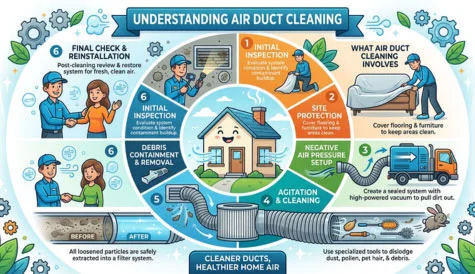
Your ducted air conditioning or heating system has a network of channels running through your ceilings and walls, pushing conditioned air into every room.
Over time, dust, pollen, pet hair, mould spores, and all sorts of airborne debris settle inside those ducts.
Every time your system runs, that accumulated mess gets stirred up and pushed into the air you’re breathing. In a city like Sydney — with its coastal humidity, long summers, and high pollen seasons — this happens faster than most people realise.
What Builds Up Inside Your Ducts?
- Dust and fine particles from everyday living
- Pet dander and animal hair
- Mould and mildew spores (especially in humid areas)
- Pollen drawn in from Sydney’s outdoor environment
- Insect debris and pest remnants in older systems
- Bacteria and allergens that thrive in warm, moist ductwork
When you clean your ducts — whether DIY or professionally — you’re trying to remove all of that. The difference between the two approaches lies in how much of it actually gets removed.
DIY Duct Cleaning — What You Can Realistically Do
There’s a version of DIY duct cleaning that’s genuinely useful, and there’s a version that gives you a false sense of security. Knowing which is which matters a lot.
What DIY Can Cover
When people clean their ducts themselves, they typically focus on the parts they can actually access — the vent covers, the visible sections of ductwork near the registers, and the return air grille.
With the right tools and some time on a weekend, you can absolutely clean these areas reasonably well.

Tools You’ll Typically Need for DIY
- A household vacuum with a long hose attachment
- A stiff-bristled brush or a flexible duct brush
- A screwdriver for removing vent covers
- Microfibre cloths for wiping down grilles and registers
- A torch to inspect inside the duct openings
This kind of surface cleaning — removing visible dust from grilles, cleaning accessible duct sections, and washing the removable covers — is absolutely worth doing between professional services. It takes a few hours and makes a noticeable difference to airflow and surface cleanliness.
Where DIY Falls Short
Here’s the part that most DIY guides don’t tell you clearly enough.
A standard household vacuum, even a reasonably powerful one, doesn’t have anywhere near the suction required to pull debris from deep inside a ducted system. The runs can extend many metres through walls and ceilings, and the debris that’s built up deep inside simply isn’t going anywhere with a shop vac and a long brush.
The Honest Numbers
Research consistently shows that DIY duct cleaning, even done thoroughly with good equipment, reaches roughly 25–30% of the total ductwork system.
That means the other 70–75% stays untouched. The dust, mould, and allergens sitting in the deeper sections of your ductwork continue circulating through your home every single time your system runs.
Real Risks of Going Full DIY
It’s not just about effectiveness — there are genuine risks worth understanding.
- Spreading contaminants rather than removing them
- If you dislodge debris from duct walls without adequate suction to capture it, you can actually push those particles into your living areas. Mould spores are particularly dangerous in this regard — once disturbed without proper containment, they spread rapidly.
- Damaging the ductwork. Flexible ducts
- which are common in many Sydney homes — can tear or become misaligned if the wrong tools are used too aggressively. Repairs to damaged ductwork aren’t cheap.
- Missing structural issues
- A homeowner cleaning their own ducts can’t diagnose problems like deteriorating insulation, pest intrusion, disconnected sections, or growing mould colonies deep within the system. These issues get missed entirely and continue worsening.
Professional Duct Cleaning — What You’re Actually Getting
Professional duct cleaning uses a completely different category of equipment and a systematic approach that covers the entire system, not just the parts you can reach from the ground.
The Equipment Difference
This is the core of why professional cleaning is so much more effective.
A certified duct cleaning technician arrives with industrial-grade HEPA vacuum systems that generate negative pressure throughout the entire duct network. Instead of pushing debris around, this creates a powerful draw that pulls contaminants out from every section of the system simultaneously.
What Professionals Use
- Industrial HEPA vacuum systems — up to 10–20 times more powerful than any household vacuum
- Rotary brushes and air whips — mechanically agitate and dislodge debris from duct walls
- Compressed air tools — blow accumulated matter towards collection points
- Sanitisation products — applied after cleaning to kill mould spores and bacteria
- Deodorising treatments — remove musty odours caused by organic buildup
- Inspection cameras — allow technicians to visually confirm the inside of ductwork before and after
What a Professional Service Covers
A thorough professional duct clean in Sydney typically includes:

- Full inspection of the ductwork before and after cleaning
- Cleaning of supply ducts, return air ducts, and the main plenum
- Cleaning and sanitisation of the air handling unit
- Removal of mould, bacteria, and allergens from the entire system
- Detection of structural issues like disconnected ducts or deteriorating insulation
- A written service report confirming what was cleaned and any issues found
Why Sydney Homes Specifically Need This
Sydney’s climate makes professional duct cleaning more important than in many other Australian cities. The combination of high summer humidity, coastal air, and long periods of heavy system use creates conditions where mould growth inside ductwork is genuinely common.
Homes near the coast deal with salt air accelerating corrosion in older systems.
Suburbs with heavy tree coverage see higher pollen loads pulling into ductwork. And Sydney’s urban environment brings its own fine particle pollution into home HVAC systems year-round.
A surface clean simply doesn’t address any of that in a meaningful way.
DIY vs Professional Duct Cleaning — Side-by-Side Comparison
| Feature | Professional Cleaning | DIY Cleaning |
| Effectiveness | Deep, whole-system clean | Surface level only |
| System reach | 100% of ductwork | 25–30% of ductwork |
| Equipment | Industrial HEPA vacuums, rotary brushes, air whips | Household vacuum, basic brushes |
| Mould removal | Yes — full sanitisation included | No — risk of spreading spores |
| Structural inspection | Yes — cameras and written report | No — issues go undetected |
| Allergen elimination | Comprehensive | Minimal |
| Time investment | A few hours (technician handles everything) | Can take an entire weekend or more |
| Risk of damage | Low — trained technicians | Higher — incorrect technique can tear flexible ducts |
| Deodorisation | Yes — included in most services | Not possible without professional products |
When You Absolutely Should Call a Professional
Some situations aren’t really a matter of preference — they genuinely require professional attention.
Signs Your Sydney Home Needs a Professional Duct Clean Now
- You or your family have unexplained allergy or asthma symptoms at home — particularly if they improve when you’re outside but return indoors, this strongly points to compromised indoor air quality from dirty ducts.
- There’s a musty or stale smell when your system runs — this is almost always a sign of mould or bacteria growth inside the ductwork that no amount of DIY cleaning will resolve.
- You’ve recently completed renovations — construction dust is extremely fine and penetrates ductwork comprehensively. A post-renovation professional clean is essentially non-negotiable for protecting your HVAC system.
- There’s visible mould around your vents or registers — if you can see mould on the outside, what’s happening deeper inside the system is significantly worse.
- You’ve moved into a new home and have no record of the last clean — there’s really no way to know what’s been building up in there.
- You’ve found evidence of pest activity near your system — insects and rodents in ductwork create contamination that genuinely requires professional remediation, not a DIY brush.
- Your system is noticeably less efficient — rooms taking longer to reach temperature, uneven cooling across the house, or a rising electricity bill without obvious explanation can all point to blocked ductwork.
When DIY Makes Sense
To be completely fair, there are situations where doing it yourself is genuinely the right call.
Appropriate Times for DIY Duct Maintenance
- Routine grille and register cleaning
- removing and washing vent covers every few months is straightforward and genuinely helpful
- Visible dust in accessible duct sections
- wiping down the first 30–40 centimetres inside a duct opening is easy and worthwhile
- Between professional services
- regular light maintenance extends the effectiveness of your last professional clean
- Dryer vent maintenance
- this is a case where DIY cleaning is actually effective, because dryer vents are short, simple, and fully accessible
Think of DIY maintenance as the equivalent of washing your car between professional detailing sessions. It keeps things looking and functioning better in the short term, but it doesn’t replace the deeper work.
How Often Should Sydney Homes Have Professional Duct Cleaning?
The general recommendation for most Australian homes is a professional duct clean every three to five years. But that’s very much a baseline — several factors push that timeline forward significantly:
Clean More Frequently If Your Home Has:
- Pets — animal hair and dander accumulate rapidly in ductwork
- Allergy or asthma sufferers — compromised indoor air quality has direct health consequences
- Smokers — smoke particles coat the inside of ductwork and require more frequent removal
- Young children or elderly residents — both groups are more vulnerable to poor indoor air quality
- Recent construction or renovation work — fine dust from building work contaminates systems quickly
- A coastal location in Sydney — salt air accelerates buildup and corrosion inside systems
Frequently Asked Questions About DIY vs Professional Air Duct Cleaning
1. Is DIY duct cleaning effective in Sydney homes?
DIY cleaning is effective for surface-level maintenance — cleaning accessible registers and visible duct sections.
However, it typically only reaches around 25–30% of your total ductwork, leaving the majority of the system uncleaned. For a thorough clean, professional service is necessary.
2. How often should I have professional duct cleaning in Sydney?
Most homes benefit from professional duct cleaning every three to five years. If you have pets, allergy sufferers, or a coastal property in Sydney, more frequent cleaning — every one to two years — is generally recommended.
3. Can dirty air ducts cause health problems?
Yes.
Contaminated ductwork circulates dust, mould spores, allergens, and bacteria through your home every time your system runs. This can worsen asthma, trigger allergies, cause sinus congestion, and contribute to respiratory infections over time.
4. What’s the risk of cleaning my own ducts incorrectly?
The main risks are spreading contaminants (particularly mould spores) rather than removing them, damaging flexible ductwork with overly aggressive tools, and missing underlying issues like structural damage, pest activity, or mould colonies deep within the system.
5. How do I know if my Sydney home’s ducts need cleaning?
Key signs include a musty smell when your system runs, unexplained allergy symptoms indoors, visible mould around vents, uneven airflow between rooms, or a rise in energy bills without another clear cause.
Conclusion
DIY duct cleaning isn’t useless — but it’s also not a substitute for professional service when it comes to the health and efficiency of your ducted system.
Cleaning accessible surfaces and grilles regularly is great maintenance habit. But genuinely cleaning a ducted HVAC system — including the deep duct runs, the air handling unit, and all the sections you can’t see or reach — requires the kind of equipment and expertise that only a qualified professional brings.
For Sydney households dealing with summer humidity, coastal air, and the demands of a system that runs for months at a time, the investment in periodic professional duct cleaning pays off in cleaner air, a more efficient system, lower running costs, and fewer expensive repairs down the line.
If you genuinely can’t remember the last time your ducts were professionally cleaned — or you’ve never had it done at all — that’s your answer right there.
