
Most Sydney homeowners spend a lot of time and energy keeping their homes clean and comfortable on the outside. But what about the air inside?
Here is a fact that often surprises people: most Australians spend over 90% of their time indoors, and CSIRO research consistently shows indoor air in Australian homes can be 2 to 5 times more polluted than outdoor air — with off-gassing from furniture and flooring, cooking fumes, mould spores, pet dander, and during bushfire season, PM2.5 concentrations above 150 micrograms per cubic metre documented in suburban homes.
That is a significant health concern — and it is one that most Sydney households are not actively addressing.
This guide covers everything you need to know about indoor air quality in Sydney — what it is, why it matters, what is affecting it in your specific local conditions, and the practical steps you can take right now to breathe better at home.
What Is Indoor Air Quality?
Indoor air quality (IAQ) refers to the condition of the air inside your home — specifically how clean, fresh, and free from harmful pollutants it is.
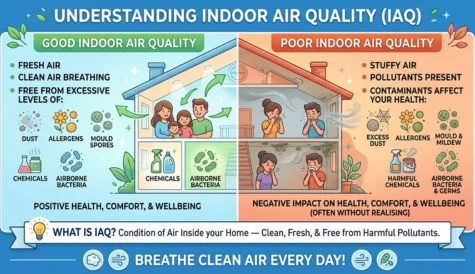
Good indoor air quality means the air you breathe is free from excessive levels of dust, allergens, mould spores, chemicals, and airborne bacteria.
Poor indoor air quality means one or more of these contaminants are present at levels that affect your health, comfort, or wellbeing — often without you even realising it.
Why Indoor Air Quality Matters for Sydney Families
Why indoor air quality matters goes well beyond basic comfort. Australia’s first national indoor air quality report, the “State of Indoor Air in Australia 2025” highlights the health, wellbeing and economic risks posed by poor indoor air quality across homes, workplaces, schools, hospitals and public buildings.
The health impacts are real and well-documented.
Poor indoor air quality can contribute to carbon monoxide poisoning from gas heaters without enough ventilation, transmission of infectious diseases like influenza and COVID-19 by airborne viruses, and respiratory and cardiovascular impacts from particulate matter. High levels of carbon dioxide and particulate matter can also affect educational results in school classrooms and reduce workplace productivity.
For Sydney families — particularly those with young children, asthma sufferers, or elderly household members — the quality of indoor air is not a secondary concern. It is a direct determinant of everyday health and quality of life.
What Affects Indoor Air Quality in Sydney Homes
What affects indoor air quality in Sydney is shaped by a unique combination of local environmental conditions and the way modern Australian homes are built and used.
1. Common Indoor Air Pollutants to Know
Volatile Organic Compounds (VOCs)
VOCs are invisible chemicals released by paints, cleaning products, synthetic carpets, flat-pack furniture, and even air fresheners. Australian homes use adhesives, engineered timber, paints, and synthetic carpets that off-gas volatile organic compounds — including formaldehyde and benzene — for 6 to 24 months after installation.
They are one of the most common causes of headaches, dizziness, and persistent tiredness in Sydney households, and most people never connect the symptoms to their home environment.
2. Mould Spores and Moisture
Sydney’s warm, humid summers create perfect conditions for mould growth — particularly in poorly ventilated rooms, under-floor spaces, and inside air conditioning units. In areas like Canterbury and Hurstville, poor sub-floor ventilation is a common cause of dampness and musty odours.
Once mould establishes itself, it releases spores into the air continuously — triggering allergies, worsening asthma, and contributing to respiratory infections across the household.
3. Dust Mites, Pet Dander and Pollen
These are the everyday allergens that most Sydney families are familiar with — but fewer realise just how concentrated they become indoors when ventilation is poor.
Dust mites thrive in bedding, carpets, and soft furnishings. Pet dander from cats and dogs accumulates in fabrics.
And in spring and early summer across Sydney’s western suburbs and the Hills District, pollen levels are significant enough to be a daily trigger for allergy and asthma sufferers.
4. Bushfire Smoke — A Specifically Sydney Concern
This one deserves special attention. During the 2019–20 Black Summer fires, Sydney recorded PM2.5 levels 11 times higher than WHO guidelines. A well-sized air purifier running on high can reduce indoor PM2.5 by 80 to 90 percent during smoke events.
Even in years without catastrophic fire events, hazard reduction burns across Greater Sydney — from the Blue Mountains to the Royal National Park — regularly push particulate matter into suburban air throughout autumn and winter.
5. Cooking Fumes and Poor Exhaust Ventilation
This is one of the most underestimated contributors to poor indoor air quality in Australian homes. When cooking, using a high-efficiency exhaust fan vented outside removes emissions and cooking odours effectively.
Many Sydney kitchens, particularly in older terrace homes across the Inner West and apartment buildings in suburbs like Surry Hills and Newtown, have inadequate exhaust ventilation — allowing cooking fumes, grease particles, and moisture to circulate through the home.
How to Improve Indoor Air Quality in Sydney — Practical Tips
Now for the part that matters most — what you can actually do about it.
1. Improve Ventilation First
Open Windows Strategically for Cross-Ventilation
Sydney’s temperate climate makes natural ventilation a practical solution, particularly during cooler months when you can open windows and doors to allow air to circulate. Cross-ventilation, where air flows in from one side of the house and out the other, can be particularly effective.
The key is timing. In summer, open windows in the early morning before the heat builds.
In spring, check pollen forecasts and close windows on high-count days. During hazard reduction burn periods, keep windows closed and rely on filtration instead.
Use Exhaust Fans Consistently
When cooking, use a high-efficiency exhaust fan vented outside to remove emissions and cooking odours. Also avoid generating moisture indoors through activities like using a clothes dryer without sufficient ventilation.
Run your kitchen exhaust fan every time you cook — not just when something is burning. Do the same in the bathroom after showers to prevent moisture buildup that leads to mould.
2. Control Humidity Levels
Keep Humidity Between 30 and 50 Percent
In Sydney’s humid climate, controlling humidity is crucial. Aim for a relative humidity between 30 and 50 percent to prevent mould and dust mites without causing dry skin or irritation.
A dehumidifier is particularly useful in Sydney homes through summer and in rooms prone to dampness — bathrooms, laundries, and ground-level bedrooms are common problem areas. Monitoring humidity with a simple, inexpensive hygrometer gives you real-time awareness of conditions in each room.
Address Moisture at the Source
If you see visible mould, address the moisture cause before treating the surface. Painting over mould without fixing the ventilation or waterproofing issue that caused it will not resolve the problem — the mould returns within weeks.
3. Use a HEPA Air Purifier
Choose True HEPA for Best Results
Air purifiers with true HEPA filters are the gold standard, trapping over 99 percent of particles like dust, pollen, and mould spores. For maximum efficiency, place the air purifier in rooms where you spend the most time, such as the bedroom or living room.
For Sydney households during bushfire season, a well-sized HEPA air purifier is not optional — it is one of the most direct and effective interventions available for protecting indoor air quality during smoke events.
Match the Purifier to Your Room Size
A common mistake is buying a purifier designed for a small room and placing it in a large open-plan living area. The Clean Air Delivery Rate (CADR) needs to match the room volume. When in doubt, go slightly larger — running a bigger unit on a lower, quieter setting is always more effective than running a small unit at maximum.
4. Maintain Your Air Conditioning System
Clean or Replace AC Filters Regularly
Your air conditioning system — whether a split system or ducted unit — is one of the primary air circulation mechanisms in your home. When the filter is dirty, it does not just reduce cooling efficiency.
It circulates accumulated dust, mould spores, and allergens directly into your living spaces.
Ensure any mechanical ventilation systems are well-maintained and have a high-grade filter to bring clean outside air indoors.
For most Sydney homes, this means cleaning or rinsing filters every one to three months — more frequently if you have pets, live near a busy road, or run the system year-round.
Book an Annual Professional AC Service
A professional service goes well beyond filter cleaning. A licensed technician cleans the evaporator coil, flushes the condensate drain, treats any mould on internal components, and checks refrigerant levels — all of which directly affect the quality of air your system distributes through your home.
5. Reduce VOC Sources Throughout Your Home
Choose Low-VOC Products Where You Can
Avoid cleaning products, air fresheners, scents and sprays, cosmetics, glues, paint, varnishes, carpet and fibreboard with high volatile organic compound content.
Practical steps for Sydney households include switching to fragrance-free or plant-based cleaning products, choosing low-VOC or zero-VOC paints for any renovation work, and airing out new furniture outdoors for several days before bringing it inside.
Ventilate Aggressively After Renovation
After painting, laying new carpet, or installing flat-pack furniture — open windows and run fans continuously for at least 48 to 72 hours. This dramatically accelerates the off-gassing period and reduces the concentration of VOCs during the highest-risk window.
6. Vacuum and Clean Strategically
Use a HEPA Vacuum for Dust and Allergen Control
Standard vacuum cleaners capture large particles but allow fine dust and allergen particles to pass through the exhaust and back into the air. A vacuum with a HEPA filter keeps those particles contained.
Vacuum carpets and rugs at least weekly with a HEPA filter vacuum to trap dust effectively. Use a damp microfibre cloth for surfaces to capture dust instead of spreading it.
Wash all bedding weekly in hot water — at least 54 degrees Celsius — to kill dust mites.
For Sydney homes with pets, a weekly HEPA vacuum is the single most effective habit for managing pet dander levels in the indoor environment.
Signs Your Sydney Home Has Poor Indoor Air Quality
You do not always need a monitoring device to tell when something is not right. Watch for these indicators.
- Persistent musty or stale smell when the AC or heating turns on
- Family members experiencing more frequent sneezing, runny noses, or sore throats at home
- Worsening asthma or allergy symptoms that improve when you leave the house
- Unexplained headaches, fatigue, or difficulty concentrating indoors
- Condensation regularly forming on windows or walls
- Visible mould spots in bathrooms, laundries, or on window frames
- Air from vents that smells dusty or stale despite the system running normally
Any combination of these is a signal to take indoor air quality more seriously — and to start with the practical steps covered above.
Frequently Asked Question About Indoor Air Quality in Sydney Homes
1. Is indoor air really more polluted than outdoor air in Sydney?
Yes.
CSIRO research consistently shows indoor air in Australian homes can be 2 to 5 times more polluted than outdoor air. This is due to off-gassing from materials, cooking fumes, mould, and the concentration of allergens in enclosed spaces without adequate ventilation.
2. What is the most common cause of poor indoor air quality in Sydney?
Inadequate ventilation combined with moisture buildup is the most common root cause. It allows mould to grow, dust and allergens to accumulate, and VOCs from household products to concentrate to levels that affect health.
3. Do indoor plants improve air quality?
While beautiful, a plant’s air-cleaning ability is far less effective than simply opening a window. You would need hundreds of plants in an average room to replicate the results of NASA’s original sealed-chamber study.
Over-watered plants can also lead to mould growth in the soil, releasing spores that worsen allergies. Prioritise source control and ventilation instead.
4. Can my air conditioner improve indoor air quality?
A well-maintained air conditioner with a clean filter does help by filtering airborne particles and controlling humidity. However, a dirty AC unit actively worsens indoor air quality by circulating mould spores and allergens.
Regular cleaning and annual professional servicing are essential for the system to have a positive rather than negative effect.
5. What humidity level should I aim for inside my Sydney home?
Aim for a relative humidity between 30 and 50 percent. Below 30 percent, you risk dry skin and throat irritation.
Above 50 to 60 percent, conditions favour mould growth and dust mite reproduction — both significant indoor air quality concerns in Sydney’s humid climate.
6. How can I protect indoor air quality during Sydney’s bushfire season?
Keep windows and doors closed during smoke events, run a HEPA air purifier on high in rooms where your family spends the most time, and avoid using gas heaters or candles that add additional combustion products to already compromised indoor air. Keep inside air as clean as possible from outdoor air pollutants such as smoke and close windows during short episodes of outside air pollution, then open them when air quality improves.
Conclusion
Improving indoor air quality in Sydney is not about making one big change — it is about building a set of consistent habits and making smart, practical choices about ventilation, humidity, cleaning, and the products you bring into your home.
The combination of Sydney’s humid summers, seasonal bushfire smoke, and the concentration of allergens in modern homes makes indoor air quality a genuinely important concern for every household in the city — from apartments in the CBD to family homes in the Hills District and everywhere in between.
Start with ventilation, Keep your AC filter clean, Control moisture. Use a HEPA air purifier in the rooms where your family spends the most time. And book a professional AC service annually to ensure your cooling and heating system is contributing to better air quality rather than working against it.
Clean indoor air is not a luxury — it is a foundation of everyday health.
