

If you live in Sydney, your air conditioner is not just a convenience — it is practically a necessity.
From the thick, sticky humidity of a January afternoon to the unexpectedly cold evenings that roll in through June and July, your system works incredibly hard throughout the year. And like any machine that puts in that kind of effort, it needs proper looking after if you want it to last.
Here is something a lot of Sydney homeowners find out the hard way: the biggest thing that shapes your AC lifespan is not the brand, the size, or how much you paid for it. It is how well — and how regularly — you clean and maintain it over time.
This guide covers everything you need to know. We will look at what the average AC lifespan actually is in Australian conditions, explain why professional cleaning makes such a significant difference, and help you understand exactly what a qualified HVAC technician does that a quick filter rinse simply cannot replicate.
What Is the Lifespan of an AC Unit?
Before we get into maintenance, it is worth knowing what you are actually working with.
What is the lifespan of an AC unit in Australia when it is looked after properly?
The average lifespan of a well-maintained air conditioning unit is 15 to 20 years.
That said, different AC systems have different lifespans and knowing what to expect from your specific unit is really important.
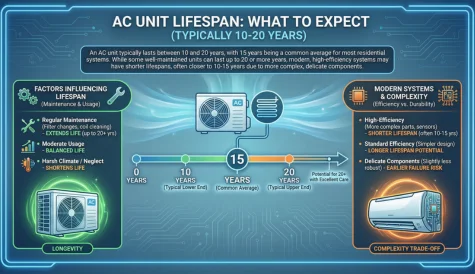
For most Sydney homes, the systems you will come across most often are split systems, reverse cycle units, and ducted air conditioning setups — and all of them sit within that 15-to-20-year window when they are properly serviced.
AC Lifespan by System Type
Not every system ages the same way, and knowing what your unit was designed to do helps you plan your maintenance properly.
1. Split system

The most popular choice across Sydney — from Surry Hills apartments to family homes in Parramatta.
With annual professional servicing, split systems regularly hit 15 to 20 years without serious trouble.
2. Ducted air conditioning
A bigger system designed to cool the whole home, ducted units are built to last 15 to 20 years.
Because there is so much more to clean — ducts, vents, the central unit — professional maintenance matters even more here.

3. Window AC units

Self-contained and simple, these units typically last 10 to 15 years.
Their compact design means they heat up faster and are more vulnerable to dust buildup, so regular cleaning keeps them running longer.
4. Portable AC units
The shortest lifespan of the group — typically 5 to 10 years.
They work hard for their size, and consistent cleaning makes a noticeable difference in how long they hold up.

What Quietly Shortens AC Lifespan
Most of the things that shorten an AC unit’s life happen slowly and invisibly — which is exactly why they catch people off guard.
- Dust and grime building up on evaporator and condenser coils
- Blocked condensate drains line letting moisture pool inside the unit
- Clogged air filters strangling airflow and overworking the compressor
- Bent coil fins reducing heat transfer efficiency
- Undetected refrigerant leaks slowly starving the system
- Corroded or loose electrical connections causing erratic operation
- Mould and bacteria growing inside the indoor unit
Whether you are in a Bondi apartment or a Blacktown brick home, these problems accumulate quietly — and each one chips away at your cooling system’s efficiency and your unit’s overall longevity.
The Average AC Lifespan in Sydney and Why Many Units Fall Short
Here is the honest reality. The average AC lifespan your system was built for and the lifespan it actually achieves are often quite different — and Sydney’s environment plays a bigger role in that gap than most people expect.
A system running in a mild climate without extreme heat, cold, or dust can have an average life expectancy of 15 to 25 years if maintained properly.
Sydney, though, is far from mild when it comes to what your AC has to deal with.
Sydney’s Climate Puts Extra Pressure on AC Systems
The combination of factors in Greater Sydney is genuinely tough on air conditioning units — and it catches a lot of homeowners off guard.
- Homes near Manly, Cronulla, and the Northern Beaches deal with salt air that corrodes outdoor condenser components faster than you would expect.
- Homes across Penrith, Blacktown, and the Hills District face heavy dust and pollen loads that coat filters and coils much faster than properties in the inner city.
- Homes running reverse cycle systems year-round — using the unit for both summer cooling and winter heating — are clocking up operational hours at roughly twice the rate of a seasonally used unit.
All of that adds up to a system that is working harder, wearing faster, and needing more attention than its design specifications alone would suggest.
What Happens When a System Is Left Without Proper Cleaning
When airflow is obstructed by a dirty filter, dirt can bypass the filter and accumulate on the evaporator coil, reducing its heat-absorbing capacity and causing the system to fail prematurely.
It starts with something as simple as a dirty filter. But from there, the problems compound.
A coated evaporator coil cannot absorb heat properly. So, the compressor works harder. A compressor running hotter than it should degrades faster than it should.
Neglecting maintenance can cut your system’s lifespan in half.
A unit designed to run reliably for 18 years that misses regular professional servicing might be having compressor conversations at the 9 or 10 year mark. That is not a manufacturing defect. It is a maintenance shortfall — and it is entirely avoidable.
What Professional AC Cleaning Actually Covers
A lot of Sydney homeowners do a genuinely solid job with the basics — rinsing filters every couple of months, clearing leaves and debris from around the outdoor unit. That is absolutely worth doing. But it covers only a fraction of what a qualified HVAC technician addresses in a proper professional service.
Here is what actually happens during a thorough professional clean.
Indoor Unit Cleaning
1. Evaporator Coil Deep Clean
Professional coil cleaning during routine maintenance dramatically improves efficiency and helps maximise AC lifespan.
The evaporator coil is where heat exchange happens inside your home. In Sydney’s humid air, it collects moisture along with dust, pollen, and anything else floating through your home’s air supply. Over time, it builds up a layer of grime that acts like insulation — stopping the coil from absorbing heat the way it is supposed to.
A technician uses specialist chemical treatments and low-pressure coil jet equipment to clean deep into the coil without damaging the delicate aluminium fins. It is a thorough process that makes a very noticeable difference to cooling performance.
2. Air Filter Service
Filters do a lot of heavy lifting in Sydney homes, catching dust, pollen, pet hair, and fine airborne particles before they reach the coil.
A professional does not just wash the filter and move on. They inspect it carefully for damage, assess whether the filtration level is appropriate for your home’s specific needs, and advise on a replacement or cleaning schedule that suits your suburb’s air quality conditions.
3. Condensate Drain Line Clearing
Moisture issues from blocked condensate drains often go unnoticed until they cause significant damage to internal components.
Your AC removes humidity from the air as it cools — particularly important during a sticky Sydney summer — and all that moisture drains away through a condensate line. When that line gets blocked with algae, mould, or debris, water backs up inside the unit, corrodes components, and creates exactly the warm, damp environment where mould loves to grow.
A professional flushes the drain line completely, checking for blockages that most homeowners would never even know to look for.
Outdoor Unit Cleaning
1. Condenser Coil Cleaning
Outdoor condenser coils can become very dirty, especially in dusty environments or if there is foliage nearby.
The condenser unit releases the heat your AC pulls from inside your home. When it is clogged with leaves, dust, grass clippings — or in coastal Sydney suburbs, salt residue — it simply cannot shed heat efficiently. The compressor then overheats trying to compensate, and that is when the most serious wear begins.
A technician uses appropriate cleaning solutions and high-pressure equipment to fully restore the condenser’s heat rejection performance.
2. Coil Fin Straightening
The aluminium fins on evaporator and condenser coils help with heat transfer. These fins can bend over time and block airflow. A qualified contractor uses a fin comb to straighten them, restoring proper airflow and system efficiency.
Most homeowners have never even heard of this step — yet bent fins are one of the most common contributors to reduced cooling system efficiency in Australian AC units.
System-Wide Safety and Performance Checks
1. Refrigerant Level Inspection
Low refrigerant is never normal. It usually indicates a leak, which can damage the compressor if ignored. Only licensed professionals should handle refrigerants.
In Australia, only technicians holding an ARC (Australian Refrigeration Council) licence are legally permitted to handle refrigerants. This is one task you simply cannot do yourself — legally or safely.
2. Electrical Component Check
A qualified HVAC technician inspects capacitors, contactors, wiring connections, and safety switches for signs of wear, corrosion, or approaching failure.
Spotting a worn capacitor during a routine spring service is a quick, affordable fix. Discovering it has failed during a Sydney heatwave means an emergency callout — and potentially far more damage to surrounding components while you wait for help.
3. Thermostat Calibration
A thermostat reading temperatures inaccurately causes your system to run longer than it needs to, burning extra energy and adding unnecessary wear to the compressor.
A professional recalibrates the thermostat and checks that the temperature your system is targeting actually reflects what is happening in the room — a small adjustment that makes a real difference to both running costs and AC unit longevity.
How Professional Cleaning Directly Extends AC Lifespan
1. Takes the Pressure Off the Compressor
The compressor is the engine of your AC system — and the most expensive part to replace.
Clean airflow equals less strain, better efficiency, and a longer system life.
Every dirty coil, blocked filter, and bent fin forces the compressor to run harder and longer just to maintain your set temperature. Less strain means fewer hours of mechanical stress — and that directly translates into a longer working life for the whole system.
2. Stops Problems Compounding Into Each Other
No issue in an AC system stays contained. One dirty filter leads to a coated coil. A coated coil leads to a stressed compressor. A stressed compressor leads to failed components and, eventually, a system that cannot be repaired economically.
Professional cleaning breaks this cycle at the very beginning — addressing every component in a single visit before any one problem gets the chance to set off the next.
3. Keeps Energy Efficiency Where It Should Be
A well-maintained air conditioner can reduce energy consumption by up to 15%. Clean condenser coils alone can improve cooling system efficiency by as much as 30%.
An efficient system runs shorter, more effective cycles. Shorter cycles mean fewer mechanical hours accumulated each season — and every hour saved is one more hour of life left in your unit.
4. Keeps Your Manufacturer Warranty Intact
Most manufacturers void your warranty without proof of regular maintenance, leaving you completely unprotected when problems arise.
Whether your system is a Daikin, Mitsubishi Electric, Fujitsu, Panasonic, or LG — the warranty terms almost always require documented annual professional servicing. Keep every service record and invoice safely. They are your protection if a major component fails and you need to make a claim.
5. Protects Your Family’s Indoor Air Quality
The dark, damp interior of an AC unit is a breeding ground for mould, making allergies and asthma significantly worse for anyone living in the home.
Professional ducted air conditioning cleaning eliminates dust, mould, and allergens throughout the ductwork, and preventative maintenance minimises repair needs while extending the lifespan of your ducted system.
In Sydney’s humid conditions, mould inside an indoor unit does not just affect air quality — it deteriorates internal components and contributes to the kind of long-term damage that quietly shortens your unit’s service life without any obvious external warning signs.
6. Catches Minor Issues Before They Become Major Repairs
During a maintenance appointment, your HVAC contractor calibrates, cleans, and inspects necessary components — identifying minor issues and recommending repairs before they grow into larger, more expensive problems down the road.
Finding a small refrigerant leak during a routine October service is a simple, contained fix. Finding it because the compressor has completely seized during a 38-degree day in January is an entirely different — and far more expensive — situation altogether.
How Often Should Sydney Homeowners Book a Professional Clean?
For most Sydney homes, the smartest answer is a professional air conditioning service once a year — with extra attention before summer, faster filter cleaning during humid periods, and earlier servicing for coastal, heavy-use, or commercial systems.
When You Should Book More Frequently
Some situations genuinely need more than an annual service to protect your AC lifespan properly.
Book professional cleaning more often if your home:
- Has pets — dog and cat fur coats evaporator coils remarkably quickly
- Sits near the coast — salt air accelerates corrosion on outdoor condenser units
- Is in a dusty area — Penrith, Campbelltown, and Western Sydney suburbs see noticeably heavier airborne particle loads
- Runs a reverse cycle system year-round for both cooling and heating
- Has family members with asthma, allergies, or respiratory sensitivities
- Has a ducted system serving multiple zones throughout a larger home
- Has a system that is already 10 years old or more
Scheduling professional duct cleaning every 3 to 5 years alongside your annual AC service can improve indoor air quality, enhance energy efficiency, and further extend the lifespan of your heating and cooling system.
The Best Time to Book in Sydney
Spring — particularly September and October — is the ideal window to book your annual professional AC service.
You beat the December and January rush when every HVAC technician in Sydney is stretched thin. Your system gets a thorough clean before its heaviest season of work. And any issues found — a low refrigerant level, a worn capacitor, a partially blocked drain line — get sorted out before a January heatwave puts your system to the real test.
Warning Signs Your AC Needs Professional Cleaning Right Now
Do not wait for your scheduled annual appointment if you are seeing any of these. Your system is telling you something is already not right.
- Rising electricity bills with no change in how much you are using the system — a classic sign of declining cooling system efficiency
- Rooms taking much longer to cool even on mild days, or struggling to reach your set temperature
- Musty or stale smells from the vents when the system runs — almost always a sign of mould or bacteria growth inside the unit
- Water dripping or pooling near the indoor unit — a blocked condensate drain line until confirmed otherwise
- Ice forming on refrigerant lines or the indoor coil — usually caused by restricted airflow or low refrigerant levels
- Rattling, hissing, or grinding sounds from either the indoor or outdoor unit
- Short cycling — the system turning on and off rapidly without completing a proper cooling cycle
- Weak airflow from the vents even when the fan is set to high speed
Every one of these is a reason to call a licensed air conditioning technician sooner rather than later. The longer these issues run without attention, the more AC lifespan gets consumed unnecessarily.
Frequently Asked Question About AC Lifespan and Professional Cleaning in Sydney
1. What is the average AC lifespan for a Sydney home?
For a well-maintained system in Sydney, the average AC lifespan sits between 15 and 20 years. With proper professional maintenance, some units can last beyond 20 years. Without consistent servicing — especially in Sydney’s demanding climate — meaningful performance decline can start showing up from around the 8 to 10 year mark.
2. What is the lifespan of an AC unit without regular servicing?
Neglecting maintenance can cut your system’s lifespan in half. A unit designed to run reliably for 15 to 20 years may start facing compressor failure or significant breakdown well before the 10-year mark if professional cleaning is skipped consistently.
3. Does professional AC cleaning really make a difference to lifespan?
It absolutely does. Cleaner coils, clear drain lines, proper refrigerant levels, and early fault detection all reduce the mechanical stress your system operates under every day. Regular professional cleaning can extend a unit’s life expectancy significantly compared to a neglected system. Less daily stress means more years of reliable performance.
4. How often should I book professional AC cleaning in Sydney?
The standard recommendation from HVAC experts across Australia is at least once every 12 months. Homes with pets, coastal exposure, heavy dust environments, year-round reverse cycle usage, or older systems should consider servicing every six months. Between professional visits, rinse or replace your filters every one to three months.
5. Does skipping AC servicing void my warranty?
Yes — for most major brands it does. Many manufacturers require proof of regular professional maintenance to keep the warranty valid. Keep every service invoice and report from your HVAC technician in case you ever need to make a warranty claim.
6. Can I clean my split system myself instead of hiring a professional?
Rinsing or replacing your filters regularly is genuinely useful and worth doing. But evaporator and condenser coil cleaning, refrigerant inspection, electrical checks, and condensate drain clearing all require professional tools, training, and in Australia — a valid ARC licence for any refrigerant work. DIY maintenance is a helpful supplement to professional servicing. It is not a replacement for it.
Conclusion
Your air conditioner is one of the most relied-upon and most valuable appliances in your Sydney home. Whether it is a single split system in a Glebe terrace or a full ducted system cooling a house in Castle Hill, the AC lifespan you get out of it comes down to one decision made each year — booking a qualified professional to properly clean, inspect, and service it.
The average AC lifespan is 15 to 20 years. Well-maintained units in Sydney regularly reach and exceed that. Neglected units in our demanding climate often fall significantly short.
Annual professional cleaning protects your compressor, maintains your energy efficiency, preserves your warranty, improves your indoor air quality, and makes sure your system is ready when a Sydney heatwave hits in January and you need it to perform without question.
