

Most Sydney homes should service their air conditioner once a year — but if you live near the coast, in a dusty western suburb, run the system daily, or have pets, that interval should drop to every six months. The honest answer isn’t a single number; it’s a number adjusted for your specific suburb and usage pattern.
Most servicing guides give you one generic answer regardless of where you live. But Sydney isn’t one climate — it’s dozens of micro-climates, and your postcode genuinely changes how often your system needs attention.
Here’s the breakdown that actually matters for Sydney homeowners.
Why “Once a Year” Isn’t the Full Answer in Sydney
Sydney’s geography creates very different wear patterns on the same system
A split system in Cronulla and the same model in Penrith experience completely different conditions.
One battles salt-laden sea air every day. The other battles dust, pollen, and extreme summer heat load. Both degrade — just differently, and at different speeds.
“We service identical Daikin units across Sydney every week — and the difference in coil condition between a Bondi unit at 12 months and a Castle Hill unit at 12 months can be significant. Location changes everything about how fast contamination builds.”
Service Frequency by Sydney Area Type
Match your suburb’s conditions to the right interval
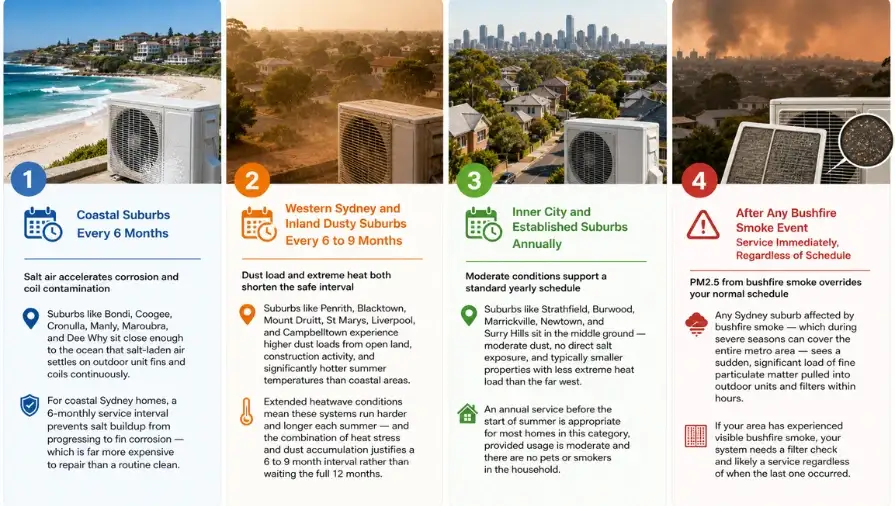
1. Coastal Suburbs — Every 6 Months
Salt air accelerates corrosion and coil contamination
Suburbs like Bondi, Coogee, Cronulla, Manly, Maroubra, and Dee Why sit close enough to the ocean that salt-laden air settles on outdoor unit fins and coils continuously. Salt accelerates corrosion of the condenser fins and creates a sticky residue that traps dust faster than inland areas.
For coastal Sydney homes, a 6-monthly service interval prevents salt buildup from progressing to fin corrosion — which is far more expensive to repair than a routine clean.
2. Western Sydney and Inland Dusty Suburbs — Every 6 to 9 Months
Dust load and extreme heat both shorten the safe interval
Suburbs like Penrith, Blacktown, Mount Druitt, St Marys, Liverpool, and Campbelltown experience higher dust loads from open land, construction activity, and significantly hotter summer temperatures than coastal areas.
Extended heatwave conditions mean these systems run harder and longer each summer — and the combination of heat stress and dust accumulation justifies a 6 to 9 month interval rather than waiting the full 12 months.
3. Inner City and Established Suburbs — Annually
Moderate conditions support a standard yearly schedule
Suburbs like Strathfield, Burwood, Marrickville, Newtown, and Surry Hills sit in the middle ground — moderate dust, no direct salt exposure, and typically smaller properties with less extreme heat load than the far west.
An annual service before the start of summer is appropriate for most homes in this category, provided usage is moderate and there are no pets or smokers in the household.
4. After Any Bushfire Smoke Event — Service Immediately, Regardless of Schedule
PM2.5 from bushfire smoke overrides your normal schedule
Any Sydney suburb affected by bushfire smoke — which during severe seasons can cover the entire metro area — sees a sudden, significant load of fine particulate matter pulled into outdoor units and filters within hours.
If your area has experienced visible bushfire smoke, your system needs a filter check and likely a service regardless of when the last one occurred. PM2.5 saturates filters and coats coils far faster than normal dust accumulation.
Usage-Based Adjustments — On Top of Location
Your habits matter as much as your postcode
| Usage Factor | Adjustment to Base Interval |
| Pets in the home | Reduce interval by 3 months |
| Daily year-round use (cooling + reverse cycle heating) | Reduce interval by 3–6 months |
| System over 10 years old | Step up to 6-monthly checks |
| Smokers in the household | Reduce interval by 3–6 months |
| Vacant or low-use property | Annual is sufficient regardless of suburb |
| Recently renovated property | Service immediately after dust settles |
These adjustments stack with your location category. A coastal home with pets and daily use should realistically be on a 4 to 5 month rotation — not waiting the full year.
The 3-Minute Rule — A Habit That Protects Every Sydney System
Something every household can do between services, free
Regardless of how often your system is professionally serviced, one simple habit protects the compressor between visits.
When switching your AC off — whether at the wall, remote, or during a power interruption — wait at least three minutes before switching it back on. This allows refrigerant pressure to equalise. Restarting too quickly forces the compressor to start against high head pressure, which strains the start components.
Expert Tip: Sydney experiences more brief power interruptions during summer storm season than most people realise — particularly in areas prone to grid load shedding during heatwaves. If your system restarts automatically after a power blip, check that it isn’t cycling on and off within seconds repeatedly. Frequent rapid restarts are one of the most common — and most preventable — causes of premature compressor failure we see in Sydney homes.
Servicing vs Deep Cleaning — Know the Difference
A standard service and a deep duct clean are not the same thing
- A standard aircon service covers filter cleaning, a basic coil wipe, drain flush, electrical safety checks, and a performance test — typically completed in 60 to 90 minutes.
- A deep clean — including full coil disassembly, blower wheel cleaning, and antimicrobial treatment — addresses contamination that a standard service doesn’t reach, and is recommended every 1 to 2 years depending on the factors above.
If your system has visible mould, a persistent musty smell, or hasn’t had a deep clean in over two years, a standard service alone won’t resolve it. That’s when a full duct and coil deep clean becomes the right call rather than a routine service.
Final Thoughts
There’s no single correct answer to how often you should service your aircon in Sydney — but there is a correct answer for your specific home. Your suburb’s climate, your household’s usage pattern, and the age of your system all combine to determine the right interval.
As a starting point: coastal and western Sydney homes should plan for 6-monthly attention, inner and established suburbs can run annually, and any household with pets, daily use, or an older system should lean toward the shorter end of their range.
