
Knowing whether to clean or replace your AC filter comes down to one thing — the type of filter your system actually uses. Getting this wrong means either throwing money away replacing a perfectly good reusable filter every month, or washing a disposable filter that was never designed to survive water.
The key factors to check include your filter material, its current condition, your household situation, and how recently it was last serviced. In this guide, we break down exactly when to clean, when to replace, and what signs to watch for in your Sydney home.
Here’s the reality most online advice skips: reusable, washable filters — standard in most Sydney split systems — should be cleaned regularly and only replaced when damaged. Disposable filters, common in larger ducted systems, are designed for replacement every one to three months and should never be washed and reused.
A lot of advice out there tells you replacement is always the better option. That’s true for one type of filter — and completely wrong for the other.
The filter type is the only thing that decides the answer, and once you know which one you have, the rest is straightforward.
When Cleaning Is the Right Choice For Split System AC Filter
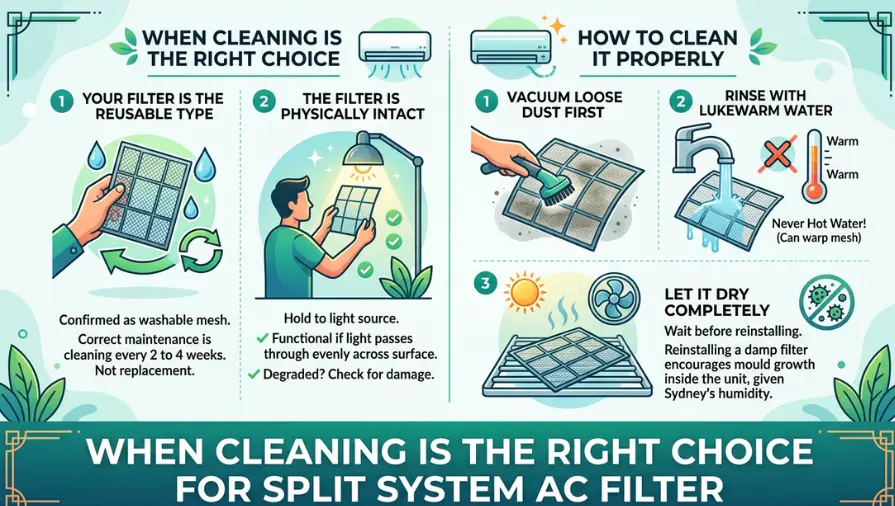
Your filter is the reusable type
If you’ve confirmed your filter is washable mesh, cleaning it every 2 to 4 weeks is the correct maintenance routine — not replacement. Reusable filters are designed for exactly this.
The filter is physically intact
Cleaning only works if the mesh itself hasn’t degraded. Hold the filter up to a light source — if light passes through evenly across the entire surface, the filter is still functional and just needs a wash.
How to clean it properly
Vacuum loose dust first, then rinse with lukewarm water — never hot, as it can warp the mesh. Let it dry completely before reinstalling, since reinstalling a damp filter encourages mould growth inside the unit, particularly given Sydney’s humidity.
When Replacement Is the Right Choice Split System AC Filter

Your filter is the disposable type
If your system uses a fiberglass or pleated disposable filter, replacement is not optional — these filters cannot be effectively washed and reused. Attempting to clean them damages the fibres and reduces filtration performance permanently.
Replacement schedule by filter material
| Filter Type | Replacement Frequency |
|---|---|
| 1-inch fibreglass filters | Every 30 days |
| 1-inch pleated filters | Every 3 to 6 months |
| 4 to 5-inch media filters | Every 6 to 12 months |
Household factors that shorten the interval
Pet owners should replace disposable filters every 1 to 2 months — fur and dander clog filters significantly faster than normal household dust. The same shortened interval applies to households managing asthma or allergies, where consistently clean filtration matters more than stretching the filter’s lifespan.
Even reusable filters eventually need replacing
A reusable filter that’s been cleaned repeatedly over several years can still degrade — torn mesh, warped frames, or persistent odour after washing all signal it’s time to replace rather than continue cleaning.
Expert Tip: Hold any filter — reusable or disposable — up to a bright light. If you can’t see light passing through clearly across the whole surface, that filter needs attention now, regardless of how recently it was last cleaned or replaced.
Reusable vs Disposable AC Filter — Which One Do You Have?

Before deciding between cleaning and replacing, check whether your filter is reusable or disposable. This single distinction determines the entire answer, and it’s the detail most generic advice skips entirely.
Reusable filters are typically made of a fine plastic mesh and are standard in most Sydney split system air conditioners. They’re designed to be removed, washed, dried, and reinstalled repeatedly over the unit’s lifespan.
Disposable filters are made of fiberglass or pleated paper-style material and are common in larger ducted systems. They’re built for a single use cycle and aren’t designed to be washed.
“The single biggest mistake we see Sydney homeowners make is trying to clean a disposable filter, or replacing a perfectly functional reusable filter every month because they read that replacement is always better. Neither approach is correct — the filter type decides the answer.”
Do Better AC Filters Make a Difference?

Higher filtration isn’t automatically better for every system
A lot of advice oversimplifies this question. The honest answer depends on your system, not just the filter:
- Higher-MERV and HEPA-style filters capture significantly more fine particles — pollen, smoke, and microscopic allergens — which genuinely matters for households managing asthma or severe allergies
- A denser filter also restricts airflow more — this is the trade-off most marketing leaves out
- Older systems with smaller blower motors can be strained by a filter denser than they were originally designed for
- This strain can lead to coil freezing or motor wear over time — a problem that costs more to fix than the filter itself saves in air quality benefit
- Always check your system’s manual before upgrading filter density — the manufacturer specifies the maximum filtration your blower can handle
A better filter only makes a difference if your system can actually handle it.
Frequently Asked Question About About AC Filters
Q1: Can I run my AC without a filter?
Technically yes, but you really shouldn’t — without a filter, dust goes straight onto the evaporator coil, causes it to freeze over, and damages the system far faster than any filter ever would.
Q2: Can you wash and reuse a disposable AC filter?
No — washing a disposable filter breaks down the fibre structure it relies on to catch particles, and putting a damp filter back into your unit is a fast way to end up with mould growing inside your system.
Q3: Can a dirty filter permanently damage my AC?
Yes, if it goes on long enough — sustained restricted airflow causes coil damage, blower motor wear, and in some cases refrigerant issues, all of which are costly repairs that a regular filter clean could have avoided entirely.
Q4: Which is better — a HEPA filter or a standard AC filter?
HEPA filters capture far more fine particles, which genuinely helps for households dealing with asthma or severe allergies — but they restrict airflow more, so always check your system’s manual before upgrading to make sure your unit can handle the extra resistance.
Q5: Is a higher MERV rating always better?
Not always — higher MERV filters do a better job catching fine particles, but older or smaller AC systems can struggle with the added airflow restriction, which can lead to coil freezing or strain on the blower motor over time.
Conclusion
There’s no single correct answer between cleaning and replacing — the filter type your system uses decides it.
Reusable filters should be cleaned regularly and only replaced when damaged. Disposable filters should never be washed and need replacing on a fixed schedule that depends on the material and your household conditions.
When in doubt, the light test takes thirty seconds and tells you everything you need to know.
