
A smelly fireplace is almost always caused by one of three things: creosote buildup coating your flue, trapped moisture leading to mould, or a reverse draft pulling stale air back down the chimney into your living room. In Sydney specifically, all three get worse during the wet, humid winter months.
The smell isn’t random, and it definitely isn’t something you have to just live with. Each cause has a clear, specific fix — you just need to match the smell to the right solution instead of guessing.
“A fireplace doesn’t smell bad for no reason. Every odour is a clue pointing straight at what’s actually wrong inside the flue.”
Here’s exactly why your fireplace smells, and what genuinely works to fix it in a Sydney home.
Common Causes of a Smelly Fireplace And How to Fix Them
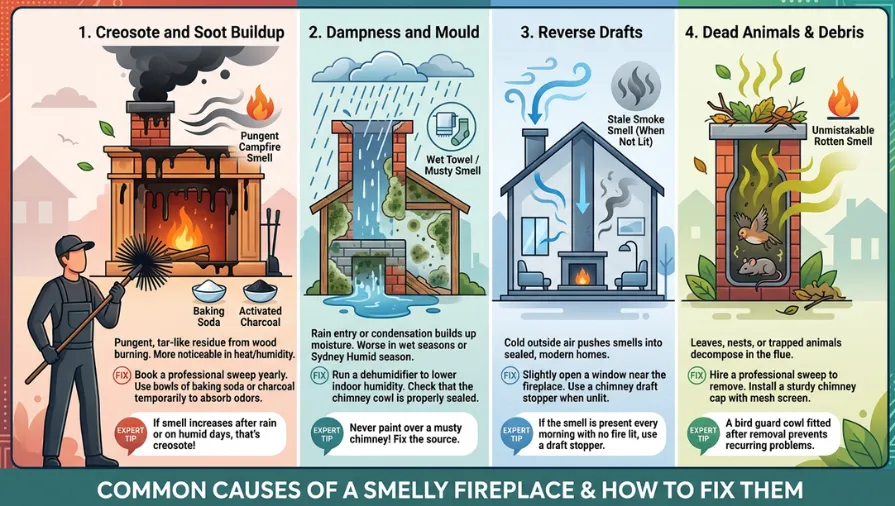
1. Creosote and Soot Buildup — Why Your Fireplace Smells Like a Campfire
The Sticky Byproduct That Coats Your Entire Flue
Creosote is the dark, tar-like residue left behind from burning wood — and it is genuinely pungent. Incomplete combustion leads to a buildup of soot and creosote, a sticky black tar, within the chimney, and once it coats the flue, the smell permeates straight into your living room.
This is the most common cause of fireplace smell in Sydney homes that burn wood regularly, and it tends to intensify on warm or humid days, when moisture in the air pulls more odour out of the residue.
How to Fix the Creosote Smell
Book a professional chimney sweep — this is the only way to physically remove the buildup rather than just masking it. Clean the chimney every year to prevent creosote build-up before it becomes both a smell problem and a fire hazard.
While you wait for your sweep, place small bowls of baking soda or activated charcoal in the hearth — both genuinely absorb odour molecules from the air rather than just covering the smell up.
Expert Tip: If the smell gets noticeably stronger after rain or on Sydney’s humid days, that’s creosote — moisture pulls the odour out of the residue faster than dry air does.
2. Dampness and Mould — Why Your Fireplace Smells Musty
Sydney’s Wet Winters Are the Perfect Setup for This
If your fireplace smells like a wet towel or damp socks rather than smoke, you’re dealing with moisture inside the chimney — not creosote.
This can be due to rain entering through an uncovered flue or condensation buildup, both common in winter — and moisture trapped inside the chimney accelerates the decomposition of organic materials, contributing to mould and mildew growth.
Sydney’s older masonry chimneys are particularly vulnerable here. The “Sydney Humid” season, typically peaking between January and March, provides exactly the moisture levels needed for dormant spores to activate and bloom, and older properties with inadequate ventilation are especially at risk.
How to Fix the Musty Smell
Run a dehumidifier near the fireplace to bring indoor humidity down — keeping relative humidity below the 50% threshold stops the active growth phase of mould by removing the moisture source it needs.
Check that your chimney cowl is properly sealed against rain. Installing or replacing a chimney cowl is one of the most effective ways to prevent rainwater and animals from entering your flue and triggering this exact musty smell.
Why it matters: moisture inside a chimney doesn’t just smell bad — it can lead to mould, structural damage to your chimney liner, and unhealthy indoor air quality if it’s left unaddressed.
Expert Tip: Never just paint over or mask a musty chimney smell — fresh paint on a damp surface is a temporary cover, not a fix, and it often leads to deeper, more established mould colonies underneath.
3. Reverse Drafts — Why Your Fireplace Smells Even When It’s Not Lit
How Sydney’s More Airtight Homes Are Making This Worse
This cause confuses a lot of homeowners, because the smell shows up with no fire burning at all.
If you can smell smoke even when your fireplace isn’t in use, you’re likely dealing with a chimney downdraft — cold outside air pushes the stale smell of soot and smoke back into your living room, a common issue in winter.
Sydney homes are increasingly being sealed tighter for energy efficiency, and that has an unintended side effect — your chimney can end up acting as the path of least resistance for air movement. Trapped indoor air becomes saturated and creates pressure differences that pull outside air, and the smells trapped within it, back down through whatever opening is available.
How to Fix the Reverse Draft Smell
Slightly crack a window near the fireplace, or use a chimney draft stopper when the fire isn’t active — this re-establishes proper airflow rather than letting your chimney function as an emergency air vent for the whole house.
Why it matters: this doesn’t just make your home smell bad — it can also lower your indoor air quality and, in more serious cases, contribute to carbon monoxide risks.
Expert Tip: If the smell is present every single morning with no fire lit the night before, the reverse draft is constant, not occasional — a draft stopper fitted properly solves this immediately.
4. Dead Animals and Debris — The Smell Nobody Wants to Think About
When Something Has Actually Become Trapped in Your Flue
Your chimney can collect leaves, twigs, animal nests, and other debris — and birds, mice, and other small animals can become trapped inside, leading to a pungent smell as their remains decompose.
This smell is unmistakable once you’ve encountered it — a rotten, organic odour that gets progressively worse rather than fading over time.
How to Fix It
This isn’t a DIY job. Your chimney needs a sturdy cap with a properly fitted mesh screen to prevent animals, leaves, and debris from entering the flue in the first place — but if something is already trapped, a professional chimney sweep needs to safely locate and remove it.
Expert Tip: A bird guard cowl fitted after removal prevents this exact problem from recurring — it’s far cheaper than dealing with another trapped animal next season.
How Do I Get My Fireplace to Stop Smelling?
Pulling all five causes together into one practical action list:
| Symptom | Likely Cause | Fix |
| Campfire smell, worse on humid days | Creosote buildup | Annual chimney sweep + baking soda/charcoal |
| Musty, damp sock smell | Moisture and mould | Dehumidifier + check chimney cowl seal |
| Smoky smell with no fire lit | Reverse draft | Crack a window + chimney draft stopper |
| Rotten, organic smell | Trapped animal/debris | Professional removal + bird guard cap |
| Smoky smell, no fire of your own | Neighbouring wood smoke | Speak to neighbour, then report to council if persistent |
How Long Does It Take for Fireplace Smoke Smell to Go Away?
This depends entirely on which cause is behind it.
- A single smoky fire from slightly damp kindling usually clears within a few hours with a window open and good ventilation.
- Creosote-driven smell won’t meaningfully improve until it’s physically swept out — air fresheners and odour absorbers only mask it temporarily, since the residue keeps releasing odour as long as it’s sitting in the flue.
- Mould and dampness smell can persist for weeks or longer if the moisture source — a leaking cowl, a cracked chimney crown — isn’t repaired, because the chimney keeps re-absorbing humidity from Sydney’s wet weather.
- Reverse draft smell can show up daily, indefinitely, until the draft itself is addressed with a stopper or proper ventilation — it’s not something that fades on its own.
Expert Tip: If you’ve tried ventilating and the smell returns within a day or two, you’re dealing with a structural cause — creosote, moisture, or draft — not a one-off smoky fire.
Conclusion
A smelly fireplace always has a specific, identifiable cause — and every single one of them is fixable.
Match your symptom to the right cause using the table above, then address the actual source rather than just masking it with air freshener.
Creosote needs a sweep. Moisture needs a sealed cowl and dehumidifier.
A reverse draft needs proper airflow. And if it’s not your fireplace at all, a quick chat with the neighbour usually sorts it out faster than any council process.
Get the right fix in place, and the smell genuinely goes away — for good, not just for an evening.
