

Most Sydney homeowners book an outdoor unit maintenance service and assume someone will show up, give the unit a quick hose down, and leave. The reality is quite different — and understanding what a proper service actually covers will help you know exactly what you are paying for and why it genuinely matters.
Most systems do not fail because one dramatic thing suddenly happens. More often, they slowly lose performance. Dust builds up. Drain lines clog.
Filters stay dirty. Airflow drops. Energy bills creep up. Then the owner asks why the house no longer feels right.
That is exactly what a professional outdoor unit maintenance service is designed to prevent.
What Makes the Outdoor Unit So Important
The Hardest Working Component in Your Entire System
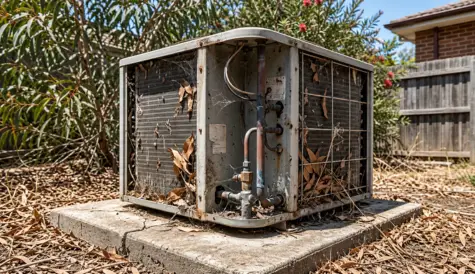
Your outdoor unit — whether it is sitting on a concrete slab in Parramatta, mounted on a bracket in Surry Hills, or tucked beside the fence in a Cronulla backyard — takes the full force of Sydney’s weather year-round.
It handles 40-degree January heat. It pushes through the coastal salt air that corrodes its fins and fittings. It collects every gum leaf, spider web, and dust particle that Sydney’s summer storms blow across it.
A neglected outdoor unit does not just underperform. It quietly drives up your electricity bill every single week.
What a Professional Outdoor Unit Maintenance Service Actually Covers
A typical maintenance visit should include condenser coil cleaning, refrigerant checks, electrical component inspection, drain line cleaning, and a full system performance test.
Here is what each of those actually means in practice.

1. Condenser Coil Deep Clean
The Most Important Step — and the One DIY Cannot Replace
The condenser coil is covered in thousands of tiny aluminium fins. These fins are responsible for releasing heat from your home into the outside air.
When they are clogged with dust, salt residue, or debris — which happens fast in Sydney’s environment — the system works significantly harder for the same result.
A technician uses specialist coil cleaner and low-pressure water to flush this buildup out completely. A clean condenser coil is the single biggest efficiency win in the whole service.
2. Fan Blade and Motor Inspection
Checking What You Cannot See From the Outside
The outdoor fan pulls air across the condenser coil during every cycle. A technician will check the blade for bending or cracking — common after debris impact — test the fan motor bearings for wear, and confirm the blade is spinning true without wobble.
Catching a worn bearing early is a minor repair. Missing it means a full motor replacement during peak summer.
3. Electrical Connection Check
Safety First — Every Single Time
On the day of your service, a thorough professional will inspect all electrical connections and refrigerant levels, and check outdoor units for obstructions or signs of wear.
The technician checks the capacitor, contactor relay, and all wiring terminals for corrosion or looseness. In Sydney’s coastal suburbs — think Manly, Maroubra, and Balmoral — salt air degrades electrical connections faster than anywhere inland.
A loose connection that is ignored long enough becomes a safety hazard.
4. Refrigerant Level Verification
Only a Licensed Technician Can Do This Legally
Under the Ozone Protection and Synthetic Greenhouse Gas Management Act 1989, it is illegal for anyone without an ARC licence to handle refrigerant.
A technician will check that refrigerant levels are within the manufacturer’s specification. Low refrigerant is one of the most common hidden causes of poor heating and cooling performance — and it cannot be diagnosed or corrected without proper equipment and licensing.
5. Rubber Mounting Pad and Clearance Check
The Small Detail That Prevents Big Noise Problems
The rubber anti-vibration pads beneath your outdoor unit degrade over time — particularly in western Sydney where units run at maximum capacity through extended summer heatwaves. A technician checks whether they need replacing and confirms the unit has adequate clearance on all sides for proper airflow.
A unit sitting flat on a deteriorated pad vibrates against the slab and can be heard throughout the house — and potentially into your neighbour’s bedroom under NSW noise regulations.
How Often Should You Book This Service in Sydney
Once a Year Is the Standard — More If Your Conditions Demand It
Annual professional service is recommended as a minimum, ideally before summer and winter seasons. High-use systems may benefit from bi-annual servicing.
For most Sydney homes, spring is the ideal timing — before the system faces its hardest months of the year. But some households should book more frequently.
Book more often if your home is:
- Within 2km of the coast — salt air accelerates corrosion significantly
- Surrounded by large trees — debris accumulation is constant
- Running the system year-round for both heating and cooling
- Home to pets — dander builds up in both indoor and outdoor components
Conclusion
An outdoor unit maintenance service in Sydney is not a luxury — it is the most reliable way to protect an expensive piece of equipment that works harder here than it does almost anywhere else in the country.
Book it in spring. Do it every year. And choose an ARC-licensed technician who provides a written service report so you have documentation for warranty purposes and peace of mind.
Your outdoor unit keeps your home comfortable through every Sydney summer and winter. A once-a-year service is the least it deserves.
